







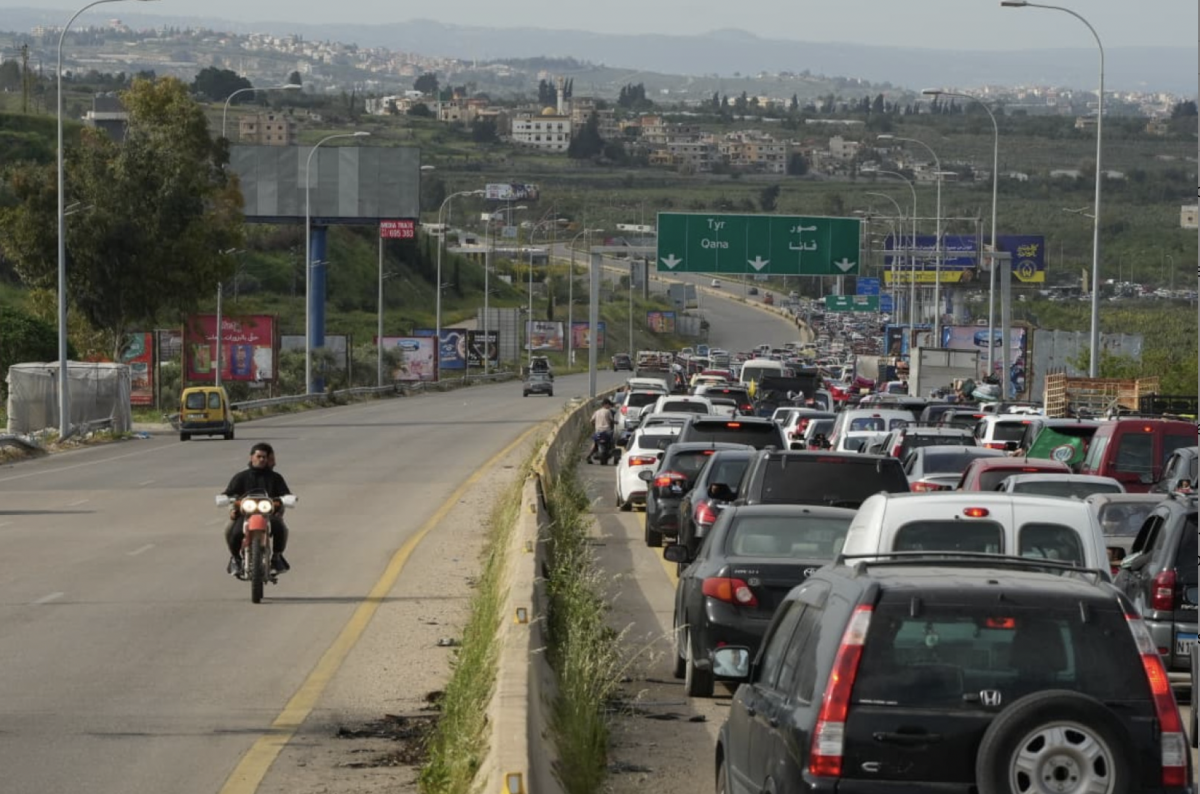
Traffic jams towards Sour, on Friday, April 17, 2026. (Credit: Mohammad Yassine / L'Orient-Le Jour)






BEIRUT — Thousands of residents from southern Lebanon and Beirut’s southern suburbs returned to their homes in areas devastated by war early Friday morning, after the start of a ten-day cease-fire announced by U.S. President Donald Trump.
Traffic resumed on the Saida–Sour highway after being at a near standstill earlier in the day due to a surge of vehicles carrying displaced people heading south, as well as the gradual reopening of the Qasmieh bridge on the coastal road, which had been bombed the previous day. The return is taking place despite Israeli army warnings urging residents not to move south of the Litani River, and despite its continued refusal to withdraw from large areas it occupies in southern Lebanon, in some cases extending up to eight kilometers deep.
As the return continues, the Lebanese Army — while urging residents not to rush south — also warned about “suspicious objects,” likely unexploded ordnance, after a teenager was killed earlier in the day in a munitions explosion in Majdal Selm (Bint Jbeil). Another person was injured, according to our correspondent in the South.
Partial reopening of the Qasmieh bridge
To facilitate the return of residents, the road at the Qasmieh bridge was fully reopened, linking Saida and Sour along the coastal route, following work carried out by the Lebanese Army “in coordination with municipalities and local associations.” A military unit has also been deployed around the bridge, the army said in a statement. The infrastructure had been struck again by Israel on Thursday.
The Lebanese Army had initially blocked access to the bridge overnight, fearing another strike, before beginning earthworks to fill the crater caused by the previous day’s bombing, according to our correspondent in southern Lebanon.
The nearby municipality of Burj Rahal also announced that the coastal road is now open and safe, allowing displaced residents to return home, although the bridge along this route remains closed for now. Further east, a secondary road has been reopened between Zrarieh and Tayr Felsay, while the main road crossing the so-called “February 6 Bridge” remains closed. That bridge was bombed on March 13.
Access to Khiam blocked, fifteen killed in Sour
Despite the cease-fire, several Israeli attacks hit southern Lebanon on Friday, our correspondent reports. In the morning, Israeli artillery fire and machine-gun fire targeted Kounine in the Bint Jbeil district, striking a team from the Islamic Health Committee (Hezbollah-affiliated paramedics). Several people were wounded.
The Israeli army also mined and blew up part of Khiam in the eastern sector. Fierce fighting had taken place in the town earlier this week, one of the most significant flashpoints in the border area after Bint Jbeil. On Friday, the Lebanese Army blocked the road at the Khiam–Marjayoun–Ibl Saqi junction, preventing access to the town, which remains under Israeli occupation. Three explosions were also heard in Qantara in the Marjayoun district, where the Israeli army advanced again on Thursday.
Meanwhile, an Israeli strike carried out as the ceasefire came into effect in Sour killed at least 15 people, according to Sour mayor Hassan Dabbouk. Search operations are continuing to determine the fate of around 10 missing people, or possibly more, he told our correspondent in southern Lebanon. He said the strike targeted buildings of five to six storeys. “If these buildings had been fully occupied, the toll would have been an even greater humanitarian disaster,” he added, noting that many residents had fled Sour following repeated Israeli warnings.
For its part, the South Lebanon Water Authority said four of its employees were killed, “while carrying out their national duty to provide water to residents of the resisting villages in the south,” without specifying when or where they were killed.