








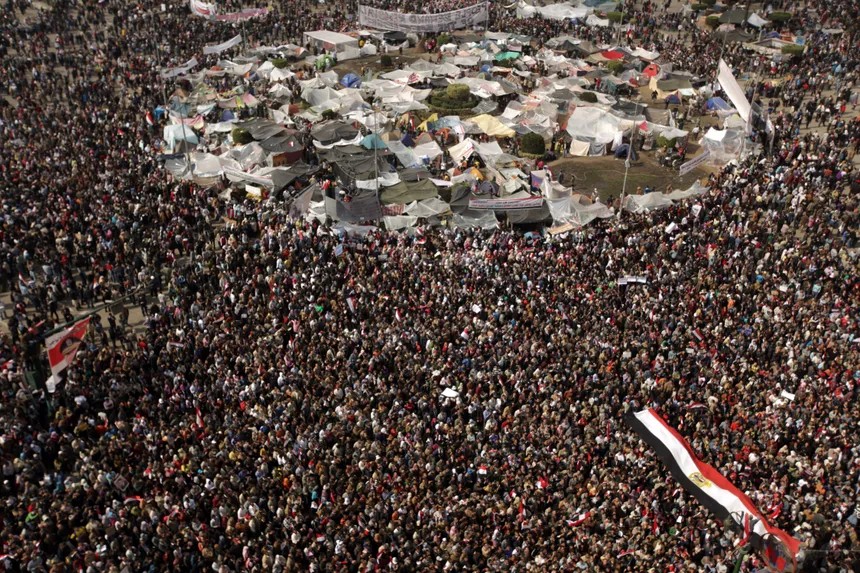
One week after Hosni Mubarak stepped down, thousands of protesters returned to Cairo’s Tahrir Square on Friday, Feb. 18, 2011, to celebrate the fall of his regime. (Credit: Patrick Baz/AFP Archives)






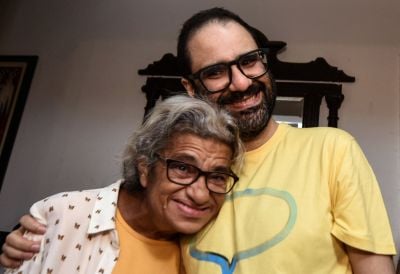
Mostafa Al-A’sar is a journalist, researcher, human rights defender, and former Egyptian political prisoner, now in exile in Canada.
The five of us stood at the edge of Tahrir Square in downtown Cairo. Every street branching off the square was packed with demonstrators. Somehow, I managed a panoramic view: protesters stretched as far as the eye could see. Egyptian police forces, heavily armed, and masked officers lined up like the teeth of a comb, blocking every entrance to the square with their bodies, while armored vehicles stood behind them.
I turned to the friend beside me and asked, “Should we urge people to protest and try to break into the square, or will they let us down?” If the movement failed, we would be the ones thrown back into prison. We looked out at the massive crowd and began chanting, attempting to break through the security cordon. One of us, already accustomed to arrest, was detained. Two others fled quickly and disappeared from sight. Another friend and I ran from the informants chasing us, trying to escape as they pursued us.
It was all a dream, on the 15th anniversary of the revolution. Of the five people in the dream, three now live in exile while two remain in Egypt. I called my friends and told them what I had seen, with a mix of irony and melancholy.
Between a smile and revulsion
In 2020, United Media Services, a company affiliated with Egypt’s General Intelligence Service, produced the first season of the television series al-Ikhtiyar (The Choice). The series tells the story of Egyptian Armed Forces officer Ahmed al-Mansi, who was killed in North Sinai in 2017, and focuses on highlighting the contrast between his character and that of former army officer Hisham Ashmawy, who later defected and became a terrorist.
When the series first aired, I was still in political detention, facing fabricated terrorism-related charges after being targeted by Egyptian security services because of my journalistic work, which made it impossible for me to follow the episodes. On the 15th anniversary of the revolution, however, I decided to watch all three seasons of al-Ikhtiyar from exile in Canada, in an effort to understand the security narrative through which some of the events we experienced over the past decade and a half were presented, documented and interpreted.
The first season of the series was relatively acceptable, despite its dramatic flaws, exaggerated dialogue and character portrayals built on simplistic good-versus-evil binaries, as well as instances of distortion — or rather selective omission — of certain events. It largely focused on the personal and professional life of an army officer serving in North Sinai during a period marked by escalating violence and terrorist attacks, without heavily adopting a paternalistic security framing of political disputes, governance failures, and internal security crises. This, to some extent, made the work digestible and open to debate.
As for the second season, from the very first minutes, falsehoods, manipulation, and distortion flooded the screen. The clumsy dialogue delivered by the actors sounded as though they were reading from a security bulletin written by an intelligence officer, completing the scene.
The third season continued in the same vein, though even more poorly executed, portraying events in a way that was largely unconvincing.
Ironically, national security officers were portrayed as angels working selflessly in service of the nation. They were presented as good guys who would never take revenge on the relatives or families of the detainees. Interrogation rooms were depicted as almost cozy places where suspects retain their dignity in the face of saint-like officers patiently questioning prisoners in a bid to extract confessions. It was absurd to watch. It was nauseating. Everyone knows how the security apparatus actually works. How Egyptians are abducted and disappear into State Security basements. How face unrestrained torture.
The specter of revolution
I have a simple, easy explanation for this dramatic decline. The first season was likely overseen by military intelligence and the Armed Forces’ Department of Moral Affairs, which focused on themes of honor and military sacrifice by highlighting aspects of the life of the fallen officer Ahmed al-Mansi.
The second season, however, appears to have been supervised by the National Security apparatus, whose officers are often brutal, remarkably incompetent with a deep unfamiliarity with the basic foundations of literature, art, and drama. As the poet Abdel Rahman al-Abnoudi once wrote, “officers insult the meaning, trample the dream under their boots, and are gifted with an ignorance that renders all knowledge unnecessary.” The result was a season centered on the lives of National Security officers, wrapped in narratives so implausible they convinced no one.
To make matters worse, the presidential establishment seems to have intervened in overseeing the final season, which turned to portraying aspects of the life of Egypt’s current president, Abdel Fattah al-Sisi, while he remains in power — a context in which error is simply not permitted.
If this reading holds, the political perspective shaping each season becomes easier to understand.
Fifteen years have passed since the revolution, yet its specter still looms on the horizon, and efforts to distort its legacy continue. Egypt’s current military-backed regime has ruled the country for 13 years, yet it continues to pin every failure on the revolution or on the Muslim Brotherhood — whose members fill prisons and detention centers and who governed for one single year before the military takeover of July 2013.
In a sarcastic Facebook post, one user wrote: “May God rid us of the Brotherhood who have been ruling us in TV series for 13 years,” commenting on the premiere of the early episodes of Ras al-Afaa (Head of the Snake), another security-driven drama airing this Ramadan that advances the regime’s narrative and promotes its security-centered portrayal through the familiar specter of the Muslim Brotherhood.
The revenge against the revolution over the past decade has been brutal. At times, it feels as though the country’s deterioration and destruction have been deliberate, and that the people’s suffering, impoverishment and subjugation were part of a calculated strategy rather than merely the outcome of political failure or a heavy-handed military dictatorship. The deeper the pain and hardship endured by Egyptians, the louder the regime’s mouthpieces repeat the same refrain: the revolution is to blame. Without it, they claim, this suffering would not exist.
What must always be remembered — and constantly reiterated — is that the revolution is not responsible for the way things turned out; the counterrevolution is. At its core, the revolution sought bread, freedom, social justice, and human dignity. It aspired to a state governed by fairness and a single rule of law, one founded on equality in rights and duties. It did not seek to divide people into hierarchical social ranks, crowned above all by the privileged class tied to the state.
A bulwark protecting the truth
The current regime has not limited itself to security repression, media control, and empowering military and business elites, economic failure, currency collapse and internal crises whose cost the population is paying. It has also sought to impose its own narrative, portraying itself as a savior that rescued the country from reactionary Islamist rule and from a terrorist organization.
Yet at the same time, it continues to brandish the specter of terrorism whenever it faces failure or fears potential domestic unrest. The message is repeatedly reinforced: the revolution was a mistake, and what happened in 2011 must never be allowed to happen again.
With the shrinking of public space and the security apparatus exercising full control over cultural and artistic production, the official security narrative has become the dominant one. Over time, this version of events may take root in the minds of those who did not live through the period, or who remain distant from its geography and context.
For this reason, every act of writing, every effort at documentation, however individual, modest or limited in the face of an overwhelming tide and a powerful system, deserves recognition and encouragement.
One day, these words may stand as a shield protecting the truth.
Our roles did not end with the defeat of the revolution; they simply transformed into different forms of engagement. If the revolution was stolen from us once, it must not be stolen again. And if we were defeated in geography, we must not be defeated in history.
Translated from Arabic by Sahar Ghoussoub.

 Evening recap: Netanyahu announces West Bank offensive; 7 killed in Jordan church shooting; tents burned in south Lebanon
 US strike on Iran this weekend? ‘Absolutely,’ says Barrack; ‘I have no idea,’ says Trump