





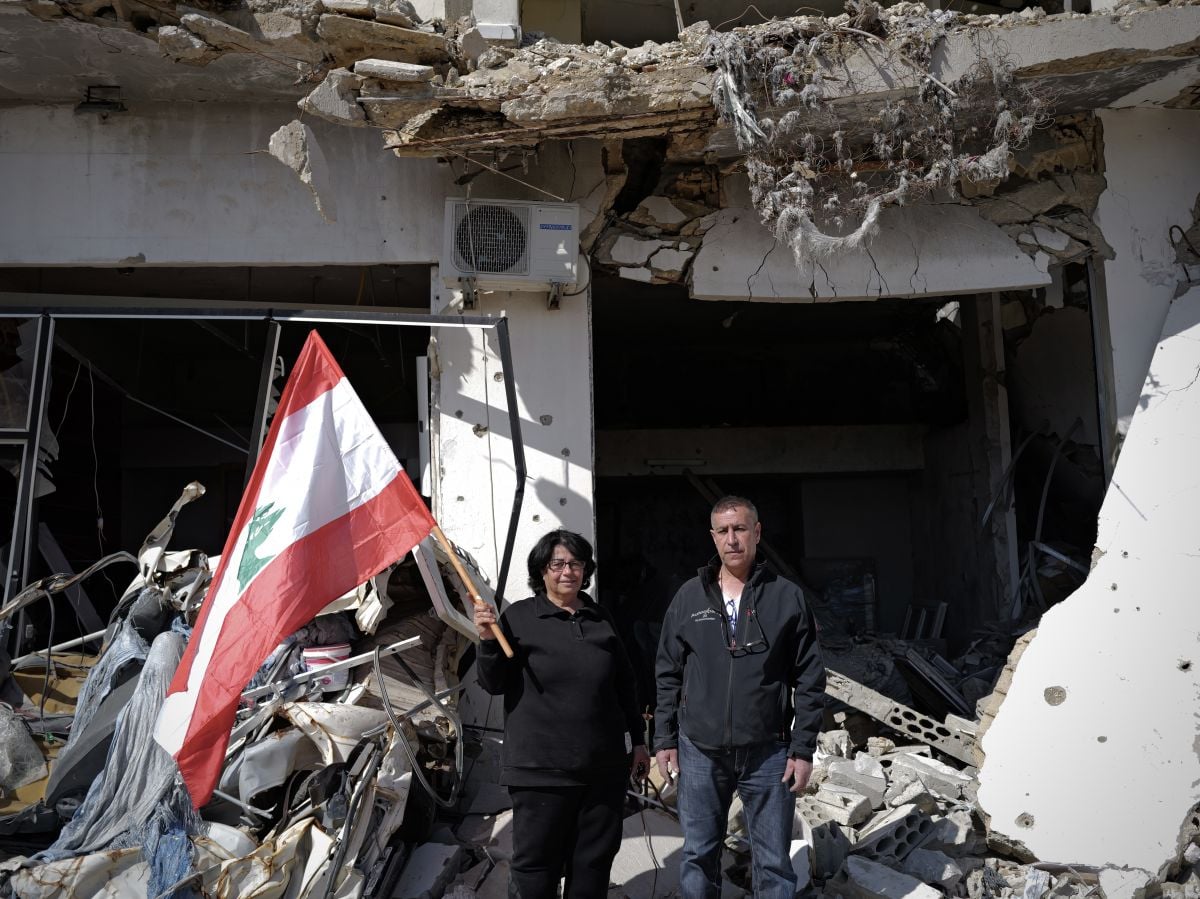
A couple holds a Lebanese flag on Feb. 28, 2025, in Houla, southern Lebanon, in front of their house destroyed by Israel, just hours after Israeli soldiers withdrew from the village. (Credit: Matthieu Karam/OLJ archives.)






Najwa Barakat is a novelist and journalist. Her most recent novel published in English is Mister N. (& Other Stories, 2022).
Since independence, the Lebanese have lived on the promise of balance, at times under the banner of the “National Pact,” at others beneath the slogans of “Lebanese model” and “parity.” Yet these arrangements, for all their importance in structuring political life, have failed to produce a form of citizenship that rises above the bonds of group loyalty, or of an individual who can step out from the shadow of their sectarian identity. Coexistence, at its core, has remained a fragile compromise rather than a deeply held conviction, a practical workaround more than a moral contract. It is therefore perpetually under threat, for it rests not on inner certainty but on fear of the alternative.
Today, there is little in Lebanon to inspire reassurance. A body worn down by wars and ravaged by crises can no longer endure even the lightest sedative, as though pain itself has become a condition of living rather than a passing affliction. The distance between sect and nation, once thought bridgeable through dialogue and daily mingling, has grown wider, sharper, and more present than ever. In a tragic and recurring pattern, the country seems to return to its earliest maladies, not to overcome them, but to sink into them once more.
Herein lies Lebanon’s most difficult paradox: the very phrase “coexistence” appears to describe something that resists definition, suspended between fragility and will, between what we hope for and what the deep structures of society and politics alike refuse. Thus, with every intensifying crisis, communities retreat from the nation as a shared space, returning instead to wounded memories, old stockpiles of distrust, and symbolic arsenals they have never truly laid down.
In recent years, Lebanon’s divisions have ceased to be merely political dysfunction or circumstantial instability, they have become a way of interpreting the world. We now live within competing narratives that collide, overlap, and clash, each claiming to hold the sole key to understanding events. The conflict is no longer fought over power, but over meaning: whoever controls the story controls part of reality, and whoever imposes their narrative defines the boundaries of the possible and the forbidden, rearranging both fear and hope.
Within this entanglement, the “resistance” narrative advanced by Hezbollah stands opposite Israel’s narrative of “preventive defense.” While on the surface they appear as absolute antagonists, beneath lies a deeply ambiguous relationship in which each sustains the other’s existence. Israeli attacks furnish the discourse of resistance with its justification and continuity, while the presence of arms and the dominance over the institutions of a weakened state provide Israeli security rhetoric with a lasting material basis and an ever-ready pretext. Hostility thus becomes not merely a clash between two sides, but a form of mutual nourishment, as though each draws from the other the very reason for its being.
Defending one’s innocence before depending their opinion
Against these two narratives emerges a third: that of the state, its sovereignty and its exclusive claim to the use of force across the entire territory. Yet in Lebanon, this narrative appears perpetually deferred. The path toward it is long, and the common ground upon which it must be built is eroding, or perhaps was never properly established to begin with. The state, which is supposed to be the solution, at times seems itself entangled in the very crisis it is meant to resolve, asked to deliver a salvation it lacks the means to provide, expected to produce from within its own structure what can only come from beyond it.
Thus, the citizen who refuses to get drawn into these divisions finds themselves in an especially harsh position: condemning Israeli aggression is read as siding with Hezbollah, while yearning to weaken Hezbollah is seen as betrayal of the resistance. Caught between these twin accusations, the individual is compelled to defend their innocence before their opinion, to justify their stance before expressing it. The question is no longer: what is right? but rather: how do we survive misunderstanding? How do we pass between condemnation and counter-condemnation without losing our humanity? Identity becomes a burden, position a risk, and neutrality a suspicion.
One question remains: can one truly equate these sides? The details resist any absolute equivalence, yet the broader picture places Lebanon like a fragile stone caught between the hammer of Israel and the anvil of Iran. What deepens the tragedy is that the country no longer appears merely as a battlefield, but as both the object and the meaning of the conflict. War unfolds not only on its soil, but within its self-image, its language, its memory, and its capacity to imagine a future ungoverned by sectarian divisions.

Lebanon today does not seem like a country passing through a crisis, but one withering in its very meaning before it withers in its reality. Nations do not die all at once; they erode first in consciousness, then in language, then in the capacity to imagine.
When the shared imagination weakens, disintegration begins to appear reasonable, even comforting at times, and the abandonment of coexistence masquerades as an escape from crisis, when in truth it is a form of collective suicide.
To defend coexistence, then, is not merely to defend a constitutional formula or a political arrangement, it is to defend the very possibility that this country remains livable, that total ruin — now the only visible horizon — does not become an acceptable idea or an inevitable fate to which we are silently led.
Translated from Arabic by Mira El-Hayek.