





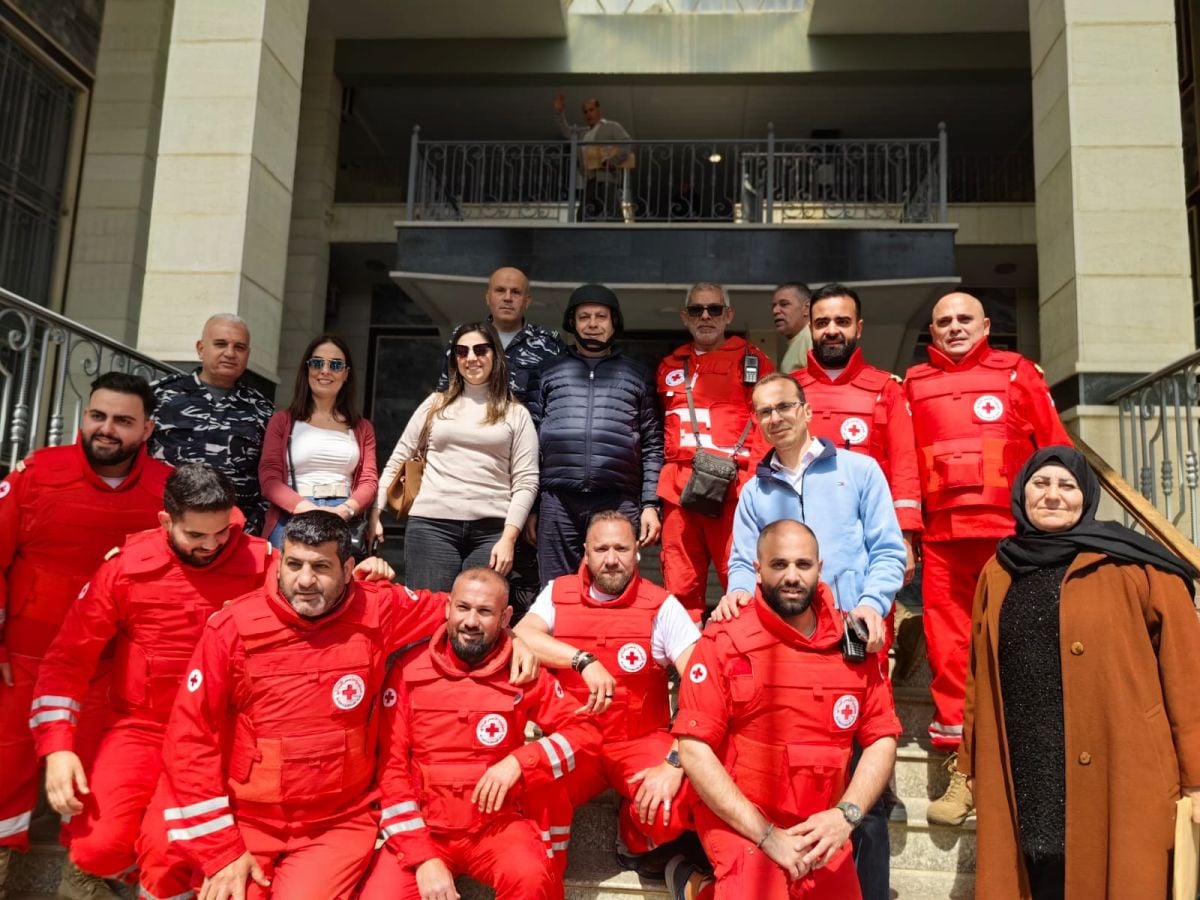
Judges Abou Shaqra, Majed, and Barakat (in vest and helmet), in front of the Nabatieh courthouse, with the Red Cross team who accompanied them. Photo sent to L'OLJ.






With courts in southern Lebanon and the Bekaa rendered inaccessible by the Israel-Hezbollah war, Justice Minister Adel Nassar and the Higher Judicial Council introduced exceptional measures to keep the judicial system running, L’Orient-Le Jour learned on Thursday.
Among the most significant steps were the transfer of case files from areas affected by the fighting and the establishment of offices in courthouses located in safer areas.
A circular issued by the Higher Judicial Council on March 23 specifies that files from the Nabatieh governorate will be moved to the Beirut courthouse, those from Baalbeck-Hermel to the Zahle courthouse, and the Saida courthouse will handle cases under the jurisdiction of the Sour–Jwayya court.
The transfer of these files will be carried out by judges and court staff, under military and security escort, the council added.
It took 10 days for the judges and court staff tasked with retrieving the Nabatieh files to secure this escort. According to L’Orient-Le Jour’s information, contacts were made with the Lebanese Red Cross and the army’s intelligence service, which required details including the identities of the mission members and the planned route in order to grant authorization.
It was ultimately on Wednesday, one of the most intense days of Israeli bombardment since the start of the war, that the officials involved, namely the first president of the Nabatieh Court of Appeal, Mounif Barakat, the court’s public prosecutor, Najat Abou Shaqra and investigative judge Fatima Majed, along with six court staff, headed to the site and returned to Beirut with the Nabatieh files.
Ruling on requests for release
Speaking to L’Orient-Le Jour, Judge Barakat stressed the urgency of the operation, which “was not without risk,” noting that he himself wore a protective vest and helmet.
The nine members of the mission traveled in three Lebanese Red Cross vans, escorted by an army vehicle at the front of the convoy and another at the rear, with an Internal Security Forces vehicle also accompanying them.
“On the way back, we had barely reached Saida when [Israeli] bombardments struck the towns of Habboush, Kfar Joz, Zifta, and Kfar Roummane that we had just passed through,” the judge said.
He added that they had barely delivered the files to the Beirut courthouse when the capital itself came under heavy Israeli strikes of rare intensity.
Despite the dangerous conditions, retrieving the files was a priority. “It was essential to take the files, especially those containing requests for the release of detainees,” Barakat said, pointing to the right of each defendant to have their case reviewed, with the possibility of being released as soon as their situation allows.
Those detained in Nabatieh have been transferred to prisons in Saida, Roumieh, and Beirut.
According to L’Orient-Le Jour’s information, files from Baalbeck-Hermel and Sour have not yet been transferred. The presiding judges of the courts of appeal in those jurisdictions, Ghada Bou Karroum and Ghassan Mouti, respectively, could not be reached to confirm this.
Among the other measures adopted by Nassar and the Higher Judicial Council is the possibility for public prosecutors and investigative judges to “question defendants remotely by electronic means, in accordance with the provisions of the Code of Criminal Procedure,” according to the circular shared within the judiciary.
This article was originally published in French in L'Orient-Le Jour and translated by Sahar Ghossoub.


 7 p.m. recap: Iran warns Egypt, Israeli soldiers vote in south Lebanon, Haret Hreik responds to Kataeb