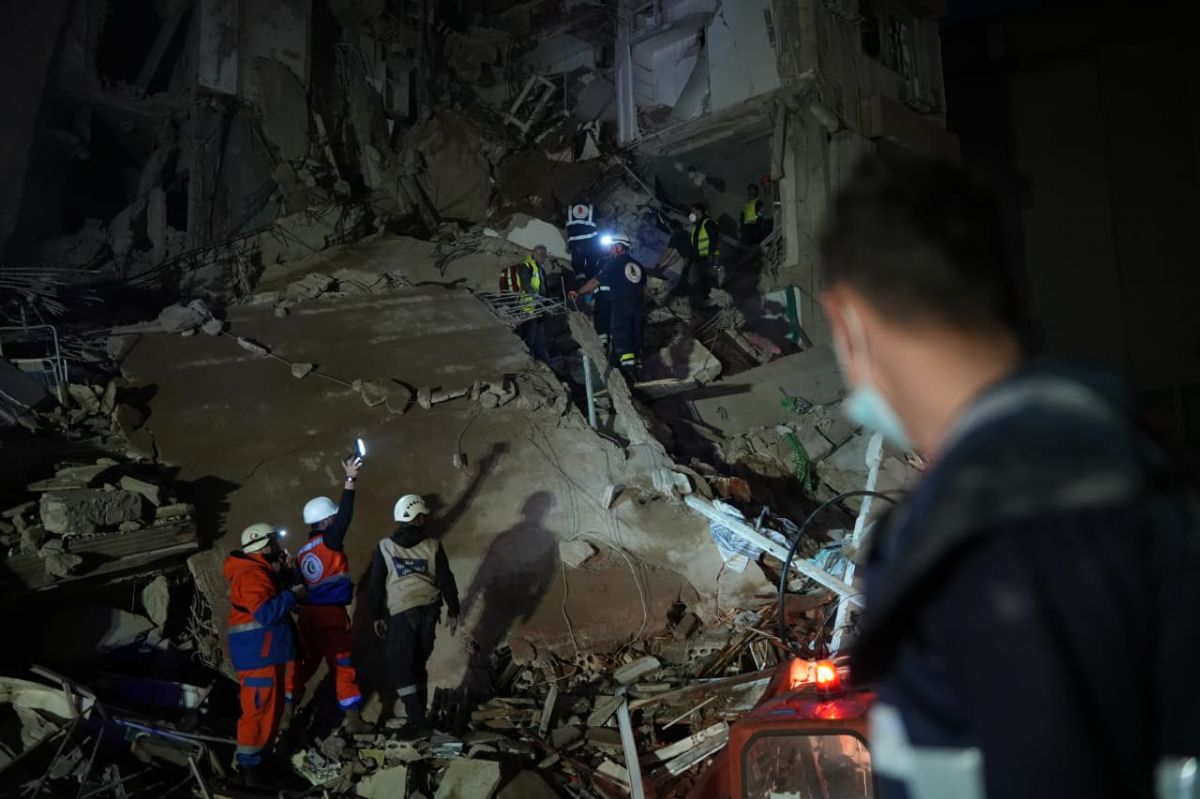
Rescuers in the rubble of a bombed building in Tallet el-Khayat, a neighborhood of Beirut, on April 8, 2026. (Credit; Mohammad Yassine/L'Orient-Le Jour)






The U.N. secretary-general expressed his deep outrage after the massive strikes carried out by Israel across Lebanon on April 8, which caused hundreds of civilian casualties, and said these bombings jeopardize the cease-fire reached overnight Tuesday to Wednesday in the region.
"The secretary-general unequivocally condemns the massive strikes carried out by Israel across Lebanon on April 8, which caused hundreds of deaths and injuries among civilians, including children, as well as damage to civilian infrastructure. The secretary-general strongly condemns the loss of civilian life and is deeply alarmed by the growing number of civilian victims," Guterres said, according to a statement conveyed by spokesperson Stephane Dujarric.

These strikes simultaneously targeted dozens of cities, villages, and several neighborhoods of Beirut. The Israeli military claimed "100 strikes in 10 minutes" against Hezbollah infrastructure and continued to hit the country throughout the day.
Risk to the cease-fire and regional peace
This bombing campaign took place just hours after the announcement of a cease-fire between the United States and Iran, placing Lebanon at the center of an extremely fragile regional context. In this context, the secretary-general warned: "The continuation of military activities in Lebanon poses a grave risk to the cease-fire as well as to efforts to establish lasting and comprehensive peace in the region."
The U.N. reiterated its call for all parties to "immediately cease hostilities" and reminded that "international law, including international humanitarian law, must be respected at all times. Civilians and civilian objects must be protected in all circumstances, and attacks directed against them are unacceptable."
'No military solution'
Guterres also stressed that "there is no military solution to the conflict" and called on all parties to "pursue diplomatic channels and re-engage in fully implementing Security Council Resolution 1701," a pillar of stability in southern Lebanon since 2006.
In a country already weakened by a deep political, economic, and social crisis, April 8 marks a dramatic turning point. With the escalation of strikes, massive civilian losses, and destruction of infrastructure, the U.N.’s calls for de-escalation and civilian protection appear more urgent than ever.