







Security personnel inspect vehicles entering the Foreign Ministry office in Islamabad on April 9, 2026. (Photo by Aamir Qureshi / AFP)






Here are the latest developments in the Middle East war:
US military will remain near Iran until a 'real deal' is secured, Trump says
The U.S. military will remain deployed near Iran until the full implementation of a "real deal," President Donald Trump said Wednesday night, following the announcement of a fragile two-week cease-fire between the United States and Iran. All U.S. Ships, Aircraft, and Military Personnel, with additional Ammunition, Weaponry, and anything else that is appropriate and necessary for the lethal prosecution and destruction of an already substantially degraded Enemy, will remain in place in, and around, Iran, until such time as the REAL AGREEMENT reached is fully complied with,” he wrote on Truth Social, warning that otherwise it will hit "stronger than anyone has ever seen before.
Hezbollah targets Israel in response to its 'violation of the cease-fire'
Hezbollah said Thursday it launched rockets at Israel in reaction to its "violation of the cease-fire." The group stated that it had "respected the cease-fire while the enemy did not," and that it "targeted the Manara area" on the other side of the border with Israel, "with a barrage of rockets at 2:30 a.m. Thursday," local time, Hezbollah said in a statement. The group had not claimed attacks against Israel since the announcement 24 hours earlier of a two-week truce between the United States and Iran, following 39 days of conflict.
On Wednesday, the Iranian Revolutionary Guards also threatened to retaliate after the "brutal massacre" in Beirut.
182 killed and 890 wounded in Lebanon after Israeli strikes
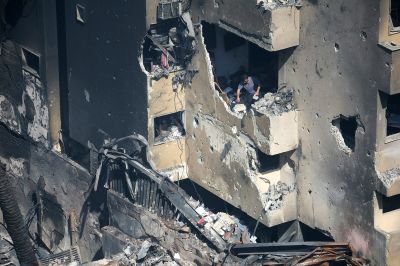
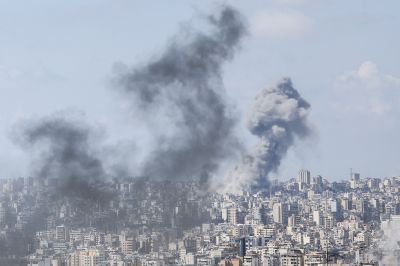
Israeli strikes on Lebanon Wednesday — 100 strikes in ten minutes — killed 182 and injured 890, according to a provisional toll from the Health Ministry. The ISF for its part, reported a higher toll of more than 200 killed. Prime Minister Nawaf Salam declared a national day of mourning Thursday and said, according to his office, he wants to "mobilize all of Lebanon's political and diplomatic resources to stop the Israeli killing machine."
The strikes hit multiple neighborhoods in the heart of the capital without warning, causing scenes of panic in southern Beirut suburbs, southern Lebanon, and the Bekaa region.
The strikes drew widespread condemnation, from the United Nations to Iraq and Jordan. U.N. High Commissioner for Human Rights Volker Türk called the scale of the killings "horrific" and urged the international community to help end the "nightmare."
The humanitarian organization Doctors Without Borders (MSF) said its teams were working in response to a massive influx of wounded, including children, at Beirut's public Rafik Hariri hospital. "Patients are arriving with shrapnel wounds and severe bleeding. One was admitted after losing both legs. The situation is chaotic, as more and more people are coming in," said Christopher Stokes, MSF's emergency coordinator in Lebanon. "These indiscriminate strikes in densely populated areas are totally unacceptable," he added. "The relentless attacks on civilians must stop. The forced and repeated displacement of populations — a war crime — must stop."
Alternative routes inside the Strait of Hormuz
The Iranian Revolutionary Guards' navy announced Thursday that ships transiting the Strait of Hormuz must use two alternative routes close to the Iranian coast, citing the possibility of "mines" along the usual route further offshore. "To be protected from possible collisions with mines, in coordination with the Revolutionary Guards' navy ...., until further notice, (ships) will have to take alternate routes for traffic in the Strait of Hormuz," Iranian media reported, citing a military statement accompanied by a maritime map showing routes south and north of Larak Island.
A 'credible and lasting' cease-fire must include Lebanon, Macron says
French President Emmanuel Macron stressed to his U.S. and Iranian counterparts, Donald Trump and Massoud Pezeshkian, the need to extend the cease-fire between their countries to Lebanon, "a necessary condition" for it to be "credible and lasting," according to him.
Iran must decide if it wants the truce to fail because of Lebanon, Vance says
Vice President JD Vance, who is to lead the U.S. delegation to Pakistan for talks with Iran on Saturday, said it is up to Iranian leaders to decide whether the truce should fail because of Lebanon. "If Iran wants these negotiations to fall apart because of a conflict in which they are getting crushed in Lebanon—a situation that has nothing to do with them, and which the United States has never said was part of the cease-fire—that is their choice. We think it would be foolish, but it is their choice," he said at the conclusion of a visit to Hungary.
Cease-fire in Lebanon, one of Iran's 'essential conditions'
A cease-fire in Lebanon is one of the "essential conditions" laid out by Iran in its ten-point plan, the basis of the truce with the United States, Iranian President Massoud Pezeshkian emphasized, according to the ISNA agency.
Restrictions tied to state of emergency lifted in Israel Thursday
Most restrictions related to the state of emergency imposed on Feb. 28 at the start of the war will be lifted starting Thursday in most of Israel, civil defense announced. Except for the northern border with Lebanon, where the military continues its war against the pro-Iranian Hezbollah up to the Haifa Bay area, Israel's largest port, the rest of the country will return to "normal activity levels" beginning at 6 a.m. (0300 GMT). The holy sites of the three monotheistic religions in Jerusalem will reopen Thursday.
Iranian parliament speaker deems cease-fire 'unreasonable'
Iranian Parliament Speaker Mohammad Bagher Ghalibaf called the cease-fire and negotiations with the United States "unreasonable," saying that three of the ten principles laid out by his country as the basis of the truce had already been "violated." In a message on X, Mr. Ghalibaf, one of Iran's top officials, mentioned the continued hostilities by Israel in Lebanon, the entry of a drone into Iranian airspace on Wednesday, and Washington's refusal to allow Iran to enrich uranium.
'High-level' talks between the United States and China
The United States and China held "high-level" talks before the cease-fire with Iran was declared, White House spokeswoman Karoline Leavitt said Wednesday at a press briefing.
Truce decided 'in full coordination' between Washington and Israel, Netanyahu says
The cease-fire with Iran was decided "in full coordination" between Washington and Israel, Israeli Prime Minister Benjamin Netanyahu said, assuring that he was not caught off guard by his American ally.