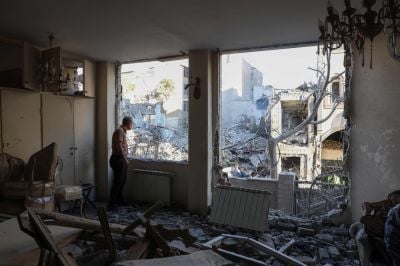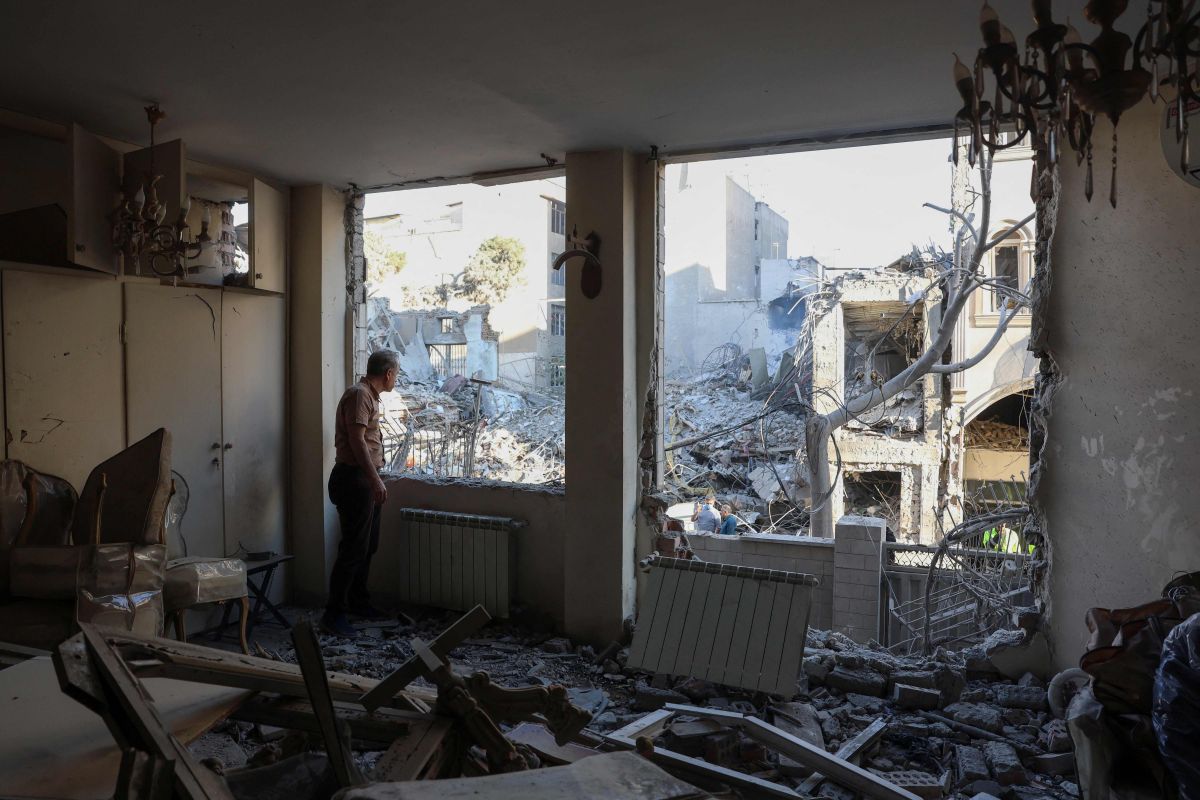
A resident looks out the window of his damaged home after Israeli-U.S. strikes that reportedly destroyed the Rafi-Nia synagogue and nearby residential buildings in Tehran, Iran, on April 7, 2026. (Credit: AFP)






Omar Kaddour is a Syrian writer based in France.
We do not yet know the outcome of the current war between the United States and Israel on one side and Iran on the other. At the time of writing, talks between the United States and Iran in Islamabad have stalled without any real progress, although the U.S. delegation has not fully withdrawn, and the U.S. vice president who led the first round has not declared the negotiations a dead end. The outcome of the negotiations between Lebanon and Israel also remains uncertain. What is clear, however, is that these two tracks are closely linked.
Yet the lack of clarity regarding developments on the ground is not what prevents the question of war and what comes after from being properly present in the public debate among the region’s populations. Rather, it reflects a total sense of helplessness in the face of the parties involved in the war and their plans. Two broad categories can be identified. The first includes countries directly exposed to war, where people’s overriding concern is to escape as quickly as possible the dangers of bombardment and reprisals. The second includes countries not facing immediate danger, yet their elites and their populations alike remain unable to think beyond the logic of battles.
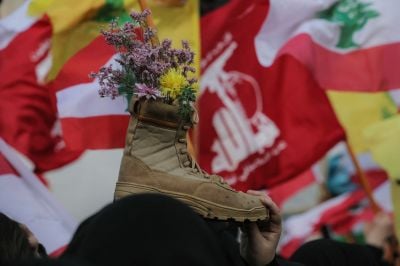
Taking Syria as an example of this second category, one sees a strong tendency to generalize optimism. The defeat of the Iranian axis in the region would live up to the expectations of Syrians who have endured death and terror at the hands of militias that supported former Syrian President Bashar al-Assad under Iranian supervision, foremost among them Hezbollah.
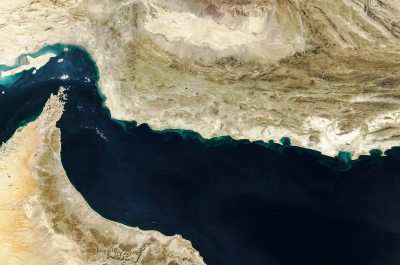
Beyond this expected political gain, some also hope that Gulf countries will seek an alternative to the Strait of Hormuz, through pipelines running from the Gulf across Syrian territory to the Mediterranean.
Such a scenario would promise an immediate recovery, driven by jobs linked to the construction of these pipelines. These large scale projects could also attract more diversified capital, building on the confidence generated by earlier international investments. One could then imagine an economically integrated regional network: pipeline infrastructure would require major ports, along with a wide range of related economic activities and services.
Greater openness among these countries could also encourage cross border initiatives, including electricity interconnection projects that had been discussed in the past before being shelved amid the political turmoil that has shaken the region for more than a year and a half.
Maintaining a level of tension
But this optimistic scenario must be weighed against present realities, dominated by rising energy prices, which are already affecting both the present and the near future. In Lebanon, for example, prices have jumped by more than 30% in the space of a month. In Syria, the lack of comparable data makes it difficult to measure the scale of the increase, but the Syrian pound has recorded its sharpest drop against the dollar since Assad’s fall. It is well known that Damascus structurally depends on oil imports, some of which arrive in the form of aid.
Excluding the cost of the war for Washington and Tel Aviv, the expected losses for the region’s economies are estimated, after one month, at around $200 billion. As for the cost incurred by Washington, it is said to exceed $1 billion per day. Available information suggests that Trump is moving toward increased pressure on Gulf countries to shoulder the costs of the war. His remarks about ending the war even as the Strait of Hormuz remains closed can be read as a form of leverage against these states, which are hit by the halt in oil exports.
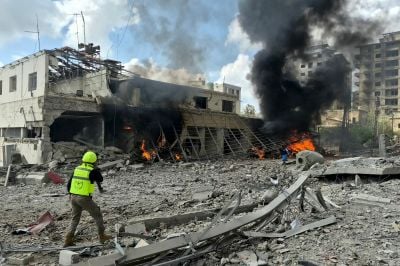
Ending the war while keeping the Iranian regime in place would preserve the reasons, or pretexts, for a future resumption of the conflict. It would amount to maintaining a level of tension high enough to prevent the development of lasting plans based on stability. In other words, what pushes some states to seek alternatives to the Strait of Hormuz would at the same time trap them in a logic of neither war nor peace. The scenario of the regime’s survival also means, mechanically, the continuation of its influence in neighboring Iraq, as well as in Lebanon, even if that influence were to recede from its current level.
In other words, this war is unlikely to lead to major shifts in regional calculations, or in the nature of regimes or their behavior. Beyond Iran’s influence in Iraq and Lebanon, Syria itself does not appear set for stability in the near future, unlike Jordan, which could be seen as a corridor for pipelines leading to ports from which Tel Aviv would benefit.
The same applies to regional cooperation projects more broadly. Lebanon’s ruling elite is the same one that played a decisive role in the country’s economic collapse, symbolized by the banking meltdown.
As for Syria’s new authorities, they have not presented a model capable of attracting meaningful external financial support. International aid therefore remains minimal, while accusations of corruption and control over key sectors of the Syrian economy are multiplying, echoing practices associated with the previous regime.
Entrenchment of ruling elites
If one considers the overall situation in the countries of the eastern Mediterranean, it is clear they are all experiencing an unprecedented economic decline, while their populations, exhausted, are no longer in a position to take the initiative for a better future. These societies have already tried to rise up against their conditions; they have been met with brutality and violence and, in the best cases, have failed because of the entrenched power of ruling elites. Economies this depleted tend to favor militarization over politics and, as a result, empower forces that invest in violence rather than stability, whether they are in power or not, local or foreign.
Roughly speaking, if the war were to end fully in the coming weeks, the region would return to the state it was in on Feb. 27, minus several hundred billion dollars. And since the most fragile countries, like the most vulnerable populations, are always the first and hardest hit, it would be wise to pay attention to what the near future suggests: new crises, or the worsening of old, chronic ones — even if we do not take into account European plans to phase out oil and gas and rely, within a few years, on electricity generated without them.
This is not about favoring pessimism over optimism; the former already prevails by the force of a well known reality that no major miracle, and none is in sight, will overturn. Not under current conditions, not in the Trump era. The situation of the countries concerned bears no resemblance to that of Europe in the aftermath of World War II, which heralded a comparable revival; it does not even resemble that of East Asia in the 1960s, which was able, through the bridge of external aid, to reach the threshold of prosperity. All signs suggest that we are not, to borrow a barely metaphorical phrase, at the end of a second world war; we are in between wars.