


That's the end of this Q&A session. Thank you for your questions and for joining. See you very soon!
Last question from En passant:
Hello,
Thank you for the quality of your reporting.
What was the sequence? The Pakistani plan, Iran’s agreement to reopen the Strait of Hormuz in exchange for halting strikes, then the Iranian ten-point plan? Or is the Iranian ten-point plan simply a negotiation framework sufficient to stop the strikes in exchange for reopening the Strait, as Trump reportedly said?
A.S: Hello En passant,
We don’t yet know what actually happened during the negotiations. Between the Iranian ten points and the 15 American demands, there is a world — and even a universe — of difference. If the negotiations proceed based on the ten points, it would mean the United States is acknowledging its defeat. On the other hand, if Washington continues to demand major Iranian concessions, the negotiations are headed for disaster.
Question from GA:
Iran can still launch missiles, its counterattacks have exposed weaknesses in Israel’s defense system, U.S. bases are in ruins (despite claims to the contrary), Iran still possesses enriched uranium, it has been able to export oil at very high prices, it has shown control over the Strait of Hormuz, and sanctions have been (even temporarily) lifted. Hezbollah has demonstrated that it has recovered, and the Israelis are unable (by their own admission) to disarm it. Is this a total defeat for the U.S.-Israeli camp?
A.S.: Hello GA, thank you for your question.
I believe the assessment is more nuanced (I’m preparing an article on this today), but for the moment, Iran has won this war.
It has survived, can continue to launch missiles, and still has 400 kilograms of enriched uranium. These three points, however, require some nuance. What truly allows the Iranian regime to claim victory is its control of the Strait of Hormuz. In my view, this is the game-changing element that gives Iran a strategic victory despite its military setbacks.
But will this victory be formalized through a final agreement, or is the cease-fire only provisional? If the agreement is based on the ten points that were at the center of yesterday’s negotiations, Iran’s victory will be undeniable. But, in my opinion, we are not there yet.
Question from Thymothée:
How should we interpret Pakistan’s role in the mediation? Does Islamabad’s involvement signal a return to the region following the security agreement with Saudi Arabia? And what role is China playing in the negotiations?
A.S.: Thank you for your question. Pakistan is one of the few winners of this war so far. It has managed to position itself as a mediator because the traditional mediators have been sidelined by Iran, and also due to its strategic alliance with Saudi Arabia and cordial relations with Iran. (For further reading, I suggest this article.)
That said, it remains to be seen whether this role can be sustained over time.
Regarding China, I don't have enough information at this time. There several reports that suggest that Beijing played an important role in convincing Tehran to accept the provisional cease-fire, which officially involves the reopening of the Strait of Hormuz. However, this has not been confirmed.
Next questions from Mona:
First, I want to thank you for the quality of information that L’OLJ consistently provides. Media outlets reporting factual, unbiased information are unfortunately becoming increasingly rare.
Question 1: Looking at the recent timeline of this U.S.-Israeli-Lebanese-Iranian conflict, could one conclude that Donald Trump, by declaring hostilities against Iran under Netanyahu’s influence, effectively gave Israel the green light to execute a Machiavellian scheme —conceived and orchestrated by Israel — to finally take control of southern Lebanon up to the Litani River?
Question 2: France and Spain have declared that Lebanon should benefit from this truce, with a cessation of Israeli hostilities in southern Lebanon, while Israel has stated that Lebanon is not covered by the cease-fire. In your view, how much room for maneuver do France and Spain have to assist Lebanon?
Thank you in advance for your insight.
A.S.: Hello Mona, thank you very much for your encouragement and for your questions.
Regarding the first question, it's at the heart of a major debate in Lebanon. Has Israel always wanted to seize southern Lebanon? If so, why has it withdrawn several times?
Regarding the second question, I would say Spain has virtually no room for maneuver, and France very little. Given the hostility the Israeli government feels toward Paris, it will not be able to take direct action. What France can do, however, is try to persuade the Gulf states, try to persuade Trump … to try to persuade Netanyahu.
Next question from WR:
How do you see Lebanon’s future? Will there even be one? People often say, “destroyed a thousand times, rebuilt a thousand and one.” But with an active militia and a passive state, what can we expect in the coming months? Are summer vacations at risk?
A.S.: Hello WR, thank you for your question.
As for summer vacations, I don’t know what to tell you. As for Lebanon’s future, it looks fairly bleak. Israel has destroyed much of the South, leaving large areas uninhabitable. It will likely try to prevent residents from returning to their villages and may remain present on Lebanese territory, to a greater or lesser extent depending on its calculations.
Internally, the humanitarian crisis and demographic pressures will add to the burden of a state that is already struggling to function.
Hezbollah will be weakened militarily and isolated politically, but its rhetoric as a “resistance movement” will likely grow stronger.
The Lebanese state is already the big loser in this war. As tensions rise and discourse becomes more radical, its position will become increasingly untenable. At best, we will linger in a gray zone; at worst, we could slide into civil war. The reality will likely fall somewhere in between.
Several questions from Nada:
This week, two politicians, Samir Geagea and Fouad Makhzoumi, mentioned the “deep state.” Geagea was more specific, referring to the deep state within the army, internal security forces, and the judiciary. Should this be understood as the deep state having prevented the full demilitarization of southern Lebanon? Who is blocking the army from deploying in the southern suburbs? Who is behind this deep state? Does this term imply collusion among certain actors to prevent the emergence of a sovereign state, in opposition to the official state? Is Lebanon being held hostage by this deep state?
A.S.: Hello Nada,
The term “deep state” is often associated with conspiracy theories in the countries where it is used. In Lebanon, its use is a way of avoiding naming names so as not to antagonize those it points to. In this case, it refers to the “security apparatus” in a fairly broad sense, which does appear to have strong connections—so far—with Hezbollah.
This apparatus has, over the past decades, been accustomed to collaborating with the party and does not seem to have fully broken that habit. But that alone does not explain what happened in the South or what is happening today. There may be a partnership between the security forces and Hezbollah, but other factors should also be considered: the fact that the president and the army fear a collapse of the troops and the risk of internal clashes; and the fact that within this apparatus, it has been difficult, so far, to intellectually regard Hezbollah as an enemy.
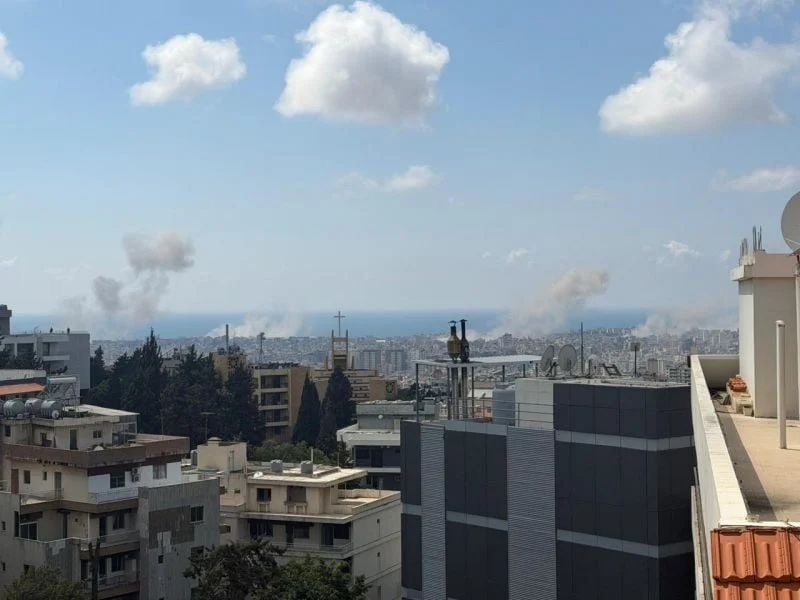
Credit: L'Orient Today
The Israeli army has just carried out a series of simultaneous strikes on Beirut.
Should Beirut take advantage of this moment to assert control on the ground against Hezbollah?
Next question from Coroll:
Shouldn’t the Lebanese government seize the pause offered by Trump’s political theater to reassert its authority — if it still has any credibility left — and take proactive on-the-ground actions to counter Hezbollah, the militia it has itself declared illegal? For example, by arresting its representatives — before a point of no return is reached.
A.S.: Hello Coroll, thank you for your question.
The Lebanese authorities as a whole — because the government is not the only decision-maker — should move beyond their relative passivity. This would involve implementing, at least symbolically, their policy of disarming Hezbollah, while simultaneously negotiating the withdrawal of Israeli troops. We are in a situation where without taking the first step, the authorities have almost no leverage to achieve the second. That said, I believe nothing will be done, given the deep disagreements at the top levels of government and the army’s unwillingness to engage in this battle.
How can Netanyahu be cornered politically?
The next question is from Nader Ezzeddine:
As usual, Netanyahu lies and interprets agreements to suit his own agenda. That was already the case during the previous cease-fire, when targeted assassinations were happening daily.
How can he be politically cornered and pressured by the international community? What levers can the Lebanese government pull to counter his war-driven rhetoric?
A.S.: Hello Nader, thank you very much for your question.
Unfortunately, I believe Donald Trump is the only person who could pressure Benjamin Netanyahu effectively. At this point, there are three scenarios that could end the war in Lebanon: pressure from Trump, an Israeli military stalemate forcing a withdrawal, or a military victory from Israel’s perspective.
The Lebanese government has limited options. Its best path would be to step up diplomatic efforts, mobilize its allies, and increase international pressure on Israel.
If Lebanon is excluded from the cease-fire, does this signal that Iran is abandoning Hezbollah?
Our first question is from Jean-Baptiste:
If Lebanon is not included in the cease-fire, should that be confirmed, could this be interpreted as Iran abandoning Hezbollah, effectively writing the party off? Thank you for continuing to keep us informed under such difficult conditions.
Anthony Samrani: Hello everyone, and sincere apologies for the delay. This is the question that has come up most frequently this morning. According to Pakistan’s prime minister, Lebanon is included in the cease-fire agreement. Hezbollah has also taken note of this, halting its operations since this morning. But Israel does not see it that way. The office of Benjamin Netanyahu said Lebanon is not covered by the cease-fire, and Israeli forces are continuing their strikes as if nothing had happened.
We will therefore have to wait for Donald Trump to wake up to know what the situation is in Lebanon. It is possible that he will allow Israel — which suffered a significant setback with the cease-fire agreement in Iran — a two-week window, the time needed for negotiations, to continue its war in Lebanon.
It is also possible that Donald Trump will give it a green light without delay, given that the war in Lebanon has no impact on the global economy or on his political base.
It would be more surprising for the U.S. president to force his ally to accept a cease-fire in Lebanon, but this cannot be entirely ruled out given the deterioration in U.S.-Israeli relations due to the war in Iran.
Hezbollah is playing this skillfully. It will be able to say it has respected the cease-fire, unlike its enemy. As for Iran, will it make Lebanon a condition without which the cease-fire agreement would be called into question? At this stage, one can assume not, but that it will try at all costs to include it in any eventual final agreement, as this would symbolize a victory not only for the regime, but also for the Axis.
Hello to all,
As Iran and the United States have reached a cease-fire, 40 days after the start of the war, questions are pouring in.
Send us yours! We will answer them today at 1 p.m. (Lebanon time).
Already have an account? Login here
You have reached your article limit
Add L'Orient Today to your syllabus.
Subscribe for $0.5/month for 3 months.
This article is only available to L’Orient Today subscribers.
Already have an account? Login here

