





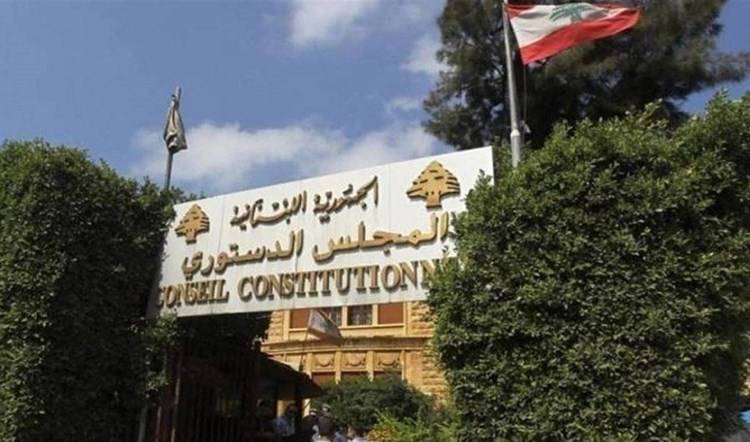
The seat of the Constitutional Council, in Hadath. (Photo: NNA)






The Constitutional Council (CC) on Tuesday rejected three appeals filed respectively by the Lebanese Forces (LF) and the Free Patriotic Movement (FPM) on March 11, as well as by nine so-called change MPs on March 24. The appeals challenged the law extending the parliamentary mandate for two years, a bill voted on March 9 by a majority of 76 out of 128 MPs.
In their petitions to annul the law, the plaintiffs argued that postponing the parliamentary elections infringes upon the principles of popular representation, alternation of power, and adherence to constitutional deadlines. They also invoked violations of international conventions on human rights, which guarantee citizens the right to elect their representatives in "regular" elections.
The law, which delays the elections to May 2028, was unanimously validated by all ten members of the CC. It had been proposed by independent MP Neemat Frem and was notably backed by the Progressive Socialist Party (PSP), Hezbollah, the Amal movement, Marada, and National Moderation (Sunnis), who cited "force majeure." The vote on the legislation took place eight days after the resumption of the war between Hezbollah and Israel on March 2. Other proposals for a shorter extension were submitted to Parliament but were not adopted.
Contacted by L’Orient-Le Jour, CC President Tannous Mechleb stated that in its ruling, the high court nevertheless found it necessary that the two-year extension should be shortened "as soon as the exceptional circumstances disappear." He emphasized, however, that the CC does not have the authority to modify the duration of this mandate on its own. According to the magistrate, this role falls to Parliament, which has the "constitutional duty" to act "as soon as the emergency situation ends." He insisted that the CC holds the power to rule on the law, either annulling or validating it in light of the country’s circumstances, but cannot adjust the delay period itself.
War context
Among the reasons for rejecting the appeals is also the fact that the electoral law stipulates that parliamentary elections must be held on a single day. However, according to Mechleb, this deadline cannot be met in the context of war, particularly since "half the population of southern Lebanon is displaced," and as recently as Monday, the Israeli army "ordered the evacuation of 40 villages north of the Zahrani River."
Additionally, the magistrate added, schools and public buildings generally used as polling centers across the country are currently serving as shelters. For the CC president, once the war ends, it will take at least six to seven months to restore the conditions needed to hold elections, notably to allow displaced people to return and to reorganize polling stations. He noted that voter lists will need to be updated, as Israel has so far killed more than 1,500 people since the war's renewed escalation on March 2, and their names, which may still appear on the voter rolls, will have to be removed.

 Evening recap: Netanyahu announces West Bank offensive; 7 killed in Jordan church shooting; tents burned in south Lebanon
 US strike on Iran this weekend? ‘Absolutely,’ says Barrack; ‘I have no idea,’ says Trump