







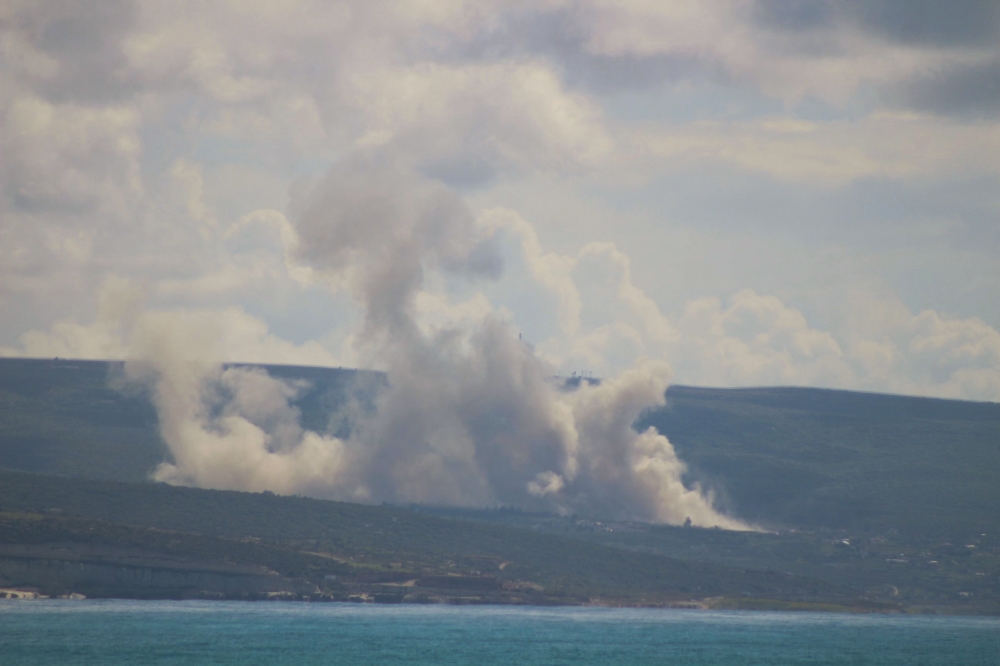
Smoke caused by Israeli military activities rising from the Naqoura area, April 6, 2026. (Credit: Kawnat Haju / AFP)






BEIRUT — Catholic Easter Monday was as violent as the previous Sunday, with Israel continuing its bombardment of Beirut's southern suburbs, south Lebanon and the Bekaa, according to our correspondents.
Early Monday evening, residents of more than 40 villages in South Lebanon were once again ordered to evacuate their homes ahead of a new wave of massive strikes. Some of these villages are located north of the Litani River, where earlier in the day, the Israeli army had already issued evacuation orders to residents through leaflets dropped over the region. According to our correspondent, at least two Christian villages were listed for the first time in the evacuation order: Addousieh, south of Saida, and Bfaoureh, in Nabatieh.
By mid-evening, many residents had evacuated villages threatened by the Israeli army. Before the first strikes, the Civil Defense center of the al-Rissala Scouts Association, affiliated with the Amal Movement, received a phone call from someone claiming to be from the Israeli army, ordering the evacuation of the village of Kfour (Nabatieh). According to the center, although some families still remain, most have left.
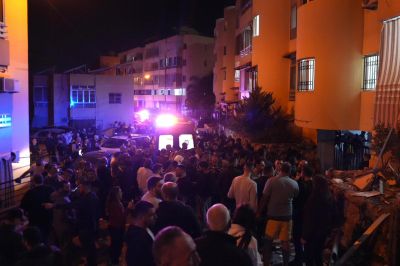
According to the Ministry of Health's latest toll, at least 1,497 people, including 130 children, have been killed in these bombardments, which are not always preceded by warnings, such as in the strike on Ain Saade that killed at least three people Sunday in an area considered safe, increasing tensions between Christian parties and Hezbollah.
By midday, a provisional tally reported at least 16 people killed in south Lebanon and the Bekaa, bringing the total to 36 killed in 24 hours, according to the ministry. The Health Ministry also reported a second attack in 12 hours against paramedics in Siddiqine (Sour), after a previous strike in Hariss (Bint Jbeil). One of the victims of an Israeli drone attack in the morning on a road in Hamadieh (Sour) was identified as Bernard al-Hajj, a Christian from the village of Tanbourit (Saida), married to a Shiite woman from Maarakeh (Marjayoun).
Attacks on Israeli tanks
Beirut's southern suburbs were struck again during the day, after the Israeli army issued an evacuation order for seven neighborhoods including Haret Hreik, Ghobeiri, Laylaki, Hadath, Burj al-Barajneh, Tahwitat Ghadir and Chiyah. The Israeli army's Arabic-language spokesperson, Avichay Adraee, claimed it targeted Hezbollah infrastructure. A second strike took place later in the evening in the Bir al-Abed neighborhood of Beirut’s southern suburbs, hitting a building housing a branch of Banque Libano-Française.
In the Bekaa, the locality of Meydoun was struck in the evening, according to our correspondent.
In south Lebanon, the carnage continued, with Israel intensifying its strikes on cities and villages, including Sour, but also Bint Jbeil, Marjayoun and Hasbaya.
In its usual statements, the Israeli army announced in the middle of the afternoon that it had destroyed "more than 300 terrorist infrastructures by air and sea" and "discovered more than 10 underground tunnels," without providing further details. A little later, it claimed to have found a "Hezbollah underground complex" filled with weapons.
Hezbollah, for its part, announced several operations, including attacks in Khiam, and said clashes were ongoing in Kiryat Shmona (on several occasions) and Metula, on Israeli territory. Hanita, Shlomi, Yir’on, Karm Ben Zimra, Margaliot, Misgav Am, as well as the Malkiya site, were also targeted. Hezbollah said it specifically targeted at 2:30 p.m. the "Ghivat Olga base, belonging to the Northern Command of the Israeli army, located 75 kilometers west of Hadera, with a rocket and attack drones." It also said it struck two Merkava tanks at 4:10 p.m. at Tallet Ghamatha, in Ainata (Bint Jbeil), using attack drones. The group subsequently released a video showing its attack on the Israeli tanks.
Lebanese Health Minister Rakan Nasreddine visited the Saida government hospital to assess its needs and consider ways to strengthen support for the medical facility.
Finally, the Lebanese army said in a statement that there were no tenants on the floor of the building struck Sunday by an Israeli attack in Ain Saade. The strike killed three people and wounded several others. The army added that a person was seen leaving the building on a motorcycle just after the strike, and said the investigation was ongoing to identify this individual and clarify all the details. A drone was also heard flying at very low altitude at 9 p.m. between Mansourieh and Ain Saade, where an Israeli strike killed three people on Sunday.
