



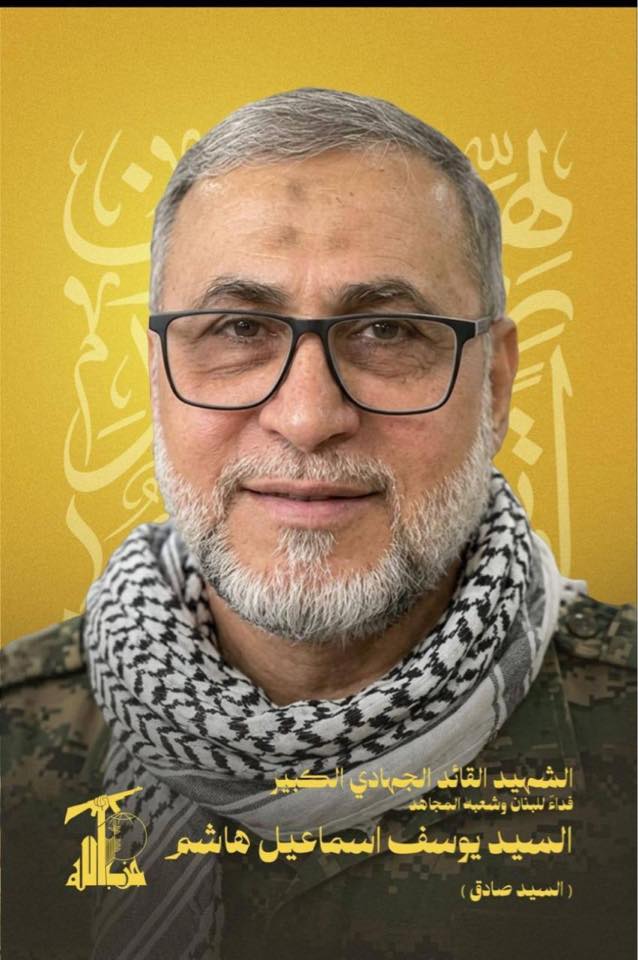
A portrait of Youssef Hachem circulating in groups close to Hezbollah.






BEIRUT — Hezbollah’s Iraq chief and Southern Front commander, Youssef Ismail Hachem — blacklisted by the U.S. Treasury and a veteran of Syria’s Deir ez-Zor battles — was killed in Israeli strikes on Jnah, though Hezbollah has remained silent.
Killed in navy strikes while "in a meeting with other party officials in a tent," according to AFP sources, he is the highest-ranking official killed by Israel since the conflict resumed on March 2.
What do we know about Youssef Hachem?
Successor to Ali Karaki on the 'Southern Front'
After the overnight bombardment in Jnah, a neighborhood in southern Beirut, the Israeli military claimed just hours later the elimination of the "Hezbollah Southern Front commander."
The Southern Front is considered "the Hezbollah unit charged with carrying out operations against Israel and fighting Israeli forces in southern Lebanon," according to a statement by Arabic spokesman for the army, Avichay Adraee. In this context,Hachem "supervised the firing of rockets and drones at Israeli territory and led efforts to rebuild" Hezbollah's capabilities, he added.
According to the statement, Hachem had "over 40 years of experience" in the party’s ranks, notably heading the different regional southern units [the Nasr, Aziz, and Badr units], and he "took command of the Southern Front after the death of Ali Karaki," who was killed in attacks on Beirut’s southern suburbs on Sept. 27, 2024, which also killed Secretary-General Hassan Nasrallah after he escaped a bombing three days earlier.
According to our correspondent in the South,Hachem was from Marouaniyeh, a village in the Saida region.
In charge of the Iraq file and sanctioned by the US Treasury
Hachem is said to have taken up his post as Southern Front commander as part of the reshuffling of positions within Hezbollah after the 2024 offensive, which struck senior military officials in quick succession and brought down the group’s decision-making hierarchy.
In this context, he concurrently held the office of Southern Front commander and military chief for Iraq, where many pro-Iran militias operate under Iran's direction, similar to Hezbollah.
A photo, which L'Orient-Le Jour could not immediately verify, shows him with Abu Mahdi al-Muhandis, former chief of the Iranian-backed Iraqi Popular Mobilization Forces, who was assassinated in Baghdad in January 2020 in a U.S. strike that also killed the former head of the IRGC's Quds Force, Qassem Soleimani.
In fact, in his capacity as overseer of the Iraq file, OFAC, the U.S. Treasury’s financial sanctions office, sanctioned Hachem in November 2018, describing him as an official affiliated with the Shiite party who "directs all operational activities related to Hezbollah in Iraq," "protects Hezbollah’s interests in Iraq" and "manages Hezbollah’s relationships with sectarian armed groups in Iraq," including coordinating the deployment of fighters to Syria.
OFAC, like announcements of his death circulating in local groups close to the party, also say he was known by the aliases “Hajj Sadek” and “Sayyed Sadek.”
Jihad Council and Deir ez-Zor battle
In these groups and on social media, Hezbollah supporters hailed Hachem as a “great jihadist commander,” a rank reserved for the elite leadership of the Jihad Council — which means he was a member of the militia’s highest military authority, responsible for major strategic, military and security decisions.
The site Janoubiya, run by Shiite dissident Ali al-Amine, described him as “one of the planners and executors of the capture of Deir ez-Zor in September 2017,” who allegedly helped lead major battles against the Islamic State group in the Syrian Badiya region. In a 2017 clip broadcast by al-Mayadeen, he appears at Deir ez-Zor airport saying Hezbollah was “part of the Iran-Iraq-Syria-Palestine axis.”
Hezbollah's silence
So far, Hezbollah has published no official announcement of Hachem’s death nor, as it did when its officials were killed in 2024, even a brief biography. The party’s press office did not respond to requests for information from L’Orient-Le Jour, a muted approach to deaths within the group the party has observed since early March.
Besides Hachem, the strikes on Jnah, which killed seven and wounded 26, also killed, according to a condolence message circulating in pro-Hezbollah groups, another fighter, Mohammad Baqer Baha’ Naboulsi, son of journalist Baha’ Naboulsi and grandson of ulama Afif Naboulsi — a leading Shiite religious authority who died in 2023.
He was also the nephew of Mohammad Afif Naboulsi, former head of the party’s press office, killed in an Israeli strike in November 2024. The condolence message states his funeral will take place during the day in Saida. For now, it is unclear what role Mohammad Naboulsi held in the movement.
On Monday, the Israeli military announced it had killed, in a strike on southern Beirut, Hamza Ibrahim Rkein, identified as the deputy commander of "Unit 1800," in charge of “coordination between Hezbollah and Palestinian organizations in the Middle East,” notably “in Lebanon, Gaza, Syria and the West Bank.”
From Shehabieh in the Sour region, Ibrahim Rkein, known by the war name “Hajj Hamza,” allegedly “supervised the transfer of fighters from these organizations to take part in the fighting against Israeli forces in southern Lebanon,” according to the army.
Reporting by our corresepondent, Mountasser Abdallah.
 Israeli army carries out demolition at Jabal Amel School in Houla as strikes continue