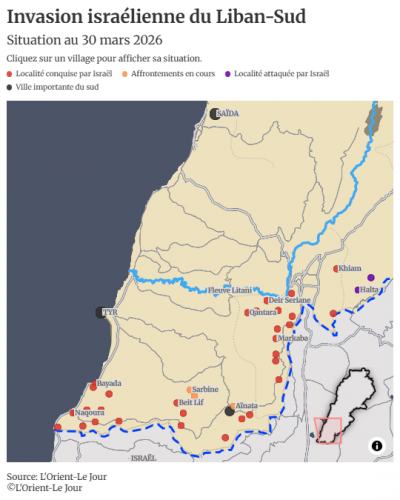
As the war between Hezbollah and Israel continues, Tel Aviv has framed its invasion of southern Lebanon — aimed at demilitarizing the region — as a central objective of the conflict. The Israeli army is deploying substantial ground forces, including tanks and multiple divisions, with fighting unfolding across three sectors. Here is an update on Israel's offensive and the situation on the ground as of Tuesday morning, March 31, 2026.
The Western sector
In the Sour district, the Israelis are attempting to advance along the coastline. Available information suggests they have captured the town of Naqoura. Hezbollah also reported attacks on Israeli army positions in Bayyada and Shamaa, indicating that the Israelis are now within roughly ten kilometers of Sour, the largest city in the region.
The central sector
In this sector, the Israeli army appears to be trying to encircle the city of Bint Jbeil, the capital of the district of the same name. Considered the "capital of Hezbollah," this city is highly symbolic. The group's former leader, Hassan Nasrallah, delivered his "victory speech" there at the end of the July 2006 war.
To encircle the city, the Israelis are advancing on two fronts. From the west, they are pushing from Qouzah toward Dibil and Rashaf. From the east, they are advancing from Aitaroun and Maroun al-Ras toward Ainata, a locality situated just northeast of the targeted city.
The Eastern Sector
It is in the Marjayoun district that the Israelis appear to have made the most progress. This area is strategically important, as the Litani River lies less than 10 kilometers from the border in this area. Israeli troops seem to have reached the river after advancing on Deir Siryan and Deir Mimas, two villages along the Litani. This positions them to isolate the eastern sector from the rest of the Litani and to prepare for a push into the Wadi Hujeir and Wadi Slouqi valleys.
The main towns in this area are Khiam and Marjayoun. Israel claims to have taken control of Khiam, although fighting continues just north of the town, in the triangle formed with Ibl al-Saqi and Rashaya al-Foukhar.
A new front in the Western Bekaa Valley?
If Israeli forces continue their advance in the eastern sector, they could push further inland towards Jabal al-Rihan (Jezzine), which borders the western Bekaa Valley. Their objective would be to gain access to the rest of the Bekaa Valley, where Hezbollah's main weapons depots are believed to be located.
On Tuesday, March 30, the Israeli army added several localities in the western Bekaa Valley to the list of areas under evacuation orders.
To achieve their objective, the Israelis could advance along two main axes in the eastern sector: from Khiam and Marjayoun towards Kawkaba and Dalafa, and from the far east, from Kfar Shuba toward Kfar Hammam and Hebbarieh, as far as Rashaya al-Foukhar and Freidis in the Hasbaya district, in order to reach areas facing key towns in the western Bekaa Valley such as Zellaya and Midoun. They could rely in this battle on positions they hold on the Syrian side of the border, in Mount Hermon.