






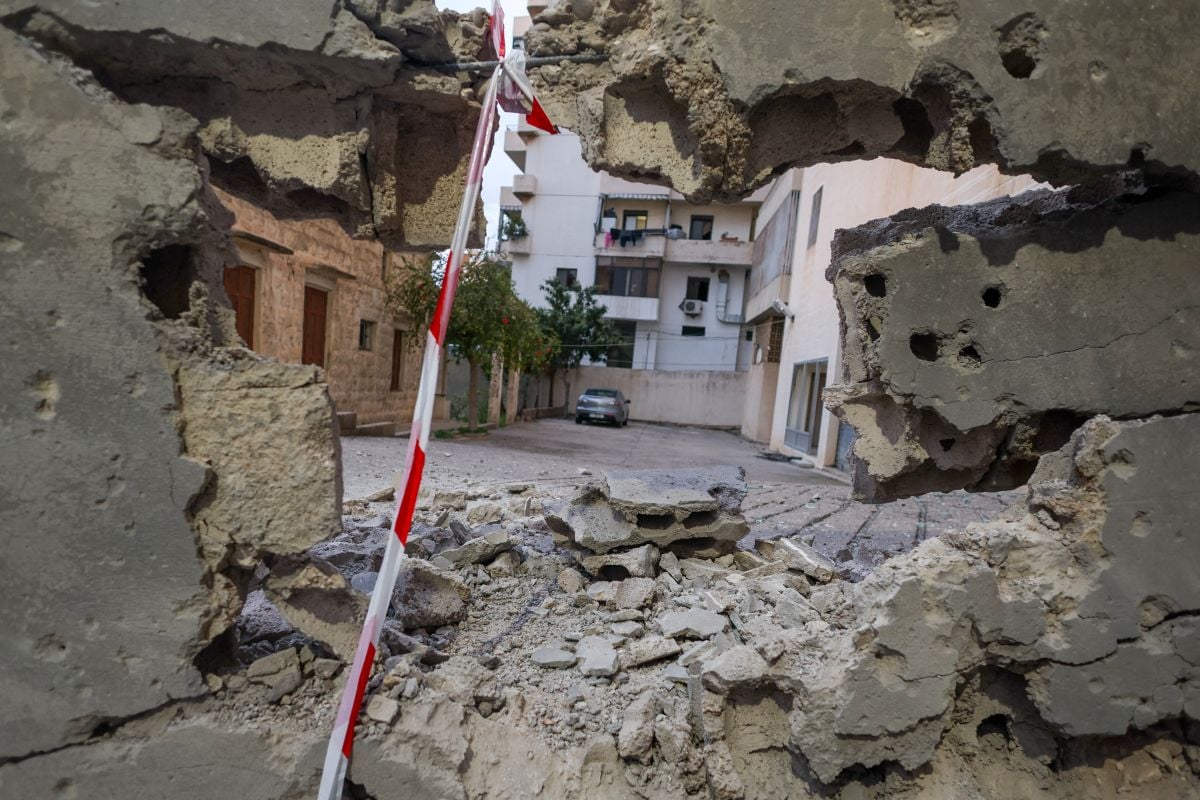
A hole in a wall after fragments from the interception of an Iranian missile hit Sahel Alma, north of Beirut, on March 24, 2026. (Credit: Amr Abdallah Dalsh/Reuters)






BEIRUT — Around 3:30 p.m. Tuesday, Kesrouan in Mount Lebanon also felt the effects of the ongoing Israeli-American war against Iran since March 2. Several muffled explosions were heard over Jounieh, the district capital, while debris fell in the neighborhoods of Haret Sakhr and Sahel Alma, causing material damage but no casualties.
Other areas in upper Kesrouan, were also affected. Over six detonations, according to witnesses cited by local media, were heard several kilometers away.
At first, the origin of these explosions was not clearly established. However, the possibility of a missile interception was quickly raised. By the end of the day, multiple high-ranking security sources confirmed to Reuters that an Iranian missile had been intercepted for the first time in Lebanese airspace.
Two of them specified that a "foreign vessel" had carried out the interception using missile defense systems. "Thank God, there are no injuries in Kesrouan following the intercepted missile," wrote MP Farid Haykal el-Khazen on X, expressing hope that "Kesrouan will remain spared from the war and its consequences."
According to a Lebanese security source contacted by L’Orient-Le Jour, the only certainty is that the missile "is an Iranian cluster munition missile" (a weapon that disperses dozens or hundreds of small explosive bombs mid-flight).
What is less certain, on the other hand, is "whether it was intercepted in flight by an interceptor missile or if it disintegrated on its own," the source specified, adding that they will have to wait for the analysis results of the metal fragments found on site.
According to this source, the interception theory remains the most plausible so far. Another unknown remains the missile’s final destination, which Lebanese security forces cannot determine with the technologies they currently have.
According to Israeli media, the projectile was fired from Iran toward an American target in Lebanon. Some Lebanese outlets report that it was targeting the U.S. Embassy in Awkar (Metn) and was destroyed in flight by an interceptor launched from the Hamate base in North Lebanon. The pan-Arab outlet al-Hadath, for its part, indicated that the base itself was the intended target. Located in Batroun district, this base houses a U.S. unit as part of aid programs to the Lebanese Army.
Finally, in what appears to be a separate incident Tuesday, the Israeli army stated in the evening that a missile fired from Iran fell at midday in Beirut. "Following an assessment and based on information available to the Israeli army, as well as in relation to earlier launches during the day toward Israel, a ballistic missile launched by the terrorist Iranian regime fell in Beirut," read a military statement without further details.
Questioned by AFP, an Israeli military spokesperson said the fall of the projectile on the Lebanese capital happened "around noon," about the same time or slightly before the Lebanese government announced its decision to expel the new Iranian ambassador to Beirut, appointed in February.
Hezbollah entered the war in the Middle East on March 2 to avenge the death of Iran's Supreme Leader Ali Khamenei, who was killed on the first day of Israeli-American strikes on Iran on Feb. 28.
Since then, Israel has carried out massive reprisals through a vast campaign of airstrikes on Lebanon and ground advances in a buffer zone along the border. Hezbollah, for its part, continues to launch rocket salvos across the border.
