A man stands in front of the rubble of a building destroyed by an Israeli strike during the night of March 17 to 18, 2026, in the Bashoura neighborhood of central Beirut. (Credit: Matthieu Karam/L’Orient Today)






Israeli attacks in Lebanon escalated Wednesday, with the targeting of bridges in southern Lebanon — particularly those over the Litani River. Two of these bridges were already destroyed around 4 p.m., one near the town of Burj Rahal and the other, the Kenayat bridge, in the Qasmiye area in the Sour district. These are not bridges on main routes connecting different regions, but rather "secondary" structures located within village perimeters, as explained by our south Lebanon correspondent.
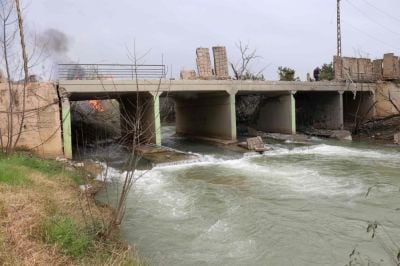
In the late afternoon, Israel carried out a new strike on a key crossing point at Qaaqaaiyet al-Jisr, between the districts of Nabatieh and Bint Jbeil. This was the first major bridge destroyed by the Israeli army on Wednesday, according to our correspondent. Its destruction also cuts off the road connecting the villages of Nabatieh to certain towns in the Marjayoun district. On March 13, the Israeli army destroyed two other major bridges: the Tayr Felsay bridge and the Jisr al-Khardali bridge.
Speaking a few hours after the strike on Qaaqaaiyet al-Jisr, Israeli Defense Minister Israel Katz stated that these bridges were "used by Hezbollah to transport combat means," adding that their destruction constitutes a "clear message to the Lebanese government," to whom Tel Aviv is demanding the disarmament of Hezbollah, even if it means a confrontation.
The operation's goal is to deprive Hezbollah of any remaining supply routes. Fierce fighting is raging between Hezbollah fighters and Israeli troops, which has increased its incursions into Lebanese territory — particularly in Maroun al-Ras (Bint Jbeil) on Wednesday — under fire from Hezbollah fighters.
The Arabic-language spokesperson for the Israeli army, Avichay Adraee, had ordered a mass displacement threat on residents south of the Zahrani River, closer to Saida. This development in Israeli strategy has come amid numerous threatening statements, with Katz earlier in the day promising "significant surprises" that would "intensify the war against Iran and Hezbollah," following a meeting of Israel's security cabinet, according to Israeli media citing his office.
Meanwhile, the death toll from the war continues to rise: according to the new report from Lebanon's Health Ministry, 968 people have been killed, including 116 children and 77 women, and 2,432 injured in Israeli attacks in Lebanon since the war began. Many of the victims are children: UNICEF laments that the war in Lebanon is killing or injuring the equivalent of a classroom of children every day.
In Saida and Beirut
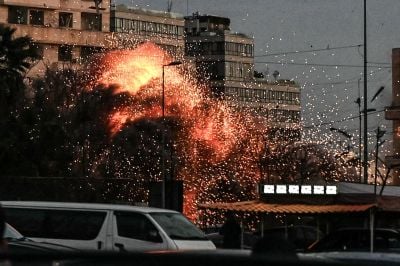
As strikes on southern Lebanon continue regularly, the "surprise" overnight was the targeting of several neighborhoods in the heart of Beirut, especially Zoqaq al-Blat and Basta, without prior warning. According to a still provisional Health Ministry tally, Israeli strikes on the capital during the night and morning in Bashoura killed at least 12 people and wounded 41 more.
One morning strike on Zoqaq al-Blat killed the director of political programs at Al-Manar, along with his wife. The death of this veteran journalist, who was bedridden following surgery, prompted widespread indignation in the country. Among those denouncing it were Information Minister Paul Morcos and the press editors' union. Other members of his family were injured.
The identity of another person who may have been targeted in the first strike on Zoqaq al-Blat during the night, around 1 a.m., has not yet been revealed.
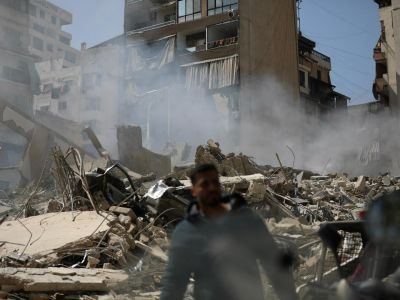
In Bashoura, in central Beirut, on a street leading to Martyrs' Square, a building of about 15 floors was destroyed in the morning by the Israeli air force. Police cordoned off the area, according to our reporters at the scene. The force of the strike completely devastated the neighborhood.
The city of Saida was not spared either on Wednesday. An Israeli drone targeted a car around 9:30 a.m., killing its driver and a 51-year-old Civil Defense rescuer who was nearby, as well as injuring another person. Israel said it targeted "a senior financier for the Palestinian Hamas movement, Mustapha Hussein Taha."
Israeli strikes also proved deadly in other regions. Victims and wounded were reported in the village of Sohmor in western Bekaa. At least nine people were killed overnight in various strikes across Bekaa, according to our correspondent in the region.
Israeli airstrikes particularly targeted Hezbollah-affiliated al-Amana gas stations in several areas of Sour and Bint Jbeil in southern Lebanon.
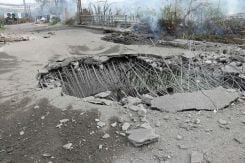
The night was also marked by an Israeli call for the evacuation of the city of Sour and its environs, causing panic and another wave of displacement. A threatened building in Aaqbieh was targeted.
Elsewhere, two new deaths were reported in the Christian border village of Qlaya, which has not been abandoned by residents, in an Israeli strike on a residential building.
'If Israel has not managed to disarm Hezbollah...'
On the political front, President Joseph Aoun at a security meeting at the Baabda Presidential Palace stressed the importance of "the unity of the Lebanese" and "rejecting sectarian incitement," and called for a "national discourse."
On al-Hadath, Aoun said he is continuing efforts to achieve "direct negotiations with Israel," pledging "to obtain internal consensus" on this issue.
Meanwhile, French President Emmanuel Macron's special envoy to Lebanon, Jean-Yves Le Drian, stated that "the only solution to end the conflict in Lebanon is negotiation," according to remarks reported by Reuters. "Israel has not succeeded in disarming Hezbollah, so it cannot expect the Lebanese government to do so in three days under bombardment," he said.
Additionally, France announced that its foreign minister, Jean-Noel Barrot, will visit Beirut on Thursday.
The only good news of the day is that Royal Jordanian Airlines announced the resumption of its flights to Beirut starting March 19, the first to do so since March 2, the date when the resumption of war drove all foreign airlines to flee.