







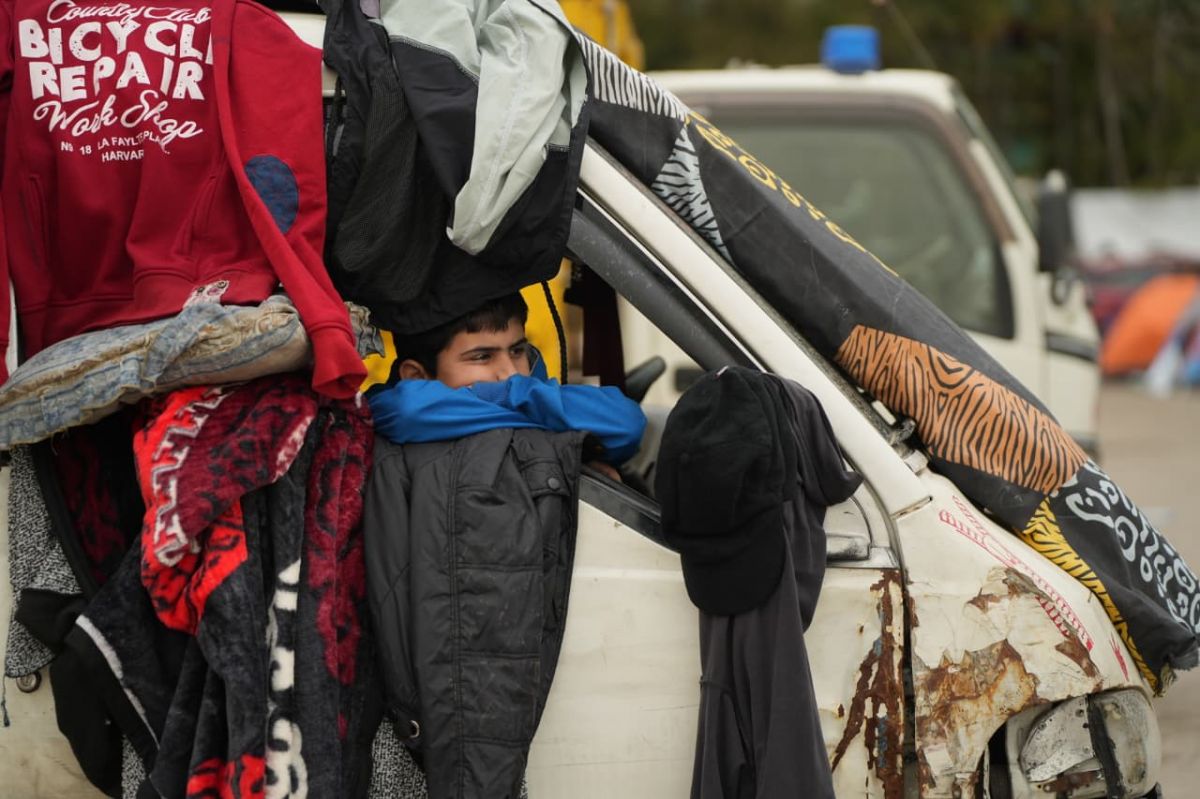
A displaced child in a van, in downtown Beirut, on March 14, 2026. (Credit: Mohammad Yassin)






After a new Israeli strike killed one person early morning in the same building in Burj Hammoud-Nabaa, a neighborhood in eastern Beirut that was already targeted on Thursday, the Israeli army concentrated its deadly attacks on southern Lebanon Saturday morning.
Later that morning, an airstrike hit an apartment in Saida, in the Haret Saida neighborhood east of the city, killing four members of the Teriaki family: father Ali, mother Youmna and their sons Abdallah and Hassan.
Arabic-language Israeli army spokesperson Avichay Adraee stated Saturday that "over 110 Hezbollah positions have been struck" since the war began on March 2, two days after Israel and the United States launched a major operation against Iran.
He added that the Israeli army was attacking Hezbollah's "command and control capabilities" as well as its economic resources and weapons.
He renewed in the afternoon his call for the evacuation of entire neighborhoods in Beirut's southern suburbs: Haret Hreik, Ghobeiri, Laylaki, Hadath, Burj al-Barajneh, Tahwitat al-Ghadir and Chiyah. A strike was carried out there in the early evening.
After reports of several incursions and violent clashes in Maroun al-Ras (Bint Jbeil), Aitaroun (Bint Jbeil) and Khiam (Nabatieh) during the night from Friday to Saturday, the Israeli army continued its raids and artillery fire on southern Lebanon throughout the day, targeting the districts of Marjayoun, Bint Jbeil, Sour, Nabatieh and Saida in particular.
It also claimed to have killed on Wednesday in a strike Hisham Abdel Karim Yassin, whom it presented as a "central official of Hezbollah's communications unit and the Palestinian Corps affiliated with the al-Qods Force," the elite force of the Islamic Revolutionary Guard Corps (IRGC).
According to Adraee, he would be the third leader of this group killed since the start of the Israeli offensive. He allegedly worked to "consolidate the Iranian presence in Lebanon" and to promote "terrorist plans under the direction of the Iranian regime."
Rescuers targeted, civilian trucks threatened
In one of his usual warnings on his X account, the spokesperson accused Hezbollah of transporting military equipment in civilian trucks through coastal areas in southern Lebanon, warning that "any truck traveling near the coast may be in danger due to Hezbollah's positioning in the area."
Adraee published a map highlighting the affected coastal area, from the Lebanese-Israeli border to the capital. "We believe some of these weapons are intended for use in terrorist operations, including plans targeting the border area, ships and maritime targets," he added. "These trucks appear to be civilian trucks to blend in and position themselves among the local population," the spokesperson continued.
As it stands, 31 rescuers and medical personnel have been killed in Lebanon since the start of the war, the Health Ministry announced Saturday.
Friday night, a strike killed 12 doctors, rescuers and nurses working at a health center in Burj Qalawieh (Bint Jbeil district) in southern Lebanon. A previous strike on the locality of Sowaneh (Marjayoun district) had killed two ambulance workers affiliated with the party. The Ministry accused Israel of "deliberately targeting" paramedics on duty, after Israel itself accused Hezbollah of using ambulances and medical infrastructure "for military purposes."
The Israeli army had threatened new attacks against medical infrastructure and ambulances in Lebanon, arguing that Hezbollah uses them for military ends.
The secretary general of the Lebanese Red Cross, Georges Kettaneh, stated on local TV channel Al Jadeed that the LRC coordinates its activities with the International Committee of the Red Cross (ICRC), the United Nations Interim Force in Lebanon (UNIFIL) and the Lebanese Army in dangerous areas.
"Our duty is to rescue and provide medical assistance to anyone wounded in the fighting, in accordance with the Geneva Conventions," he added.
Hezbollah ready for war
UNIFIL stated Saturday it had been fired on with heavy machine guns the previous day near one of its positions close to Mais al-Jabal, causing a fire and slightly injuring a peacekeeper.
Hezbollah, for its part, announced confrontations with the Israeli army on several fronts in southern Lebanon. While Axios reported that Israel is preparing a large-scale ground invasion of Lebanon, the pro-Iranian party claimed several rocket, artillery and kamikaze drone squad attacks targeting gatherings of Israeli soldiers and certain border areas, as well as the Ein Shimer base, located 75 km from the border, and Stella Maris base, strategically important for maritime surveillance on the northern coast.
Comments from a party source reported by AFP indicated that Hezbollah had decided to fight months ago, but was waiting for a change in the regional status quo, “which it found in the American-Israeli war against Iran.”
The party, the source added, “knows very well that whatever the outcome of this war, its turn would come, and that Israel would not hesitate to launch a major campaign against it.”
It has “absorbed the shocks of the previous war, healed its wounds ... and reorganized its ranks.” Hezbollah has now “put everything it has into the battle”: either “it will be annihilated, or it will impose a new equation involving the complete withdrawal of Israel from Lebanon and the end of its attacks,” the source said.
The Guterres visit
To date, Israel has killed 826 dead and wounded 2,009, according to the latest figures from the Health Ministry. In its latest updated report, the disaster risk management unit, attached to the prime minister’s office, said 831,882 people have been displaced since March 2.
The total number of displaced people in the 619 shelters across the country stands at 132,419, or 33,902 families. Meanwhile, the government continues to monitor the delivery of aid to Lebanon and ensures the continuity of services with the relevant ministries, said Information Minister Paul Morcos on Saturday following the daily Cabinet meeting established in the wake of the war.
Prime Minister Nawaf Salam welcomed the humanitarian appeal, launched on Friday by U.N. Secretary-General Antonio Guterres, to raise $325 million during his visit to Beirut.
On Saturday, Guterres called for “an end to the bombardments and a cease-fire,” estimating that “the only solution lies in diplomacy and dialogue.”
Lebanese Army Commander Rodolph Haykal expressed his gratitude for Guterres’ efforts and praised UNIFIL’s role, highlighting “the importance of cooperation and coordination between it and the army,” during a meeting in Yarze with the secretary-general.
