






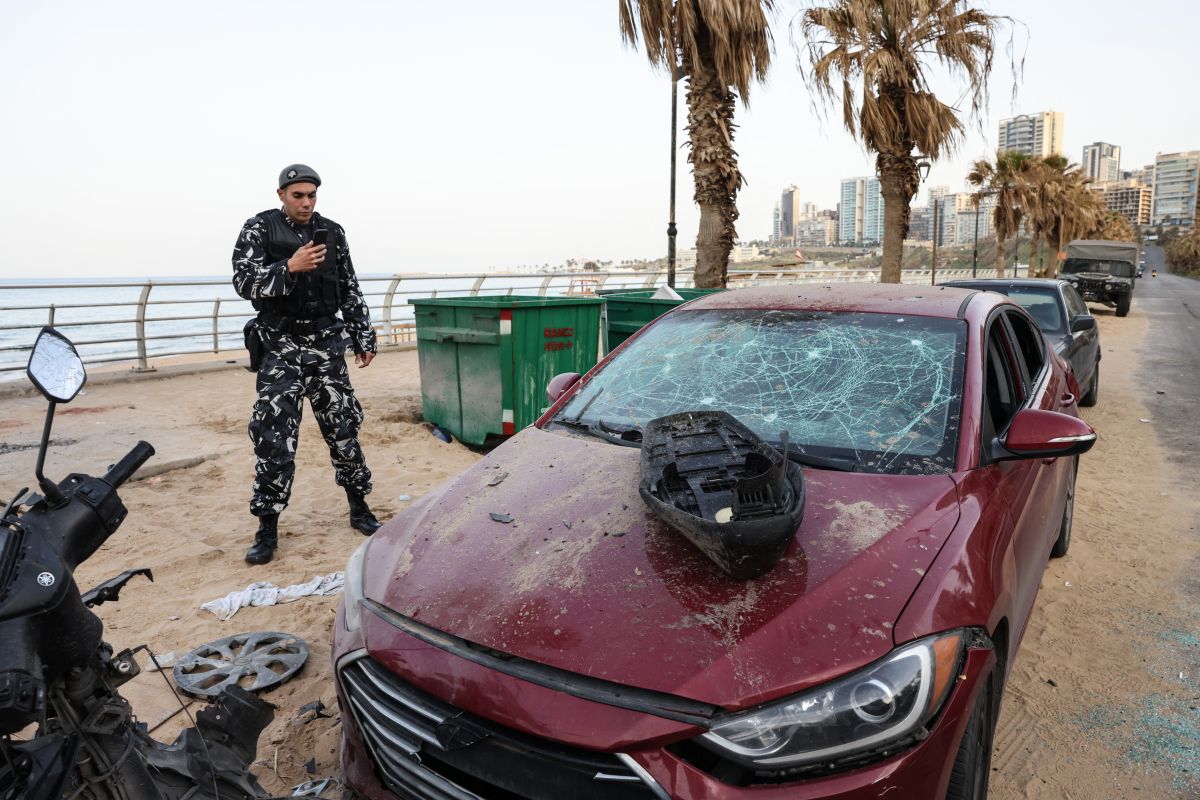
A policeman inspects a damaged car at the site of an Israeli airstrike on the seaside area of Ramlet al-Bayda in Beirut early on March 12, 2026. Lebanon said an Israeli strike on central Beirut's seafront killed at least seven people early on March 12, another attack in the heart of the capital as Iran-backed Hezbollah launched more missiles at Israel. (Credit: Anwar AMRO/AFP)






Nadine Khayat is an academic, urban planner and researcher. Her research is focused on migration and displacement, multiculturalism, leisure practice, and physical and social integration across public space typologies in the Global South.
Early on Thursday morning, an Israeli strike on Beirut’s Ramlet al-Baida seafront killed at least seven people, many of whom had taken refuge on the public beach after being displaced by Israeli threats and attacks.
The tragedy underscores a reality city planners and governors often overlook: in moments of crisis in countries with scarce state resources, parks, public spaces and seafronts, like the Corniche or Martyr’s Square, become critical urban infrastructure. They turn into sites of temporary safety for vulnerable residents who have nowhere else to go.
Unfortunately, another reality is that when displaced people gather in visible places, they become exposed to the dangers of militarized airspace.
Planning for a crisis, therefore, means planning for inequality. It requires acknowledging that public spaces are not neutral; they are shaped by governance failures, privatization and years of neglect. Crisis only magnifies these divides.

Rethinking public spaces’ designs and contingency planning
Beirut’s public spaces, already scarce and unevenly accessible, often become a last resort for those with the fewest resources. But we have also seen them turn into refuges, like during the 2015 garbage crisis and the October 2019 uprising. Lebanon also experienced a mass return to these spaces during the 2019–2024 economic collapse (Abou Aoun, 2020).
People head to waterfronts and public squares during crises because they are familiar and collectively accessible. They offer visibility, air, escape routes and social solidarity, all of which feel safer when institutions or even homes are at full capacity.
But the same qualities that create a sense of refuge also make these spaces highly exposed under modern aerial warfare. They become sanctuaries and targets at the same time.
Urban geographer James Scott reminds us that open spaces increase top‑down legibility for states using surveillance and aerial targeting. As planners and designers, we must then rethink our approaches.
Designs should be flexible enough to accommodate emergency functions, equipped with basic infrastructure for relief, such as water access, parking, storage facilities, shaded areas and underground bunkers. Landscape could add natural protective elements that offer basic forms of cover without compromising openness. .They should also be accessible to all segments of the population, particularly vulnerable groups.
Spatial output of emergency preparedness can encourage well-being and placemaking in both emergency and non-emergency situations, in a concept known as “contingency planning.”
This is not a perfect solution, but it is an honest one for a city forced to navigate the geography of war.
Urban planning in Beirut has long treated public space as a backdrop for leisure or private tourism. But the past decade has made it clear that we need to think differently.
In a city marked by electricity blackouts, heatwaves, mass displacement and repeated rounds of conflict, parks and seafronts have become places to sleep, breathe, organize, seek help, and sometimes simply to survive.
Authorities must stop thinking of these spaces as an optional amenity and start treating them as lifelines. Ramlet al-Baida was never designed to serve as an emergency shelter. Yet that is precisely what it became. And until Beirut integrates crisis thinking into its urban planning, its public spaces will continue to bear the weight of political failures, forcing our most vulnerable residents to pay the price.
Contingency planning can no longer be separated from the realities of militarized airspace and targeted strikes; it needs to work alongside the use of public spaces as refuge under contemporary forms of conflict.
References & further reading
Bou Aoun (2020). Reclaiming Public Space and Its Role in Producing the Revolution. Legal Agenda
Breivik-Khan, H. & Hemmersam, P. (2024) ‘The Mountain Hall and the Smart Club: The architecture of emergency reception in Norwegian cities’, Wellbeing, Space and Society, 6.
Harb, M. (2013). Public Spaces and Spatial Practices: Claims from Beirut. Jadaliyya.
Khayat (2020). Rebuilding Beirut’s port: an opportunity for social justice. Landscape Department blog, University of Sheffield.
Khayat, N., & Rishbeth, C. (2023). Exploring Urban Co-presence and Migrant Integration on Beirut’s Seafront. Migration Studies.
Madanipour, A. (1999). Why are the design and development of public spaces significant for cities?. Environment and planning B: Planning and Design, 26(6), 879-891.
Rishbeth, C. (2001). Ethnic minority groups and the design of public open space: an inclusive landscape?. Landscape research, 26(4), 351-366.
te Lintelo, D. J. H., Ip, M. A., Lappi, T.-R., Lakshman, R. W. D., Hemmersam, P., Dar, A., & Tervonen, M. (2024). Urban Displacement and Placemaking in Public Space for Wellbeing: A Systematic Review of Global Literature. Environment and Urbanization, 36(2).