








Lynn Harfoush, member of the executive committee of the National Bloc, speaking before the U.N. Security Council on March 11, 2026. (Credit: National Bloc)






“The mask fell, and I saw the truth,” Lynn Harfoush told the U.N. Security Council on Wednesday. Originally from Baalbeck, she grew up in Beirut’s southern suburbs. She used to support Hezbollah, before experiencing the wars of 2006, 2023 and 2026, as well as the resulting displacements that she and her family suffered.
Now a member of the executive committee of the National Bloc, she accused Hezbollah of “once again [dragging the] country into a war the Lebanese people did not choose.”
As the Security Council met to discuss the escalating conflict in Lebanon, Harfoush shared her personal experience and that of her compatriots. “I am 34, and I’ve never known anything but Hezbollah’s hegemony in my community. I myself grew up supporting Hezbollah,” she said, denouncing a war “imposed by a militia that answers to interests beyond our borders.”
“In the early hours of last Monday [March 2] morning, while Lebanese families slept in their homes, Hezbollah once again dragged our country into a war the Lebanese people did not choose. Today, like many Lebanese families, mine too is displaced,” she continued.

In her remarks, the activist reflected on her adolescence. “I was raised in the very environment from which Hezbollah claims its legitimacy. I know its language. I know its threats,” Harfoush explained.
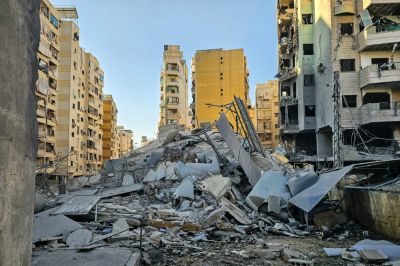
She recalled the 2006 war with Israel: “My neighbourhood, in [Beirut's southern suburbs], got razed by Israeli bombs. I was 14 then, and saw Hezbollah as protectors, even as I was displaced on a traumatizing night.”
'Who is paying the price?'
But her perspective changed when she returned to her destroyed neighborhood. “But coming back to our neighbourhood, I found our livelihood destroyed, suffocated by yellow flags claiming a 'divine victory.' Seeing them celebrate over our collective ruin, while their grip on our streets only tightened. I felt they were occupying our wreckage to secure their own dominance.”
“The mask fell, and I saw the truth,” she continued.
“The truth that resistance was a mere facade to exploit an entire country for an expansionist project.
The truth that Hezbollah sought to break us away from other communities, through its ideological and social project.
The truth that under Hezbollah’s dominance, Iran’s arm in Lebanon, war becomes a recurring reality, fear our constant companion, and our lives a mere expendable for the sake of the supreme leader.”
Harfoush then addressed the wars of 2023 and 2026. “The terrible part in all this is that the very same scenario played again in 2023, when Hezbollah decided to open what they called a 'support front' against Israel, right after Oct. 7. And again in 2026, after they had promised the Lebanese government they wouldn’t commit suicide once again,” she said, before denouncing the humanitarian consequences of the current escalation.
“Hundreds of Lebanese have been killed in just a week. The number of internally displaced persons has reached more than a million, including nearly 200,000 now living in collective shelters across hundreds of sites,” she said.
“As I speak, thousands of Israeli soldiers are massed at our southern border, and we Lebanese fear that the conflict will only widen further. And we, the Lebanese, are trapped in this unending war of axes,” she added.
“Who is paying the price? Not the men who deliver speeches about resistance from protected bunkers, but the mother carrying two sleeping children down the stairs at one in the morning. But the elderly in Baalbeck, the families in Nabatieh and all the displaced now sleeping in cars, on sidewalks or in overcrowded shelters,” Harfoush continued.
'Let my people live!'
For her, the answer to this humanitarian crisis cannot "only be humanitarian. It needs to be political.”
“At its core, Lebanon’s crisis is one of sovereignty, accountability and a weakened state. No society can rebuild, no economy can recover, and no youth can build a future when a country’s fate is controlled by a suicidal faction. I am here to tell you: Millions of Lebanese — including many Shiites — want a different future,” the activist said. “The Lebanese feel helpless and alone in the face of Israel’s aggression ... Dismissing international law, the global community has validated the rule of the strongest. This double standard has turned Lebanon into a graveyard for the very principles this Council was built to uphold.”
She added that “Security Council Resolutions 1559 and 1701 clearly affirm that there must be no weapons outside the authority of the Lebanese state and that armed militias must be disarmed,” and she welcomed the actions taken by the Lebanese government to regain control of the situation.
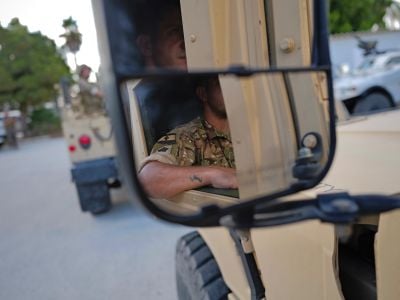
She also called on the international community to support the Lebanese Army, “sole legitimate defender of the country.” “Help them disarm Hezballah and prevent Iranian interference and dominance, and protect our Lebanese borders from Israeli invasion. Supporting the Lebanese Armed Forces should therefore not be viewed as charity or assistance. It is an investment in regional stability,” she said.
“We, Lebanese, deserve peace. A sustainable peace based on justice ... A simple [life], without fear ... A life to live. Not only to survive!” she concluded, finishing her speech with the words of former Lebanese representative to the U.N., Ghassan Tueni, spoken in 1978 before the Security Council, when southern Lebanon had just been invaded by Israel: “Let my people live!”


 8 p.m. recap: Israel again threatens Beirut’s south suburbs; 2 ships hit near Hormuz; Riyadh football matches canceled