






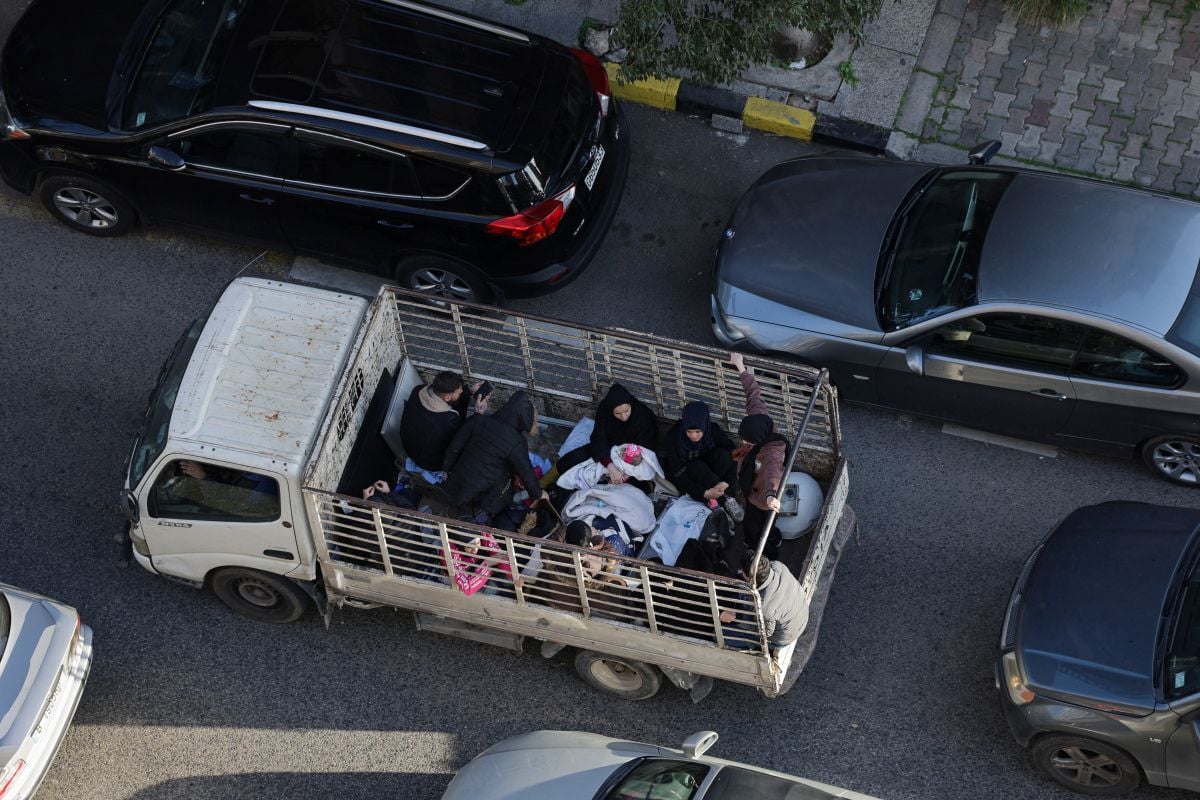
People crowded in the back of a pickup truck as road traffic intensified in Beirut after the Israeli army warned residents to evacuate the southern suburb of the city, March 5, 2026. (Credit: Khalil Ashawi/Reuters)






Beirut’s southern suburbs are gripped by fear and uncertainty. At 3 p.m. Thursday, the Israeli army called on all residents to leave their homes, after already ordering on Wednesday the evacuation of all towns south of the Litani River in south Lebanon.
In the streets of Chiyah, Burj al-Barajneh, Haret Hreik and Hadath, all in the southern suburbs, panic has set in. Residents are fleeing in whichever way they can, while others decided to stay, despite the threats.
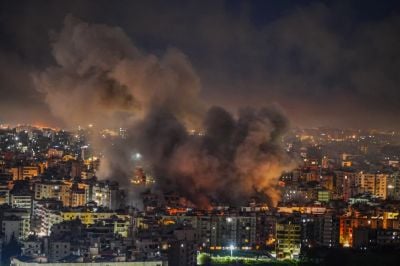
Hussein Ayash’s 73-year-old mother refuses to leave her home on AbdelKarim Street in Chiyah, one of the neighborhoods mentioned in the mass Israeli evacuation order.
“She doesn’t want to end up on the street. ‘I’d rather die at home,’ she told me,” her son told L’Orient Today.
Ayash, 35, explains that he hasn’t been able to convince her to leave. “So we’re both staying in Chiyah,” he says.
🤳 #Vidéo | Les habitants du camp de réfugiés palestiniens de Bourj el-Brajné fuient après l'ordre d'évacuation israélien. pic.twitter.com/rHEDTULcLH
— L'Orient-Le Jour (@LOrientLeJour) March 5, 2026
“We are staying. Where do you want us to go? God willing, they won’t strike us. There is nothing here,” says Sara, who lives in Burj al-Barajneh, even though yesterday’s strike on a car on the airport road occurred less than 500 meters from her home.
“You see what is circulating on social media. We are not welcome anywhere. So I prefer to stay at home,” Sara continues.
She adds that two other families have remained in the building, while one family with three children was packing their belongings to leave and “wait in their car somewhere safe.”
The building’s concierge, Mohammad, had left his two daughters with relatives in Khaldeh at the start of the war but remained with his wife in the building. On Thursday, he set off to join them. "The roads toward the South are less crowded than those heading to Beirut," he recounts along the way.
He describes panic and chaos on the roads: "It’s crazy. There’s nowhere to go. It will take hours for everyone to leave. And if the attacks start now, everyone will die."
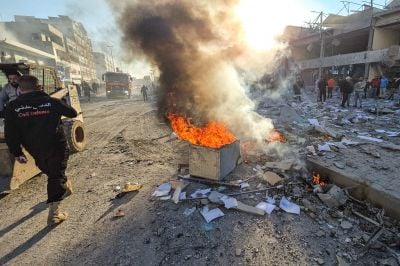
The Israeli army called, via a message from its Arabic-language spokesman Avichay Adraee on X, for the total evacuation of the Haret Hreik, Burj al-Barajneh, Hadath and Chiyah neighborhoods in Beirut’s southern suburb.
"Residents of the Burj al-Barajneh and Hadath neighborhoods: please head east, toward Mount Lebanon, via the Beirut-Damascus road," Adraee wrote on X. "Residents of the Haret Hreik and Chiyah neighborhoods: you must move north, toward Tripoli via the Beirut-Tripoli road, and east, toward Mount Lebanon, via the Metn highway," he adds.
"Any movement south could endanger your lives," he adds, emphasizing that the Israeli army "will inform them of the appropriate time to return to their homes."
Even during the 2024 autumn war on Lebanon, there had never been such a massive evacuation order covering entire neighborhoods indiscriminately.
Alya’s parents tried to leave Chiyah by car but were quickly caught in traffic jams. They had to park on the side of the old Saida road and continue on foot toward Tayyouneh, like most people had to.
The reason they didn’t leave Chiyah earlier, Alya explains, is simple: "We cannot afford to rent a house outside the southern suburb, and staying in a school hosting the displaced would be overwhelming."
The main roads around Beirut are jammed. On the Beirut-Damascus highway, a truck is carrying eight cows on its flatbed, two hearses are moving slowly, and a family — a man, a woman and four children — is riding a crowded motorcycle.
Dozens of container trucks mingle with other vehicles, while delivery workers and their wives carry pizza bags on scooters, trying to reach safer areas. Jams are also spreading on the Metn highway, as residents of the southern suburbs try to flee north or east.
On the road to Baabda, Joud Salloum, in her 20s, is with 20 members of her family. "We left in a second, with nothing. Dad went back to get Jeddo [grandpa], who refuses to leave the apartment. He’s old and there’s no elevator," she says. "We’re all preparing to go to Baalbeck."
'I always sleep with my hijab on, just in case'
In front of the Mohammad al-Amin mosque and Martyrs' Square in Downtown Beirut, traffic is completely clogged. Cars stop in improvised parking lots as two police officers struggle to manage the chaos. Through car windows, you can see the faces of terrified children.
In one pickup, babies huddle under blankets. The vehicles are crammed with whole families. "We can’t talk. We’re devastated," confided a woman.
Nazah Rmeiteh, 52, from Majadel (Sour district), is parked with six people in her car. She fled Monday morning to her in her Chiyah apartment.
"We were used to leaving for Chiyah every time there was an evacuation warning in Ghobeiri [another southern suburb]. At 3 a.m., we’d return home. Then we fled Chiyah again: the road was completely blocked," she says. "I had everything ready in the car just in case. We weren’t even scared; we just needed to grab my bag. I always sleep with my hijab on, just in case. Now, we’ll stay in the car. There’s no place to rent."
On-site are people who’ve been there for three days alongside those who have just arrived.
Abbas, 28, lives in Beirut’s southern suburbs and left everything behind when his family fled Sour. "We weren’t surprised by this order. [In the South], it’s been routine since the war. They want to put even more pressure on the resistance, for us to tell them to stop. We’re waiting," he says.
"When the bombing stops, we’ll come back. Hamdellah [Thank God], we trust in God. Even if everything is hit and destroyed, we’ll return. I didn’t take anything, just my small bag," he adds. "We hope to be back this evening, Inshallah [God willing]."
Another woman, tears in her eyes, says, "We’re in shock, I can’t talk," as her daughter sobbed in the car.
A group of Ethiopian migrant women, who worked in an office near Beirut’s southern suburb, also fled. One, age 25, says: "I saw everyone leaving, so we fled too. We’re trying to find a place to live. We’re all afraid of the strikes. I’ve lived in Lebanon for six years and worked for [the same office], but now, we’re just scared."