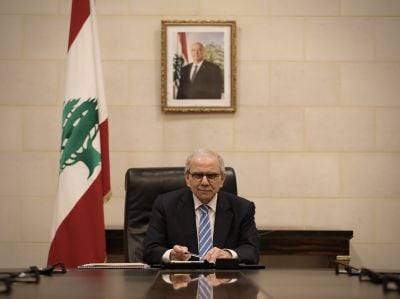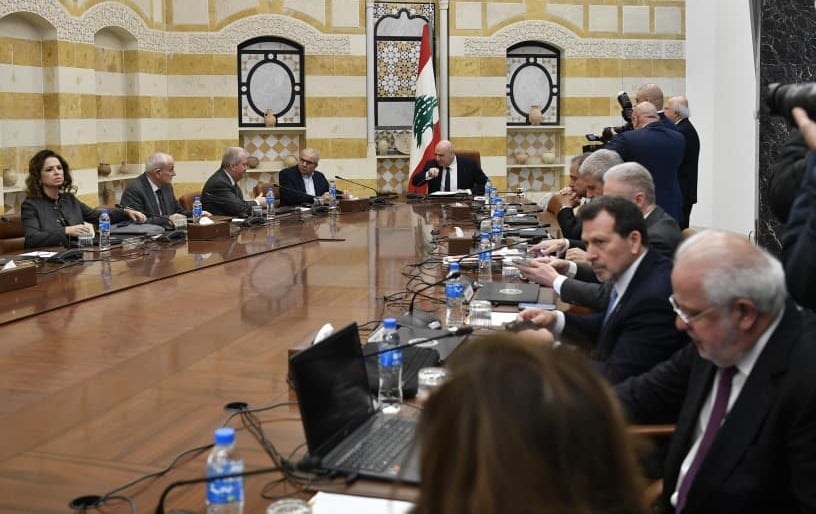
Emergency Cabinet session on March 2, 2026, after a night of Israeli strikes on Lebanon. (Credit: Mohammad Yassine/L'OLJ)






BEIRUT — The government on Monday banned all “military and security actions” by Hezbollah, a day after the party fired rockets at Haifa in northern Israel, leading to a large-scale Israeli operation against Lebanon amid its war on Iran.
Prime Minister Nawaf Salam decreed that Hezbollah must retain only its political wing and that the government now prohibits any attacks carried out from Lebanese territory, with arrests and judicial measures to follow.
L'Orient-Le Jour learned that Justice Minister Adel Nassar urged Prosecutor General Jamal Hajjar to ensure the arrests of those who launched rockets from southern Lebanon and those who ordered the attacks.
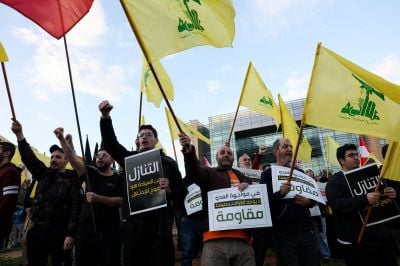
According to our information, during the several-hour session in Baabda Presidential Palace, Hezbollah — which holds two ministerial portfolios — objected to the “criticism of the resistance” contained in the text but does not intend to withdraw its ministers from the government.
A ministerial source told L’Orient-Le Jour that the session “was stormy” and marked by “almost generalized anger.”
Hezbollah’s 'illegal' activities and weapons
Reading the Cabinet’s decisions after the meeting, Salam announced his “absolute rejection, without ambiguity or possible interpretation, of any military or security action carried out from Lebanese territory outside the framework of its legitimate institutions.”
He said that “the decision of war and peace rests exclusively” with the state, "which entails the immediate prohibition of all Hezbollah’s security and military activities, considered illegal, as well as the obligation for it to hand over its weapons to the state and limit its role to political activity.”
This is intended to “enshrine the state’s monopoly over arms and strengthen its sovereignty over its entire territory,” he said.
To that end, the government asked the army and security services to “immediately take all necessary measures to prevent any military operation or any rocket or drone fire from Lebanese territory and to arrest violators.”
It also called on the army to “immediately and firmly begin implementing” its disarmament plan north of the Litani River, "using all necessary means.”

Risk of confrontation with the Lebanese Army?
The government authorized the army to use force if necessary so that the disarmament process does not take up to four months, as estimated two weeks ago by Army Commander Rodolph Haykal.
“During the discussion of this point, Gen. Haykal warned of a possible confrontation between the army and Hezbollah in the event of the use of force. But he obtained official approval to act as he sees fit,” a minister told L’Orient-Le Jour on condition of anonymity.
Lebanon also called on the guarantors of the November 2024 cease-fire — France and the United States — to “secure a clear and definitive commitment from Israel to end its attacks across Lebanese territory,” and announced that it is ready to resume negotiations on the matter “with civilian participation and under international sponsorship.”
Hezbollah’s opposition to the text
The Cabinet also asked the Social Development Ministry to provide shelter for displaced residents and supply them with food and essential needs, in coordination with the relevant ministries, the Higher Relief Committee, the Council for Development and Reconstruction, the Council for the South and the Disaster and Crisis Risk Management Unit at the Grand Serail.
According to our information, much of the session focused on debating what tone the government should adopt. Ministers from the Lebanese Forces were the main advocates of firmer language toward Hezbollah.
Despite the categorical tone of the decisions, Labor Minister Mohammad Haidar, affiliated with Hezbollah, confirmed to L’Orient-Le Jour that the group does not intend to resign from the government. “We expressed our opposition to the text, and that’s all,” he said, specifying that the objection mainly concerns the first point, which “criticizes the resistance.”
The Cabinet statement enabled the government to hold a series of diplomatic contacts with members of the Quintet, as well as other countries and the United Nations, in an effort to end the escalation. “Without this statement, no one would have even answered our phone calls,” a member of the ministerial team said.
L’Orient-Le Jour has learned that ambassadors from the Quintet countries will visit Baabda on Tuesday for talks with President Joseph Aoun to review efforts toward a ceasefire.
'The ball is now in the Lebanese army’s court,' says Geagea
The head of the Lebanese Forces, Samir Geagea, said in a statement that the Cabinet has taken “a new step toward establishing a true state.” He added: “The ball is now in the court of the Lebanese army, security forces, and judicial authorities to immediately implement the government decision.” Geagea emphasized that these institutions must promptly begin dismantling Hezbollah’s military and security structure, including the seizure of any medium or heavy weapons, wherever they are located in Lebanon.
Samy Gemayel of the Kataeb Party described the government decision as “a historic step that must be complemented by further measures.” He called for a state of emergency, the deployment of all military and security forces across Lebanon to prevent any party from dragging the country into a confrontation outside the state’s authority, and the severing of diplomatic ties with Iran, including expelling its ambassador and mission. Gemayel also urged the closure of illegal economic and financial institutions affiliated with Hezbollah to reaffirm Lebanon’s sovereignty and prevent its territory from being used as a platform for foreign interests.
In a statement, Free Patriotic Movement (FPM) leader Gebran Bassil said his party “supports the path set by President Joseph Aoun and the Cabinet’s decisions, to prevent Lebanon from entering a war that is not its own, and to complete the process of bringing weapons under the state’s monopoly.”
Walid Joumblatt, former leader of the Progressive Socialist Party, praised the government decision in a statement to An-Nahar, calling it “an excellent decision, in line with the fundamental principles of the Taef Agreement.” He recalled that the Taef Agreement “ends any armed activity outside the framework of the Lebanese state,” and said that the presence of Hezbollah members in southern Lebanon means the party “violates international resolutions and the Taef Agreement.” Joumblatt added that Hezbollah Secretary-General Naim Qassem “is out of touch, acting on Iran’s orders to the detriment of Lebanon and the Shiite and Lebanese citizen.”
He also said that “the Lebanese army has done a considerable job in the past, but it needs more support,” and criticized the postponement of the army support conference originally scheduled for March 5 in Paris, calling it “a big mistake.” When asked about the possibility of a prolonged conflict or an Israeli ground invasion of southern Lebanon, he replied: “Anything is possible.”