






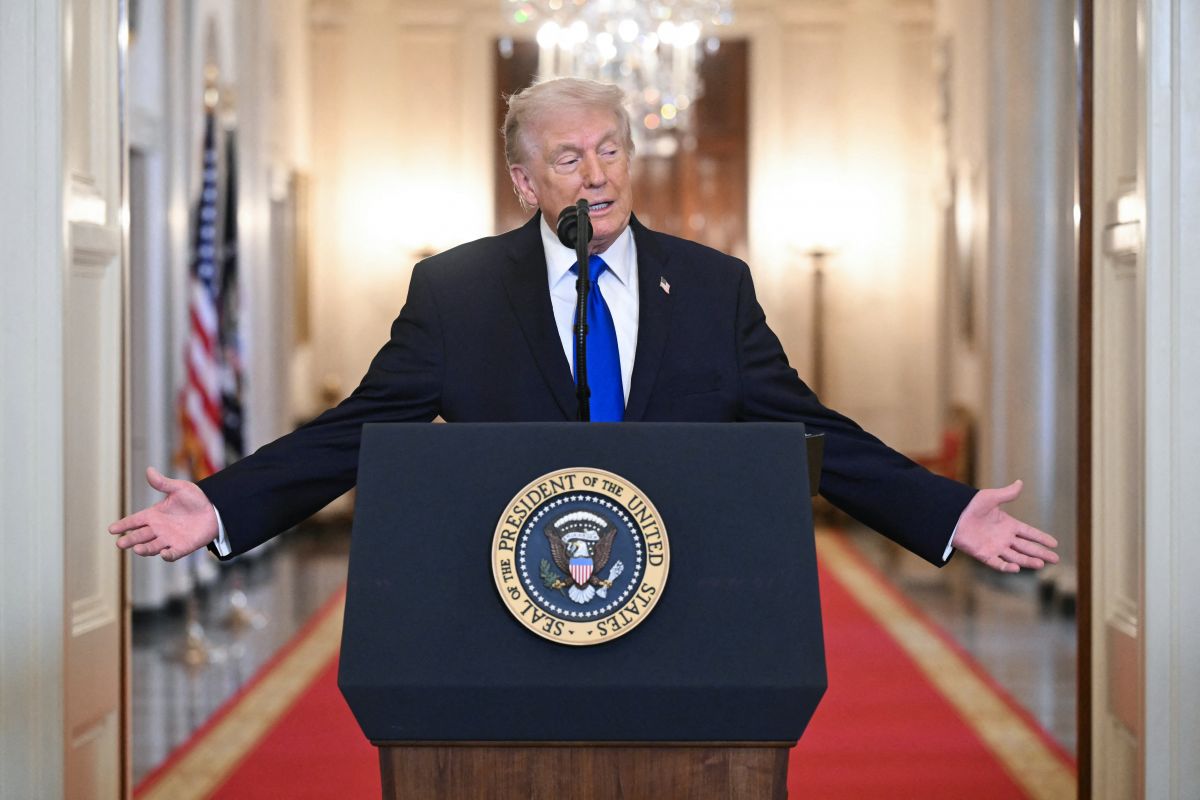
U.S. President Donald Trump speaks during the Angel Families memorial ceremony in the East Room of the White House in Washington, DC, on Feb. 23, 2026. (Credit: Saul Loeb/AFP)






Accusations by U.S. President Donald Trump that Iran will soon possess a missile capable of reaching the United States are not supported by reports from American intelligence agencies and appear "exaggerated," according to multiple sources close to the matter, casting doubt on part of his argument for a possible attack against the Islamic Republic.
In his State of the Union address delivered Tuesday before Congress, Trump began to explain to the American public why the military might launch strikes against Iran, claiming that Tehran was "working on missiles that will soon reach" the United States.
But according to sources contacted by Reuters, who requested anonymity in order to discuss sensitive intelligence, no changes have been made to a previously unclassified 2025 assessment by the U.S. Defense Intelligence Agency, which indicated that Iran could take until 2035 to develop a "militarily viable intercontinental ballistic missile" (ICBM) from its existing space launch vehicles (SLVs) used for satellite orbit launches.
One of the sources said that even if China or North Korea — who cooperate closely with Iran — provided technological assistance, Iran would probably still need at least eight years to produce "something that is truly ICBM-level and operational."
They also emphasized that they were not aware of any U.S. intelligence assessments indicating that Iran was developing a missile capable of soon reaching U.S. territory, but did not rule out the possibility that a new intelligence report could exist without their knowledge.
Trump leveled these accusations regarding Iran's ballistic capabilities while American and Iranian officials continue negotiations over Tehran's nuclear program, with no major breakthrough in sight to avoid possible U.S. strikes.
In his Tuesday speech, the U.S. president also criticized Tehran's support for armed groups in the region, such as Hezbollah, the killing of demonstrators during the crackdown in December and January, and the country's nuclear and ballistic programs, describing them as threats to the region and the United States.
Without providing evidence, he claimed that Tehran had begun rebuilding its nuclear program, asserting it had been "wiped out" by U.S. airstrikes last June on three major sites involved in uranium enrichment.
U.S. Secretary of State Marco Rubio referred to Iran's ballistic missile program on Wednesday in less categorical terms than Trump, suggesting that Tehran is "on track to be able one day to develop weapons capable of reaching the continental United States."
Iran denies wanting to acquire nuclear weapons, asserting that its uranium enrichment — a process that can produce fuel for power plants or warheads depending on its duration — is strictly for civilian use.
In an interview with India Today TV aired on Wednesday, Iranian Foreign Minister Abbas Araghchi denied that Iran was developing its ballistic capabilities.
"We are not developing long-range missiles. Their range is deliberately limited to less than 2,000 kilometers," he insisted. "We do not want this to become a global threat. We use them only for our defense. Our missiles have a deterrent role."

 8 p.m. recap: Israel again threatens Beirut’s south suburbs; 2 ships hit near Hormuz; Riyadh football matches canceled