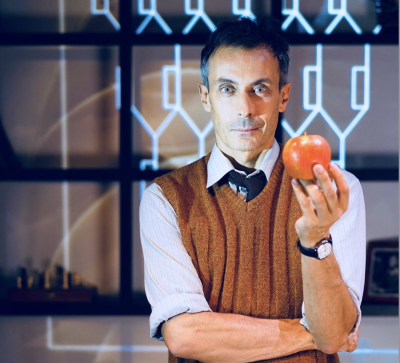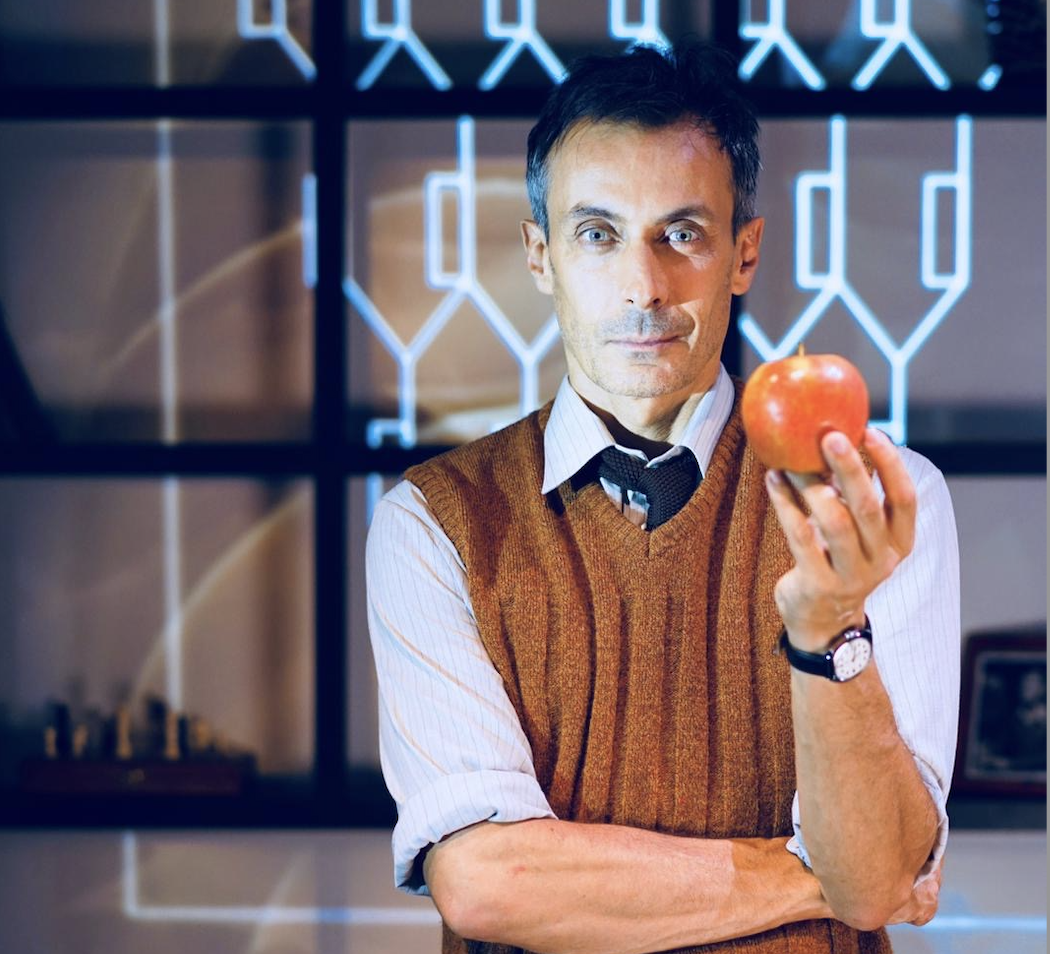
Benoît Solès in "The Turing Machine." (Credit: Courtesy of Benoît Solès)






Ahead of Francophonie Month, the Monnot Theater is decked out in French colors to welcome "The Turing Machine," a play by Benoît Solès.
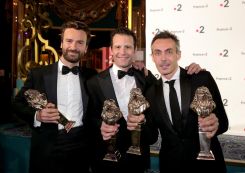
With thousands of performances, around 15 adaptations worldwide and four Molières under its belt (best private theater production, best French-speaking living author for Solès, best actor in private theater for the same and best direction for Tristan Petitgirard), the play can already be counted among the standout works of the season.
Solès became interested in Turing by chance while researching the symbolism of the apple — from Newton to Adam and Eve, passing through Snow White, all the way to the Apple logo, whose origin is still debated but could be linked to Alan Turing.
"This was in 2017, he had not yet been rehabilitated, there was not much about him online, but at least it was known that he was a visionary mathematician, a major craftsman of the Enigma codebreaking during World War II, which enabled the Allies to win.
"He is also the pioneer of computer science thought, of AI, essentially the one who laid the foundations of the modern computer.
"It is also known that he was a man condemned to chemical castration by the very country he helped save. His crime? Being homosexual.
"He ended up committing suicide by eating an apple dipped in cyanide, hence the possible connection with Apple, which was only mentioned by his collaborators after Steve Jobs' death, as he wanted to avoid offending well-thinking companies," Solès explained.
Solès’ "The Turing Machine" does not function solely as a biographical play: It stages a tense face-off. Solès himself plays a stammering, sensitive Turing at different points in his life.

Antoine Ferey, performing alongside him, takes on three different roles: the policeman, the lover and the great mathematician who will hire Turing to decode Enigma.
It is Turing against the world, thought confronting the established order, where intelligence disturbs, and difference becomes a crime.
"The show, created in June 2018 for Avignon, was, for financial reasons, formatted for two," confides Solès, who, during writing, decided to place Alan Turing face to face with the world.
"The play shows how each of these three characters, in their own way, moves from a form of fear, mistrust, even hostility towards Turing, to admiration or friendship. I believe that Turing was someone who transformed people through his intelligence, his vision and his great curiosity."
The play begins at the moment he is about to bite into the apple and functions as a narrative of his life, not chronologically, but structured around three main narrative strands: the investigation by a policeman testing whether Turing would disclose the results of his research, which he was forbidden to share; a more intimate thread about his life with his partner and what would lead to his conviction; and finally, the decoding of Enigma.
At the heart of the play is a pivotal question: that of difference, specifically homosexuality, then punishable by British law.
Genius put to the test
"The play ultimately raises questions about a page of World War II history, about the genesis of computer science, and about the history of human rights, or even the right to be different," says Solès.
"I think a major part of the play’s success is due to the emotional power felt by the audience, because there is a lot of empathy for this character of Turing, both funny and brilliant, strong and fragile. I wanted him not to be an indecipherable genius, but a man who bares himself and who, while extraordinary, never overwhelms us with intellectual superiority.
"I am convinced Turing was someone simple and likable. He always sought to understand the world, and for a mathematician at the origin of highly specialized research, there is something that borders on metaphysics; from there, we approach spiritual questions."
He, who proclaimed himself an atheist, was passionate about religions and the paranormal. "If nature has a code and mathematical sequences, then there’s a logic, so a thought and a programmer, and he wanted to know who that was," says Solès.
By crossing science, the personal and the political, "The Turing Machine" reminds us that technical progress does not necessarily accompany moral progress, and that behind every intellectual revolution there is a vulnerable being, exposed to the prejudices of his time.
Are geniuses or prophets inevitably doomed? Those who think ahead disturb. In the 1950s, when Turing spoke of a thinking machine capable of learning from its mistakes, they called him mad, but he would become the precursor to all the excitement we experience today.
"His life, his courage, are ultimately a message inviting us to be ourselves, to assert our difference. This play is an ode to the freedom of thought. When a show can accelerate lives, change decisions, that's not nothing," concludes Solès.
A success that goes beyond the theater
About his success, Solès confides that it is very moving to go from shadow to light and that he is very happy that the play is now taught to middle schoolers.
"The Molières allowed us to travel the world and keep going for years. This was totally unimaginable for us. The play arrived at the moment when it was necessary to recognize Turing; we modestly contributed to that, and I am very proud. It’s wonderful, it’s both a reward and a challenge for what comes next because you have to live up to that success."
For Solès, who came to perform "Breakup at Home" a decade ago at the Monnot Theater — also directed by Tristan Petitgirard — this visit carries considerable symbolism.
"Lebanon has a heavy ancient and recent history. At the same time, Beirut is magnificent. To come and perform this play here, which in a way speaks of resistance and resilience, of freedom, echoes profound things rooted in this wonderful country. I can’t wait for the audience to come and meet Alan, and for us to be able to connect."
Feb. 26, 27 and 28 at 8:30 p.m. at the Monnot Theater.
This article originally appeared in French on LOrient-Le Jour.