






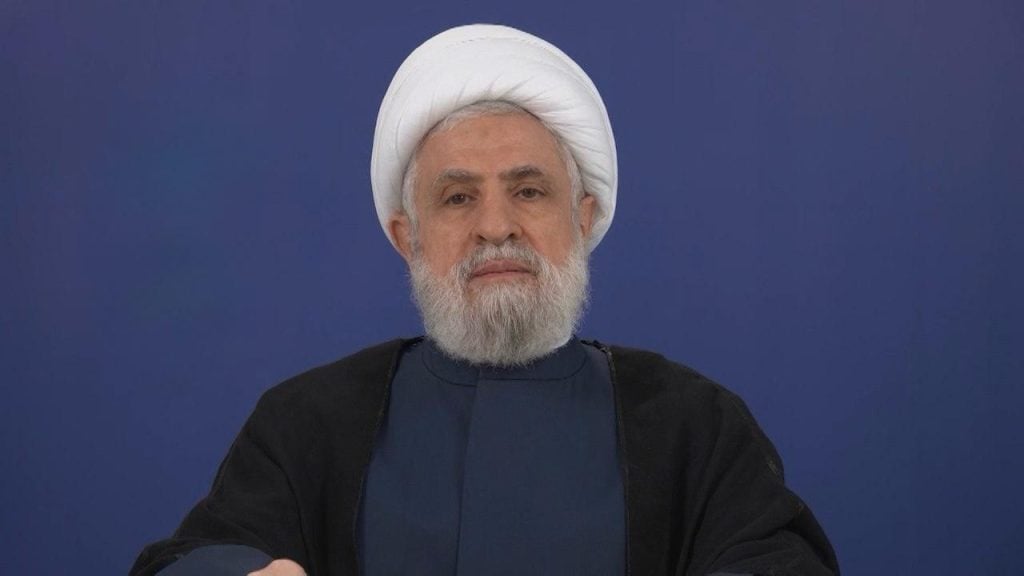
The Secretary-General of Hezbollah, Naim Qassem. (Credit: Undated photo released by Al-Manar on Feb. 23, 2026)






The Secretary General of Hezbollah, Sheikh Naim Qassem, said Monday that “the aggressive war against Lebanon is an American war,” waged by Israel “to ensure American domination.”
He denounced Israel’s desire to influence the decisions of the Lebanese state, including the decision to disarm Hezbollah, while emphasizing that the party’s “right to defense and to resistance is legitimate.”
Denouncing American and Israeli interference in the region, Qassem described the Israeli entity as an “imperialist and colonial creation, managed by the United States and serving their interests primarily.”
According to him, “the aggressive war against Lebanon is also American, conducted through Israeli crimes to ensure American domination.”
He condemned “the violation of the Nov. 27, 2024 cease-fire agreement, the continuation of Israeli aggression while applying political pressure on the Lebanese state to influence its decisions and disarm the resistance in order to eliminate it.”
For Qassem, the American strategy, summarized in U.S. President Donald Trump’s slogan “peace through strength,” is nothing but “an expression of colonialism and domination by force.”
On Feb. 16, Army Commander in Chief Rodolph Haykal presented his vision for implementing the second phase of the militias’ disarmament plan — in particular, Hezbollah's — to the Cabinet.
With the government’s approval, he set a four-to-eight-month timeline to complete this stage, which concerns the region between the Litani and Awali rivers.
By setting a deadline, the army sought to demonstrate its determination to progress on this front in the face of international pressure, especially from the United States and Israel.
However, the formula ultimately adopted also seems to have been designed to avoid an internal crisis, as Hezbollah maintains that the November 2024 agreement requires its disarmament only south of the Litani River and calls on the government to “relinquish the monopoly on weapons.”
“We seek to equip Lebanon with the tools of a strong state that holds the monopoly on arms,” said French Foreign Affairs Minister Jean-Noël Barrot on Monday.
He was referring to the conference in support of the Lebanese Army and the Internal Security Forces (ISF) planned for March 5 in Paris. Haykal and ISF chief Gen. Raed Abdallah left Beirut Monday for Cairo to attend Tuesday’s preparatory meeting for the conference.
“I know this is a difficult period, but together we have passed the stage of war,” Qassem also said. “When the time for any decision comes, we will not hesitate. Our path is clear: The land is ours, our right to defense and resistance is legitimate, and we will remain steadfast and prepared for either outcome: victory or martyrdom. There is no room for defeat, no matter the sacrifices.”
Qassem made these remarks in an interview with the news site Al-Ahed on the first anniversary of the funerals of former Hezbollah leader Hassan Nasrallah and his intended successor, Hashem Safieddine.
He reflected on the funerals of the two leaders, describing the ceremonies as “majestic,” and noting “the exceptional presence of a million people, which marked a turning point in the history of Lebanon and the region.”
These grand funerals, prepared over several weeks, took place nearly five months after massive Israeli bombings killed the two leaders, on Sept. 27, 2024, and Oct. 3, 2024, respectively, during the war between Lebanon and Israel.
Hezbollah supporters came from across the country, while thousands of others traveled from Iran, Iraq and Yemen specifically to attend the funerals in Beirut’s Sports City and pay their last respects to the deceased.
Qassem also discussed his personal relationship with Nasrallah. “I worked directly with Sayyed Hassan since 1987. We were brothers, companions in the cause. Together, we went through every stage of the resistance — its difficulties, dangers, complexities, victories and sacrifices. I lost a lot on a personal level. I lost a refuge, a guide.”
The successor to Nasrallah also asserted that “it is a very great responsibility to lead the Islamic resistance. I have not hidden that, ever since I assumed this responsibility, my love for the people has grown.”
Furthermore, Foreign Minister Joe Rajji, who is in Geneva to participate in the 61st session of the U.N. Human Rights Council, reaffirmed, during a meeting with his Russian counterpart Dmitry Lyubinsky, “the Lebanese government’s commitment to concentrating arms in the hands of its legitimate military institutions, in accordance with its decision of Aug. 5, 2025, and in compliance with the Taif Agreement and relevant international resolutions.”
He called on Hezbollah to “lay down its arms, now that a state capable of fully assuming its sovereign responsibilities exists and extends its authority over all Lebanese territory.”
He also stressed “the need to end Israeli attacks against Lebanon and the withdrawal of its forces from the points they still occupy.”

 8 p.m. recap: Israel again threatens Beirut’s south suburbs; 2 ships hit near Hormuz; Riyadh football matches canceled