


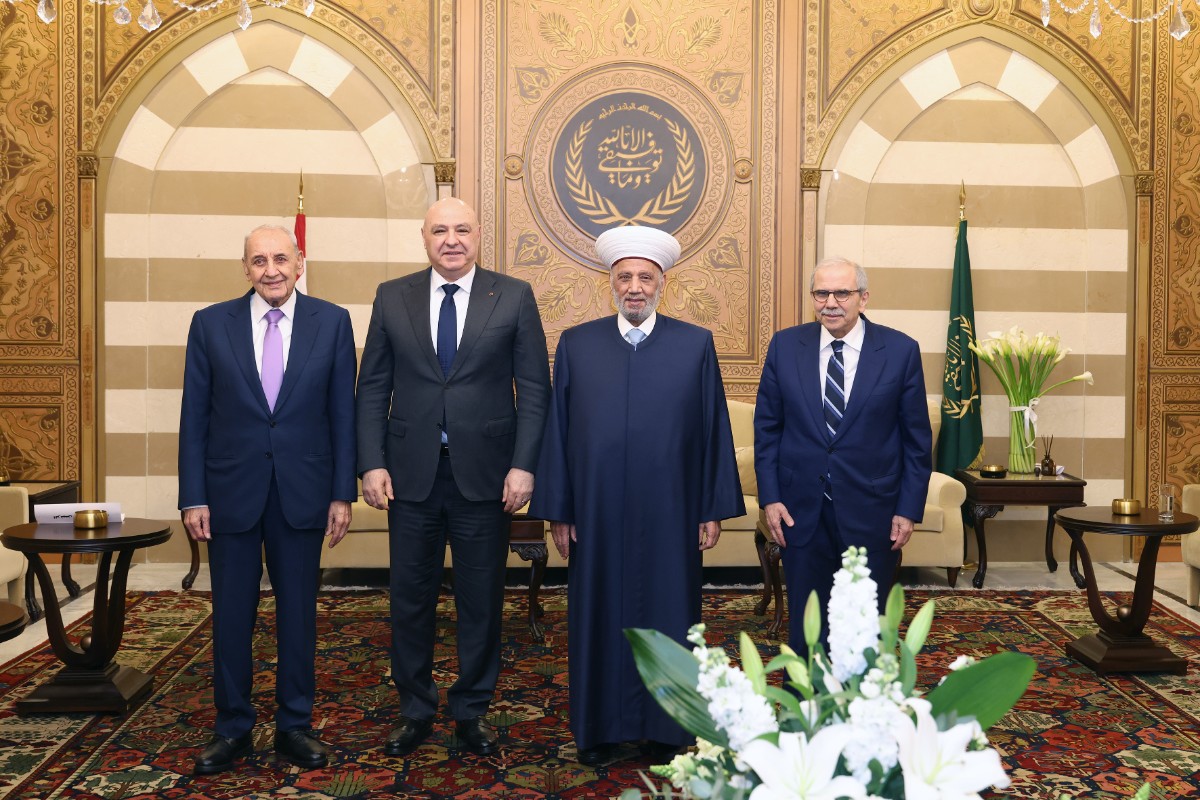
Mufti of the Republic, Abdellatif Deriane, alongside the President of the Republic, Joseph Aoun, Prime Minister Nawaf Salam, and Parliament Speaker Nabih Berri on the occasion of an iftar at Dar al-Fatwa, Feb. 19, 2026. (Credit: NNA)






BEIRUT — Lebanon’s Grand Mufti Abdellatif Derian stressed the importance of “political compromise” on Thursday evening during the annual Ramadan iftar hosted by Dar al-Fatwa, the country’s highest Sunni authority.
This call was made in front of an audience of personalities from all backgrounds, from President Joseph Aoun to former Prime Minister Saad Hariri, as well as representatives of various religious communities.
The moment came at a time when many issues are dividing Lebanese politics, such as the upcoming parliamentary elections, economic reforms and the disarmament of Hezbollah.
In his speech, Derian emphasized that "respect for the Taif Accord is a commitment to the unity of Lebanon and its Arab identity."
This accord "established the foundations of partnership and balance among all national components," he added, reaffirming that "any rescue project can only be based on the Taif Accord."
This text, signed in Saudi Arabia, ended 15 years of civil war in 1989. It provided for a better distribution of power among the various communities, notably benefiting the Sunnis.
However, many provisions of the accord, such as administrative decentralization, the creation of a Senate, and the total disarmament of militias, have so far remained dead letters. Addressing the head of state, Mufti Derian praised the start of the presidential mandate and the first year of the government, which he said broke with "the stagnation" of previous mandates, "marked by appeals for help and cries of distress and despair," in favor of a "new dynamic" and a revival of administrations.
Derian also called for prioritizing "political compromise," stating that he was addressing a president who "neither seeks nor wishes for conflict," but "always favors compromise solutions."
Aoun illustrated this approach in his handling of the issue of regaining the state's monopoly on arms, in which he favored open dialogue with Hezbollah while some parties called for disarmament by force.
According to the mufti of the Republic, the president has a "state culture" as the holder of decision-making authority, whose past absence had led "to the proliferation of weapons, the dispersion of economic decisions and multiple policies toward neighboring countries and abroad."
In this context, the Sunni religious dignitary advocated for a steadily stronger reinforcement of state authority. "A state that is strong by its decision, no matter how small, enjoys a wide margin of freedom, both domestically and in its external relations," he declared.
At the end of the event, Speaker of the Parliament Nabih Berri and former Prime Minister Saad Hariri, who withdrew from the political scene in January 2022 but temporarily returned to Lebanon for the commemorations of the assassination of his father Rafic Hariri on Feb. 14, 2005, left Dar al-Fatwa together in the same vehicle, heading to Ain al-Tineh to hold a meeting.

 7 p.m. recap: 1 person killed near border with Lebanon; 200 kilos of explosives carried by mules; Riyadh shuts its airspace