






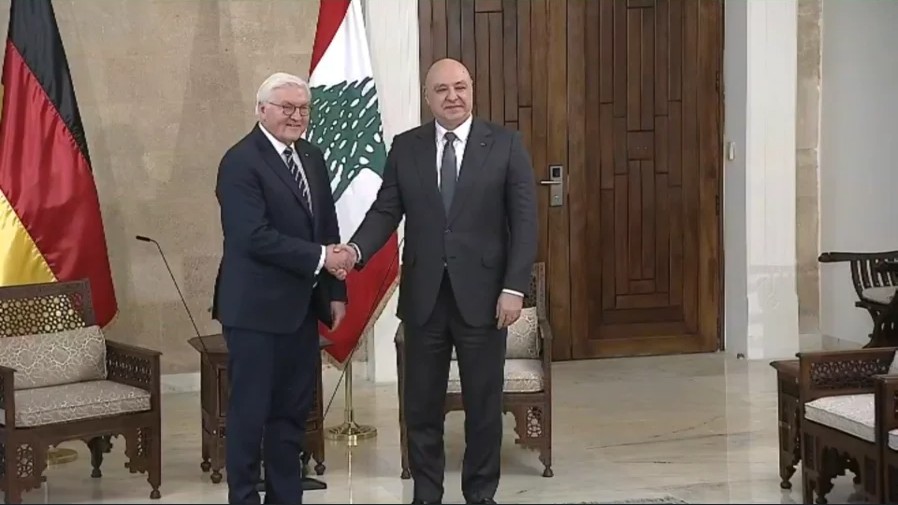
Lebanese President Joseph Aoun (right) and his German counterpart Frank-Walter Steinmeier at the Baabda Presidential Palace on Feb. 16, 2026. (Credit: National News Agency)






German President Frank-Walter Steinmeier is currently visiting Lebanon to put pressure, according to his own words, on Israel and Hezbollah to respect the November 2024 cease-fire agreement, and as a show of support for the Lebanese Army, which is expected to deploy in the South and disarm Hezbollah.
For his part, Lebanese President Joseph Aoun, the first to receive Steinmeier, emphasized that Lebanon seeks "absolute and unconditional peace."
As part of his visit to Beirut, Steinmeier met with President Joseph Aoun in the morning at Baabda Presidential Palace, where he was received with great ceremony.
After their meeting, the two heads of state held a joint press conference, during which Aoun stressed the importance of Lebanon "free itself from all occupation and all tutelage" and rebuilding "by our will, our means, and with the support of our friends."
"I tell you on behalf of all Lebanese: We can no longer bear conflicts or the burden of anyone," the president continued, alluding to the "support front" opened by Hezbollah in solidarity with Gaza, which led to 13 months of war between Hezbollah and Israel, from October 2023 to November 2024.
He also considered that Berlin could play a "key role" after UNIFIL's withdrawal. Referring to statements made by Steinmeier during his 2018 visit to Beirut, Aoun affirmed that Lebanon "insists on absolute peace, and we reject any condition, except those of law and goodness."
Strengthening the army, 'backbone' of Lebanese stability
Steinmeier, for his part, reaffirmed Berlin’s commitment to "support and strengthen" Lebanon in a "difficult security context," promising to "stand by Lebanon even after the end of the mission" of the United Nations Interim Force in Lebanon (UNIFIL).
UNIFIL is set to gradually withdraw most of its peacekeepers from the South by mid-2027, ahead of its mandate expiring at the end of the year.
In this context, "we must think about how to strengthen the backbone of Lebanon’s stability — that is, its army — once the UNIFIL mission is over," the German president added, also mentioning the current cooperation between the Lebanese Army and the German navy.
A German ship is part of UNIFIL's naval force
Beirut is seeking support for the Lebanese Army, which is struggling to recover from the devastating economic crisis of the past six years, even as it is expected to deploy thousands of soldiers to southern Lebanon and disarm militias, primarily Hezbollah.
In this context, an international conference in support of the military institution is scheduled for March 5 in Paris.
Steinmeier further clarified that his visit to Lebanon is meant to "ask Hezbollah and Israel to respect the cease-fire agreement," insisting that "the disarmament of Hezbollah must proceed gradually" and on the withdrawal of Israeli troops from southern Lebanon, where they still occupy several positions.
During his visit, the German president also met with Parliament Speaker Nabih Berri and Prime Minister Nawaf Salam. Berri stressed "the need for the international community to redouble its efforts to compel Israel to cease its aggression and violations of Resolution 1701 and the cease-fire agreement reached in November, an agreement with which Lebanon has complied fully from the outset."
He affirmed that "Lebanon and the Lebanese people do not want war, will not accept the Israeli occupation of their land, and cannot yield to the pressure of daily violations and aggression." For his part, Steinmeier reiterated "Germany's continued support for Lebanon in all areas and its commitment to stand by the country, while rejecting the Israeli occupation of Lebanese land."
Discussions between Salam and Steinmeier focused "on the progress of administrative and financial reforms undertaken by the government, as well as on the process of state monopoly on weapons. The post-UNIFIL phase was also discussed," the Grand Serail said on X.
Steinmeier's tour also includes visits to the port of Beirut, the National Museum, and the Naval Academy in Jounieh.