





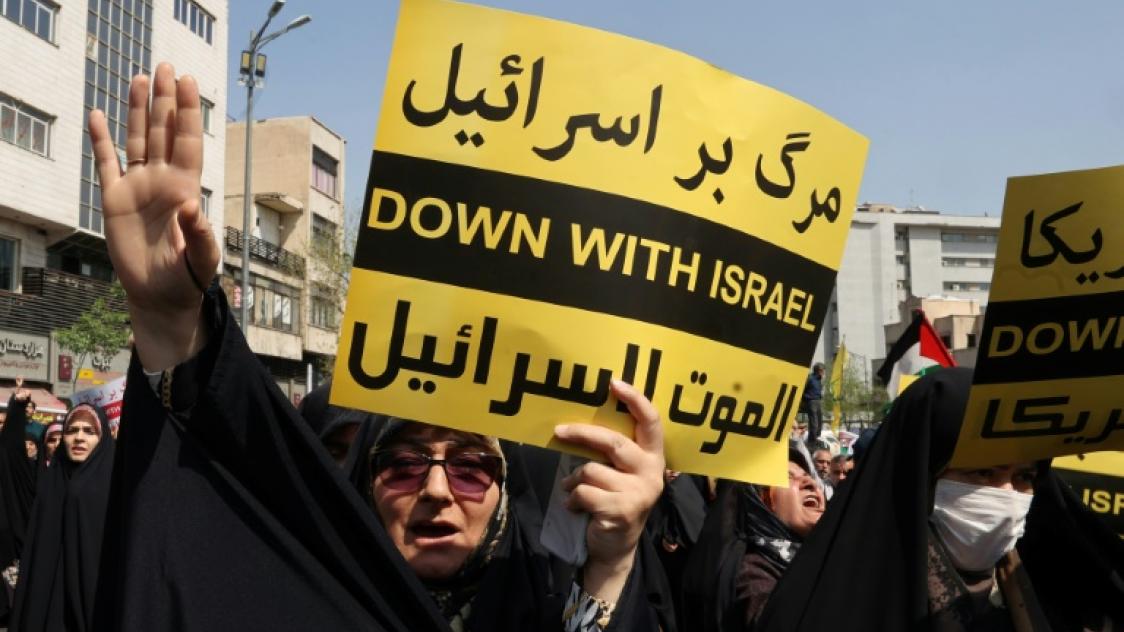
A woman takes part in an anti-Israel protest in Tehran, on April 19, 2024. (Credit: Atta Kenare/AFP)






What do Arab citizens think about recognizing Israel? According to a survey published Tuesday by the Arab Center for Research and Policy Studies, 87 percent are opposed to it.
The poll surveyed 40,130 respondents across 15 countries: Algeria, Egypt, Iraq, Jordan, Kuwait, Lebanon, Libya, Mauritania, Morocco, Palestine, Qatar, Saudi Arabia, Sudan, Syria and Tunisia. The results, released by the Washington-based institute, point to a steadily deteriorating image of Israel in the region, including in countries that signed the 2020 Abraham Accords normalizing ties with the state.
The findings come against the backdrop of the Gaza war, which has thrust the Palestinian issue back to the forefront of public debate across several Arab countries, including those engaged in normalization processes.

The Arab Center has tracked these viewpoints since 2011. In Morocco, for example, 20 percent of the population supported recognizing Israel in 2022 and 2023, after Rabat signed the Abraham Accords on Dec. 22, 2020.
In 2024 and 2025, that figure dropped to 6 percent following the Oct. 7 attacks and the war in Gaza that followed. While normalization has advanced at the state level, including Israel’s recognition of Morocco’s sovereignty over Western Sahara in July 2023, public opinion continued to move in the opposite direction.
Sudan, which also signed the accords in January 2021, shows a similar trend. After fluctuating between 13 percent and 23 percent in surveys between 2012 and 2023, the percentage of those supporting recognition of Israel fell to 7 percent, according to the report.
In Saudi Arabia, where the Gaza war complicated any prospect of normalization, opposition reached 61 percent in 2024 and 2025, the lowest level among the countries surveyed. By comparison, opposition stands at 89 percent in Lebanon and 96 percent in Libya.

In Syria, despite official talks between the new authorities and Israeli officials, 70 percent of Syrians surveyed oppose any agreement with Israel without the prior return of the occupied Golan Heights. The 1,200 square kilometer territory was captured by the Israeli army in 1967 during the Six-Day War and annexed in 1981.
In addition, 88 percent of Syrians believe Israeli policies threaten their country’s stability, as Israel carried out numerous strikes in Syria, including on the capital Damascus, and expanded its control over parts of the Golan following the fall of former President Bashar al-Assad.
Palestine, ‘a collective Arab cause’
The 15 countries surveyed are largely united in opposing recognition of Israel and also broadly aligned in their support for the Palestinian cause. Eighty percent of respondents view it as a collective Arab cause.

In Lebanon, however, 29 percent of those surveyed believe the Palestinian cause primarily concerns Palestinians themselves, the highest share among the 15 countries studied. These figures may reflect the fallout from Hezbollah’s support front with Hamas during the latest war, as well as the legacy of Lebanon’s 15-year civil war from 1975 to 1990, during which Palestinian fighters and Lebanese militias clashed.
The study also highlights the psychological toll of the Gaza war. Since the war began, 87 percent reported feeling psychological stress as a result, and 70 percent reported closely following developments.
Israel seen as the main threat
The context of Israel’s military campaign is also shaping security perceptions across the region. In the Levant countries surveyed Iraq, Jordan, Lebanon, Palestine and Syria 53 percent of respondents view Israel as the primary threat to national security. Across the 15 countries polled, 44 percent identify Israel as the greatest threat to the Arab nation, ahead of the United States at 21 percent and Iran at 6 percent.
Asked why they hold this view, 31.5 percent say Israel is a colonial state occupying Palestine. Another 13.3 percent cite what they describe as its expansionist character and its ambition to dominate Arab countries and control their resources. Overall, 84 percent of respondents believe Israeli policies threaten the stability of the Arab world. That figure is higher than the share who see Iran as a threat at 53 percent or Russia at 48 percent and even slightly above the U.S. at 77 percent.
This article was originally published in French in L'Orient-Le Jour and was translated by Sahar Ghoussoub

 7 p.m. recap: Iran warns Egypt, Israeli soldiers vote in south Lebanon, Haret Hreik responds to Kataeb