


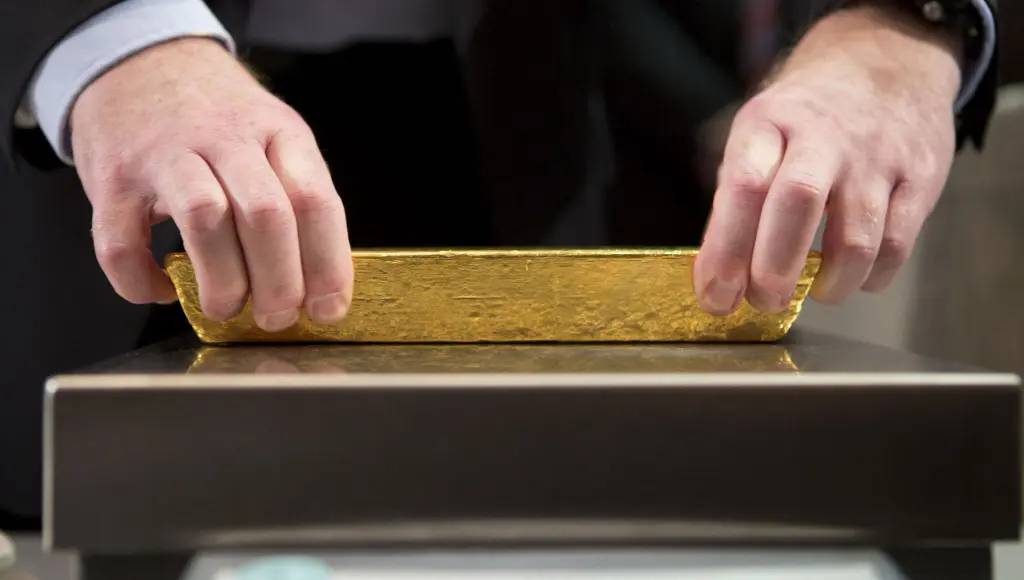
An employee puts a bar of gold on a scale. (Credit: Frank Rumpenhorst/AFP)






Lebanon is often described as a country in financial ruin, a collapsed economy with few remaining resources and no credible path to recovery. Yet Lebanon still holds one of the world’s most extraordinary concentrations of gold reserves relative to the size of its economy.
If Lebanon holds such a large pool of value, why has it not translated into financial stabilization or credible recovery planning?
At the current gold price hovering around $5,000 per ounce, Lebanon’s official gold holdings of approximately 286.8 tons are worth $47 billion. Using a nominal Lebanese GDP of $35 billion, this implies that Lebanon’s gold stock alone is equivalent to approximately 134 percent of its GDP.
In other words, Lebanon is not “asset-poor.” It is “governance-poor."

A ranking that puts Lebanon in a category of its own
To put Lebanon’s gold position in perspective, few countries, whether advanced economies, major emerging markets, or distressed sovereigns, come close to Lebanon’s gold-to-GDP ratio
This ranking highlights a striking point: Lebanon’s gold ratio is not merely high, it is extreme.
Even countries that are considered “gold-heavy” by global standards, such as Russia, Turkey and Kazakhstan, remain far below Lebanon when gold is scaled relative to GDP**.
How Lebanon compares to peer groups
Advanced economies typically hold gold equivalent to single-digit percentages of GDP, with an estimated average of 6 percent. This is mainly driven by historical reserve accumulation rather than current policy.
Large emerging economies may hold significant gold in absolute terms, but their GDP bases are much larger, putting their average at 3 percent.
Even countries rated B/B- or worse, including stressed sovereigns, rarely show extreme gold-to-GDP ratios, with an estimated average of 2.5-3 percent.
Gold is not the problem; governance is
If Lebanon holds such a large pool of value, why has it not translated into financial stabilization or credible recovery planning?
The answer lies not in the size of the asset, but in the lack of a credible framework to deploy it. Lebanon’s gold is subject to legal and political constraints, and attempts to treat it as a quick fix have repeatedly collided with public mistrust and institutional paralysis.
Gold cannot compensate for the absence of fiscal discipline and the failure to execute various financial and governance reforms, including restructuring banking liabilities transparently. Parliament has yet to approve a coherent national recovery program since it blocked the Lazard plan in 2020 and pre-empted Saade Chami’s plan before it was even submitted.
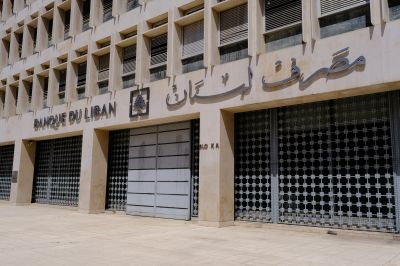
When managed properly and deployed within a legally protected and economically sound structure, gold could become a confidence anchor, not a “cash machine.”
A strategic asset, not a liquidation plan
The key policy debate should not be framed as “sell the gold” versus “never touch the gold.” That binary and narrow-minded thinking is destructive.
Instead, Lebanon needs to explore whether gold can be used intelligently, as part of a broader reform package. It has the potential to strengthen confidence, trigger a major economic recovery, attract major direct investment, reduce perceived sovereign risk, and anchor instruments that require credibility to trade.
This can be done without selling the gold but by using it as limited collateral or credit enhancement to support a recovery instrument, by placing part of it into a legally ring-fenced gold trust with independent oversight, or by structuring asset-backed securities linked to central bank assets where gold would serve as a credibility anchor rather than a source of spending.
Among the options that can also be explored is to link any orderly use of gold to a program to return part of the deposits of small and mid-sized depositors up to a ceiling of $1 million per depositor.
Beneficiaries would then be conditioned to direct a meaningful share of the recovered amounts into productive investments inside Lebanon led by the private sector, like electricity generation and energy projects. This would extend the benefits to the Lebanese economy as a whole, not depositors alone.
Under this cap, this could mean settling the claims of around 99 percent of depositors (by number).
Any solution of this kind, however, must be embedded within a comprehensive governance framework that ensures transparency, oversight and fairness, especially with respect to depositor losses and asset allocation.
Lebanon’s gold reserves represent one of the most powerful financial asymmetries in any emerging market today: a nation with a collapsed banking system and weak institutions, yet holding gold worth more than its annual economic output.
That paradox is the story.
Lebanon’s crisis is not defined by the absence of resources, but by the failure to govern, structure and deploy them in a credible recovery plan.
* Saeb El Zein is a former hedge fund manager and investment banker based in Dubai and London
** Below is a simplified ranking of gold reserves as a percentage of GDP, using official gold holdings and nominal GDP comparisons. Lebanon’s GDP is fixed at $35 billion for comparability.
| Rank | Country | Gold Reserves / GDP |
| 1 | Lebanon | 134 percent |
| 2 | Libya | 49 percent |
| 3 | Uzbekistan | 38 percent |
| 4 | Venezuela | 33 percent |
| 5 | Kazakhstan | 16 percent |
| 6 | Russia | 15 percent |
| 7 | Algeria | 10 percent |
| 8 | Qatar | 8 percent |
| 9 | Turkey | 7 percent |
| 10 | Egypt | 5 percent |
| 11 | South Africa | 5 percent |
| 12 | Saudi Arabia | 4 percent |
| 13 | India | 3 percent |
| 14 | Pakistan | 3 percent |
| 15 | UAE | 2 percent |
| 16 | China | ~2 percent |
| 17 | Argentina | ~1.5 percent |
| 18 | Brazil | ~1 percent |
| 19 | Mexico | ~1 percent |
| 20 | Indonesia | <1 percent |