





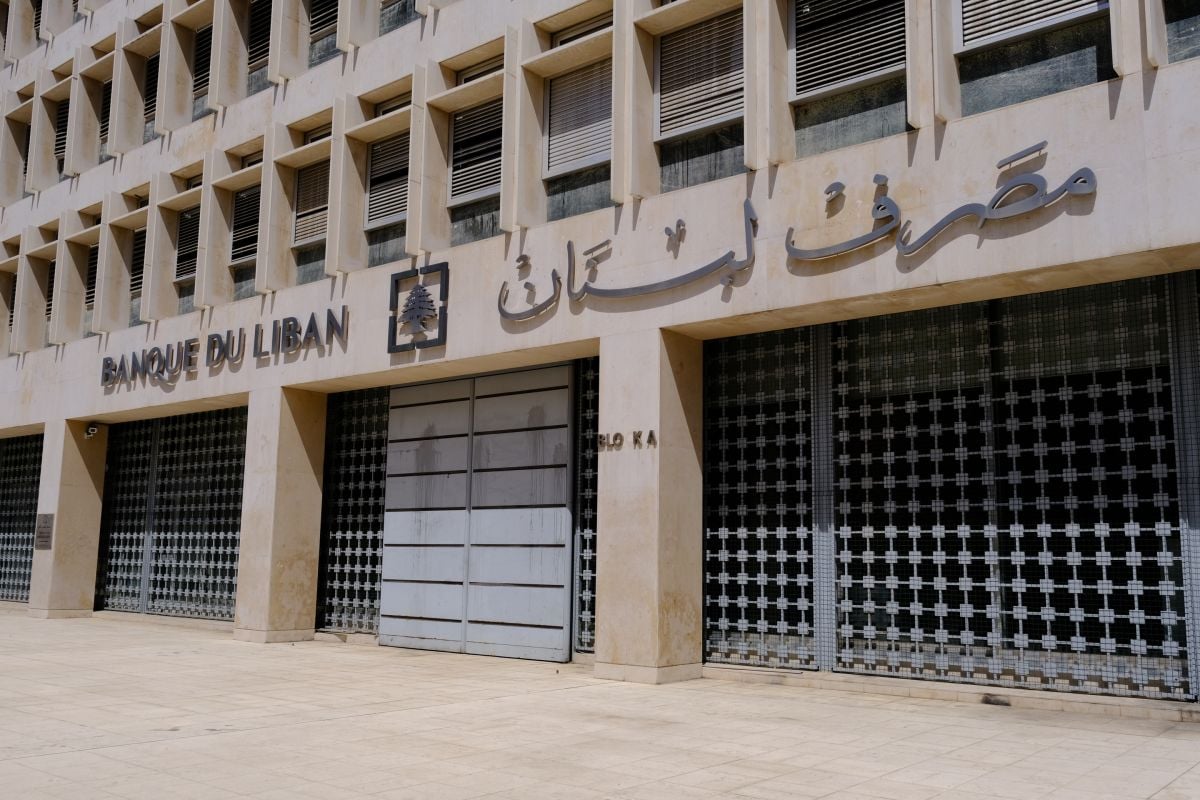
The facade of the Central Bank, in the Hamra neighborhood, in Beirut. (Credit: Fouad Gemayel)






Cabinet has adopted a new draft law on Financial Stability and Deposit Recovery, commonly referred to as the “Financial Gap Law.”
Given the centrality of the issue to Lebanon’s crisis, the draft must be judged by whether it can serve as a credible foundation for reform and for restoring international confidence and support.
A formal framework is a welcome and necessary step. The draft reflects an attempt to navigate political resistance through strategic ambiguity. However, any serious effort must confront difficult trade-offs — between speed and accuracy, fairness and feasibility, immediate relief and long-term sustainability.

Despite its shortcomings, the draft should be improved rather than killed outright as some powerful economic groups have been calling for. The Association of Banks and the Lebanese Business Association, along with politicians motivated by approaching elections, have launched vehement attacks aimed at discrediting the draft. The same political-financial nexus that helped produce the crisis appears once again determined to block reform, regardless of the national cost.
Crisis resolution requires burden sharing. Banks cannot continue to oppose every reform to shield what remains of their capital, in defiance of international resolution standards. Businesses must engage constructively, not only out of social responsibility but also because economic recovery is in their direct interest. Depositors, painful as it is, must accept that not all deposits can be recovered at full real value. The Central Bank and the government must be fully aligned to secure an International Monetary Fund (IMF)-supported program.
Progress will not come easy. It will require a reform-minded coalition capable of improving the law and mobilizing political support for its adoption in Parliament. Without organized and sustained pressure of this kind, the draft risks meeting the same fate as previous reform efforts.

A framework to build on
The draft deserves recognition for imposing structure and moving the debate forward. It seeks to introduce accountability — though this could be strengthened — and to penalize those who benefited from the crisis. As in the previous government plan, it aims to protect small depositors and respect the hierarchy of claims, although this should be stated more explicitly to avoid misinterpretation.
The draft, which initially appeared to be fully owned by the team, was later undermined by a public statement from the central bank challenging key components of the proposal. This revealed a split within the group that had been concealed for some time. Although the central bank’s concern about liquidity constraints is valid, the argument that bank capital should not be touched before irregular accounts are addressed runs counter to international norms and is likely to be challenged by international partners, including the IMF.

Absence of numbers
The most conspicuous weakness of the draft law is the absence of numbers. A law addressing the collapse of a financial system cannot be meaningfully assessed without a quantitative backbone. If not embedded in the law itself, such figures should at least appear in an accompanying document to anchor the public debate.
Even under conservative assumptions, long-term instruments imply very large implicit haircuts. Softening this reality — whether for political convenience or to avoid confrontation — cannot form the basis of durable reform. Transparency is essential for restoring credibility and rebuilding trust; officials should therefore exercise caution when asserting that deposits will be returned “in full.”
The draft neither quantifies the financial gap nor clarifies how losses would be shared among banks, the central bank, the State, and depositors. It also fails to identify the resources available to meet its commitments. Although a full audit is warranted, it will take time — especially as reputable international firms continue to de-risk from Lebanon. The draft could have relied on existing central-bank figures as a provisional basis, to be refined once audit results become available. Excluding interim estimates risks turning delay into policy.

The draft further complicates matters by leaving unresolved the central bank’s claim on the State, estimated at $16.5 billion. Deferring this issue creates a major analytical gap. If such claims were recognized, even partially, they would weigh heavily on debt sustainability and could undermine the prospects for an IMF-supported program.
Liquidity constraints
The draft commits to repaying deposits of up to $100,000 over four years and to addressing larger deposits through long-term securities with maturities of 10 to 20 years. Both commitments are highly liquidity-intensive.
The liquidity required to honor these commitments far exceeds what the system can realistically mobilize. Usable foreign-exchange reserves are limited once government funds and prudential buffers are excluded. Commercial banks face similar constraints, with usable liquidity far below what would be required.
One could argue that liquidity pressures will ease as the rush to withdraw deposits diminishes and confidence gradually returns.

Although this argument has some merit, it is highly optimistic within a four-year horizon. Moreover, relying on future IMF financing to ease liquidity constraints would be misplaced: IMF and partner financing cannot be used to bail out depositors, and even if money is fungible, any program would require rebuilding net foreign assets, further limiting available liquidity. An accelerated repayment schedule that cannot be sustained risks eroding credibility and worsening outcomes.
It was not without reason that the previous government draft envisaged a longer repayment period for smaller depositors, reflecting binding liquidity constraints. That approach was more realistic than the shorter timeline presented as an improvement over the previous draft. An even more delicate political choice would be to apply upfront reductions reflecting present-value losses — more appropriate in insolvency cases.
Long-term securities and their backing
If liquidity is the binding constraint for smaller deposits, credibility becomes the binding constraint for larger ones. That credibility depends on whether long-term instruments are genuinely backed by identifiable assets and reliable cash flows.
Spreading repayment over time is common in financial crises, often reflecting political constraints rather than economic optimality. In insolvency cases such as Lebanon’s, however, flow-based solutions imply large net-present-value losses and delayed adjustment. From a transparency standpoint, upfront recognition of losses would be cleaner — though politically difficult.
References to gold are particularly ambiguous. While the draft refers to revenues generated from gold, it does not explain how such revenues would be generated. Public statements ruling out the sale or mortgaging of gold sharpen this contradiction, given that gold represents the bulk of the central bank’s assets. This ambiguity weakens the economic value of the proposed securities and is likely to result in steep discounts in secondary markets.
Given the draft’s reference to the State’s obligation to recapitalize the central bank, these instruments amount in substance to sovereign obligations, with direct implications for public debt and IMF negotiations.
A more sensible approach would be to first determine how much support the State can realistically provide to the central bank without undermining debt sustainability. That assessment would establish a ceiling within which remaining losses could be allocated among other stakeholders. Such decisions must be embedded in a broader macroeconomic framework.
The omission of bail-in
The draft entirely omits a bail-in mechanism, under which large deposits would be converted into bank equity. Bail-in mechanisms reduce liquidity needs, facilitate recapitalization, and allow large claimants to share in any upside if reform succeeds. Their omission appears driven by sectarian sensitivities related to bank ownership. More legitimate concerns — such as depositor participation in governance — could have been addressed through alternative equity structures such as non-voting or differentiated share classes. At a minimum, depositors should have been offered a choice between long-term instruments and equity-linked participation.

Continuity and Parliament
Claims that the current draft is the first serious attempt to address the financial gap are misleading. Two detailed plans were previously prepared but blocked by the political-financial nexus. Acknowledging this continuity would strengthen — not weaken — the credibility of the current effort, especially since the draft borrows from earlier proposals. One notable difference is that the earlier plan protected the deposits of large syndicates and key social institutions, which represent pooled savings of thousands of beneficiaries who would individually qualify as small depositors.
The real test now lies in Parliament. Electoral dynamics and vested interests may either block the law or dilute it to the point of losing international support. With elections approaching, incentives to avoid difficult choices are strong, making reform harder precisely when it is most needed.
In Lebanon, demanding reforms tend to advance more under sustained external pressure, as the passage of the banking secrecy amendments illustrates. Whether similar pressure can be mobilized now is uncertain. With elections approaching and populist rhetoric rising, political incentives favor avoiding difficult distributional choices, making policymakers less responsive to external leverage. As a result, external pressure — normally a key catalyst for reform — may be weakest precisely when it is most needed.
The draft law deserves recognition for imposing structure and moving the debate forward. Yet its strategic ambiguity reflects an attempt to postpone difficult choices rather than resolve them. The depth of Lebanon’s crisis demands realism, clarity, and political courage.
The law should be amended to restore credibility, clarify responsibilities, and ensure implementability. At a minimum, this requires defining a sustainable State contribution, integrating it into a transparent assessment of losses, addressing liquidity constraints explicitly, and clarifying how assets will back long-term instruments.
This will not be easy. It will require a coalition of reform-minded professionals, parliamentarians, constructive elements within the banking and business communities, depositors, and civil-society actors capable of exerting sustained pressure on decision-makers and counterbalancing organized special interests. It will be an uphill battle but one worth waging. The alternative would mean deeper losses and further hardship.

 Midday news recap: Hebron attack sparks Israeli crackdown, international meeting in Istanbul for regional 'de-escalation'