






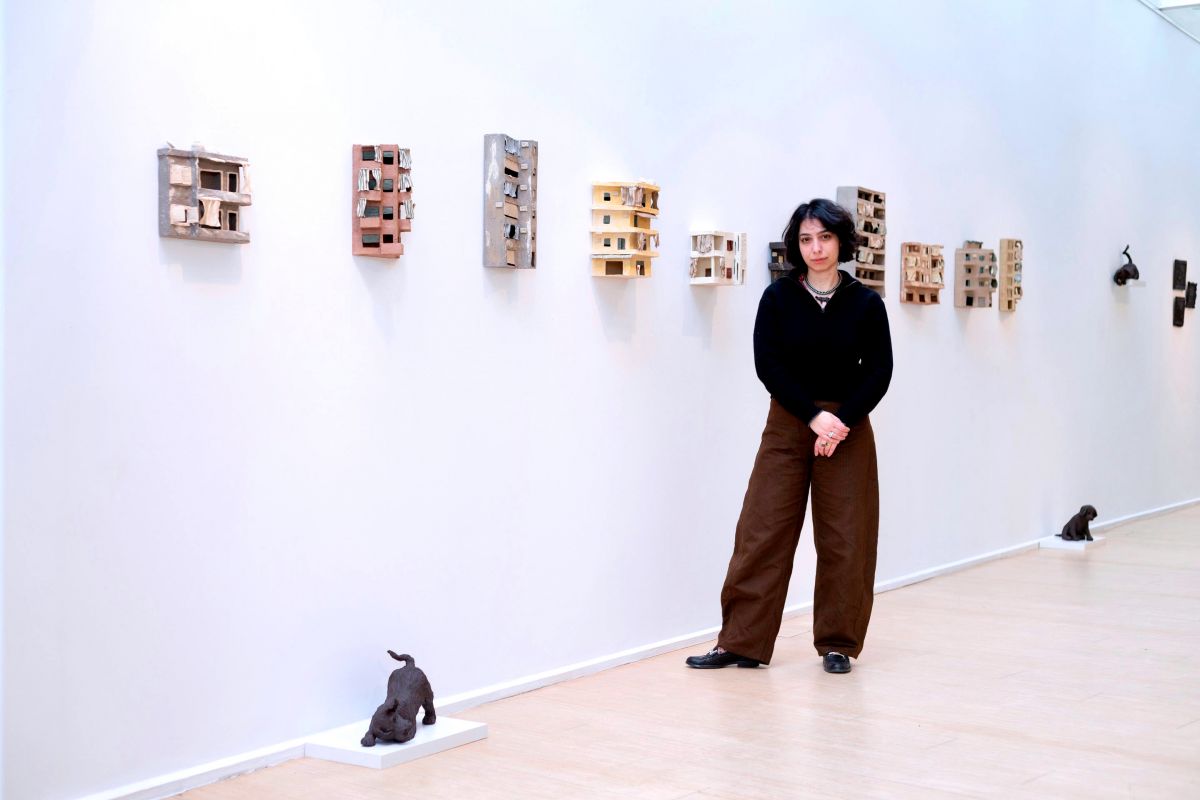
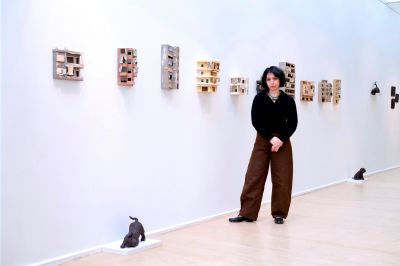
Diana Bou Salman at the Janine Rubeiz Gallery, where her exhibition "Shadows and Shelters" is being held until Feb. 28. (Credit: Photo provided by the Janine Rubeiz Gallery)






She draws you quietly into her world. Between urban architectures and animal figures, a sensitive universe where clay, shaped by bare hands and transformed into small sculptural pieces, expresses her longing to reconnect with Lebanon.
Born in France in 1997 to two Lebanese parents, Diana Bou Salman grew up, like many Franco-Lebanese, straddling two countries, two cultures, two allegiances. "Like many expatriate families, we traveled to Lebanon every year," she says.
These regular returns, beneath the happy glow of summer vacations, exposed her to a country scarred by war and subject to periodic destruction.

She then found her calling as an architect. "In a very naive way, I got into studying architecture with the idea that Lebanon, perpetually at war, was in constant need of rebuilding," she confides to L’Orient-Le Jour.
'This heap of memories'
Enrolled at Paris Malaquais, it was through her passion for building architectural models that she began working with ceramics in 2019, entirely self-taught.
After earning her master's in architecture, she specialized in exhibition design in 2021 and occasionally led production workshops at architecture schools.
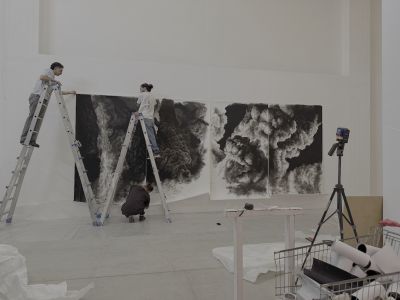
Meanwhile, she devoted herself to working clay, driven by a need for materiality that allowed her to ground these "heaps of memories of Lebanon" that inhabit a corner of her mind.
"I've carried those images for a very long time and wanted to express them as honestly as possible," she says.
She found "in ceramics, a medium that symbolizes the connection to the earth and takes form quite quickly, without using molds, to capture memories on the spot."
This practice quickly became central to the young visual artist. She presented a particularly convincing first sample of her work at "Encounters," the group exhibition dedicated to emerging talents and organized by the Janine Rubeiz Gallery in Beirut in 2023.
There, she unveiled "Collectibles," a series of 25 ceramics, miniature reproductions of everyday Lebanese objects, from wicker baskets and figs to tires and plastic chairs, which to her symbolize the artifacts of her Lebanese identity.
Balcony curtains, stray cats and roaming goats
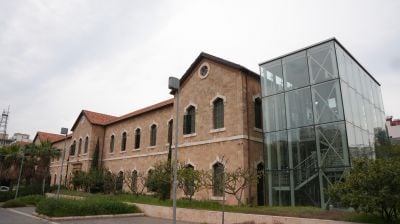
After this first exploration of the relationship between objects, identity, and heritage, she returned to the Janine Rubeiz Gallery with a solo exhibition titled "Ombres et abris"* ("Shadows and Shelters"), featuring ceramic works still fed by the soil of her identity explorations, but developed this time as a journey through "the city, the mountain, and the sea."
These are the three chapters of her connection to Lebanon. She translates them into three-dimensional architectures and animal figures, in small formats, presented in a delicate, sometimes unexpected display, forming a sequence that conveys a certain image of Lebanon.
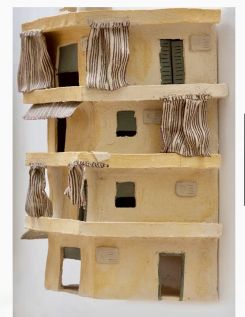
Thus, as fragments of a miniaturized Beirut, her small yellow stone buildings, hung on a gallery wall, reveal through their striped balcony curtains — often faded, sometimes torn (crafted with impeccable realism) — something of the lived violence and abandonment typical of the Lebanese capital.
Arranged directly on the floor beneath this row of suspended urban facades, a few stray cats made of gray stoneware lounge or stand on alert, radiating a familiar yet unsettling presence charged with a trembling tension.
In a nearly secluded corner, a patinated stoneware tableau offers a silent, haunting vision of an urban terrace, both inhabited and devoid of any human presence.
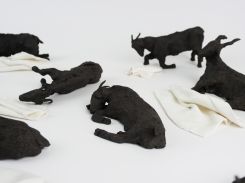
A bit further, on a display table, a herd of goats scatters freely, without any shepherd, illustrating a Lebanese mountain more authentic and original than the usual panoramas of peaks, cedars and pine forests to which it is often reduced.
The same goes for the enameled ceramic mural representing the sea, envisioned as a space open to other horizons.
Drawn from the images that inhabit her, all these ceramic pieces form the fertile ground of her exploration, through kneading the clay, of her link to Lebanon.
Balancing an underlying sense of abandonment and the search for shelter, this young artist conceived a land like an alter ego. She, like many binational Lebanese of her generation born abroad, sometimes wrestles with the feeling "of not truly belonging to either country."
By summoning into her work seemingly ordinary elements, which she shapes "to spotlight what surrounds us and therefore helps shape us," Bou Salman composes a work full of "stories, narratives that can speak to people, fuel their imagination and help them rediscover that sense of belonging that is so essential to every human being."
Bou Salman, unable to rebuild Lebanon, has built her entire oeuvre around it.
*"Ombres et abris" by Diana Bou Salman, on view until Feb. 28 at the Janine Rubeiz Gallery, Raouche, Majdalani Building
This article was translated from L'Orient-Le Jour.

 8 p.m. recap: Israel again threatens Beirut’s south suburbs; 2 ships hit near Hormuz; Riyadh football matches canceled