





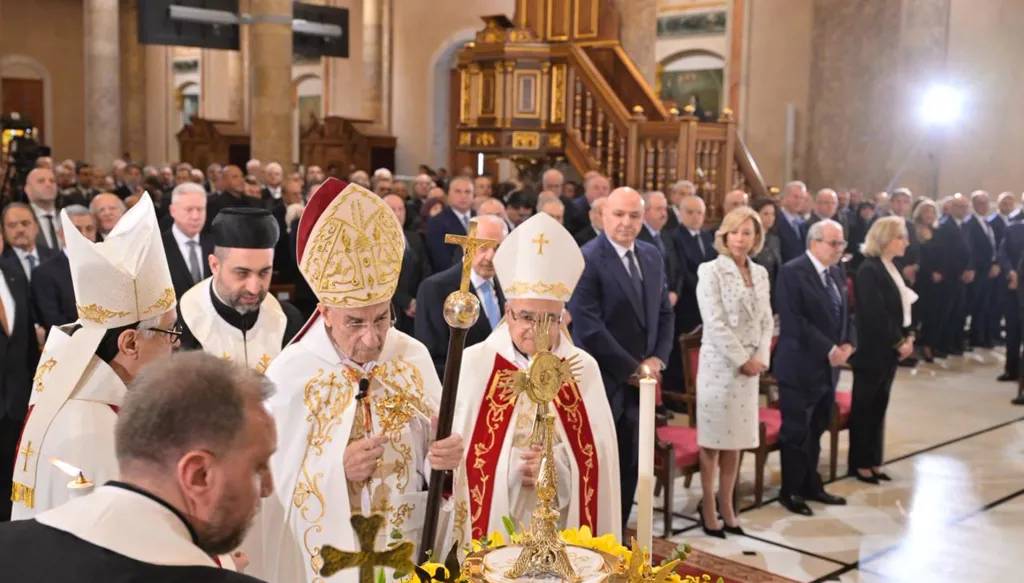
The Maronite Patriarch Bechara Rai during the mass celebrating Saint Maron, at Saint George Cathedral in Beirut, on Feb. 9, 2026. (Credit: Nabil Ismail/an-Nahar)






Maronite Patriarch Bechara Rai celebrated Mass on Monday for Saint Maron’s Day at Saint George’s Cathedral in downtown Beirut, attended by President Joseph Aoun, Prime Minister Nawaf Salam, Parliament Speaker Nabih Berri, and others.
Before heading to the ceremony, Joseph Aoun, speaking from the Baabda Palace, expressed hope that this holiday would become "a national day of unity, through which Maronites and all Lebanese would reconnect with the values of Lebanon — land of the message and messages, land of saints and the righteous, and refuge for free people, like those who defended this country, faith, and freedom." The president also hoped that "after all the sacrifices, we might see the rise of the free country we aspire to, a sovereignty fully realized, and a just, balanced state capable of granting the rising generation their rightful opportunities for success and for Lebanon’s radiance."
He also expressed hope that this holiday would be celebrated in the future "when the open wound in the South will have healed, stability will have been restored there, and residents of the South will have returned to their villages and towns, and when the sufferings and troubles of the Lebanese people will have ended." He specifically mentioned "the repeated tragedies in Tripoli, due to the collapse of dilapidated buildings," asserting that "the relevant authorities should have taken the necessary preventive measures to avoid these dramas and the deaths of innocent people, including beloved children." The head of state expressed his solidarity with the victims’ families "in this difficult time," following the collapse of a building in the Bab al-Tabbaneh neighborhood of Tripoli, which according to the latest count, caused at least 14 deaths.
Information Minister Paul Morcos, meanwhile, declared "that on this occasion, we remember the victims of the disaster that struck Tripoli on Sunday, pray for the recovery of the wounded, and express our solidarity with them."
Residents of Tripoli are experiencing heightened anxiety and fear due to numerous cracked and at-risk buildings in several neighborhoods, particularly Qobbeh and Bab al-Tabbaneh, our correspondent reports. Many lack proper shelter. In Bab al-Tabbaneh, some residents have evacuated a residential complex over fears of collapse, while others have chosen to remain. The management of the Port of Tripoli said in a statement that it is ready to provide support and solutions for the evacuated residents.

Mass celebrated at Saint George’s Cathedral
This religious commemoration, part of the national calendar, is celebrated each year for Saint Maron’s Day. Since 2024, the liturgy has been held at Saint George’s Cathedral, which has greater capacity, and is attended by the nation’s top officials, including the president, prime minister, and parliament speaker, as well as many political figures. Previously, the celebration traditionally took place at Saint Maron’s Church in Gemmayzeh. The Mass is now presided over by the Maronite patriarch, rather than the Maronite archbishop of Beirut.
Saint Maron was a Syriac hermit priest who lived between the 4th and 5th centuries in what is today the Turkish region of Antioch, near the Syrian border. He chose to live as a monk-priest on Mount Nabo in Syria, living outdoors and enduring the elements. Saint Maron transformed a pagan temple into a church and spread the Gospel to all who came to him for salvation and healing. Free from worldly life, he lived in prayer, meditation, and penance. Inspired by the Holy Spirit, he devoted himself to reading about the saints and imitating Christ. His austere, sacrificial life, coupled with his charisma, quickly earned him renown throughout the region. Crowds flocked to his place of solitude: men and women sought his prayers or wanted to share in his spiritual discipline.
The theologian Theodoret of Cyrrhus, who recounted his life, described the unique “philosophy” of Saint Maron — a powerful and unshakeable wisdom that heals both body and soul and gives all an orientation and a profound sense to their lives. He described him as one who “sowed God’s garden with many flowers,” a “multicolored” garden, referencing the diversity of his disciples, each distinguished by their unique hermit existence. Whenever he encountered a remarkable monk, Theodoret discovered he was a disciple of Maron.

 Evening recap: Netanyahu announces West Bank offensive; 7 killed in Jordan church shooting; tents burned in south Lebanon
 US strike on Iran this weekend? ‘Absolutely,’ says Barrack; ‘I have no idea,’ says Trump