






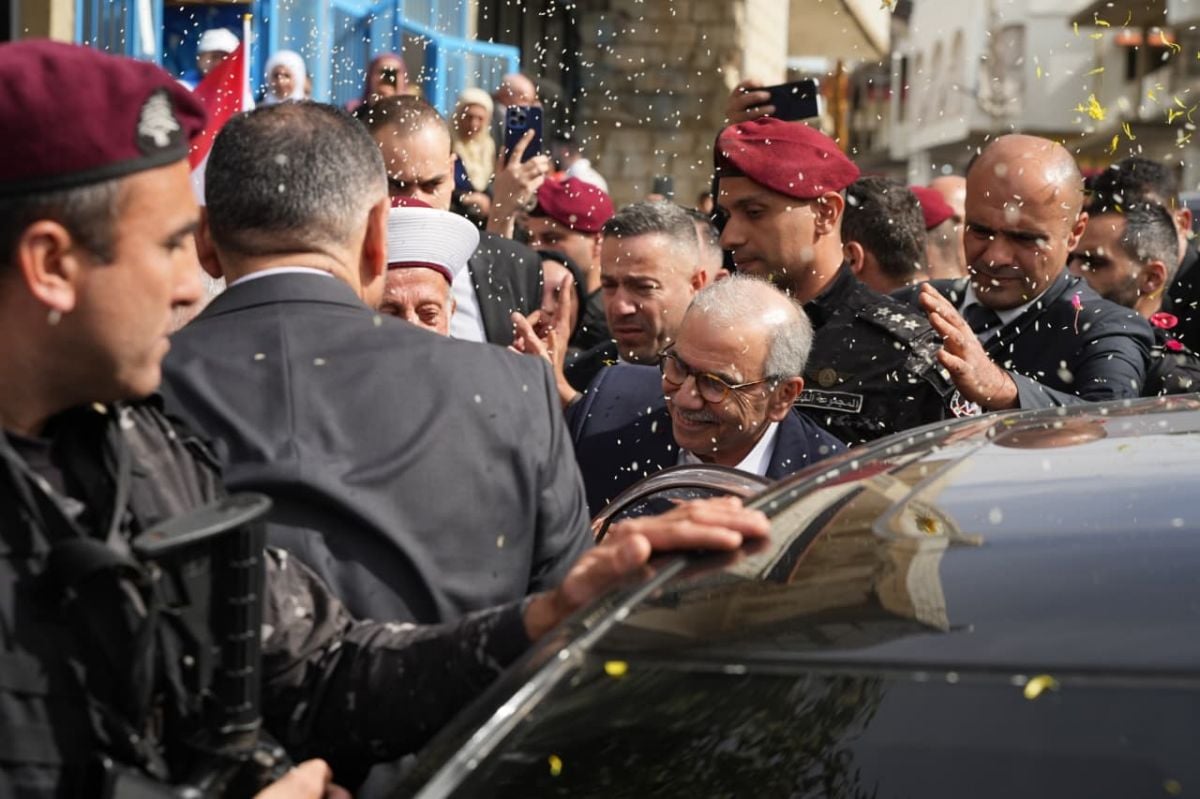
Lebanese Prime Minister Nawaf Salam, welcomed by the crowd during a visit to South Lebanon, February 8, 2026. Photo Mohammad Yassine/L'Orient-Le Jour






On the second day of his tour in southern Lebanon, Prime Minister Nawaf Salam was greeted warmly by residents in Kfar Kila (Marjayoun) and Kfar Shuba (Hasbaya), as he reaffirmed the government’s commitment to rebuilding villages destroyed by the last war between Hezbollah and Israel. Those villages also continue to suffer from near-daily Israeli attacks despite a cease-fire in effect since November 2024.
Salam, who began his southern tour on Saturday, started Sunday in Kfar Kila, a village left in ruins by Israeli strikes. Welcomed with bouquets of flowers and olive branches, the prime minister, traveling in an armored Lebanese Army vehicle, pledged to restore the village’s infrastructure to enable residents' return. "Work to repair roads and deploy a telecommunications network will begin in the coming weeks," he said. "Our visit aims to reaffirm that the state stands alongside the affected villages." He acknowledged Kfar Kila faces "more difficult" conditions than other areas due to ongoing Israeli cease-fire violations and its proximity to the border.
"The residents’ return cannot happen because the village is completely destroyed and continues to be targeted," said MP Ali Hassan Khalil affiliated with the Amal Movement. MPs Kassem Hashem (Amal bloc) and Melhem Khalaf (2019 protest movement) were also present.
‘The state has long been absent from the South’
After Kfar Kila, Salam went to Kfar Shuba, where he was welcomed by residents, MPs, and civil society representatives. "Kfar Shuba is a symbol of resilience. We are fully aware of the hardships the people of Arkoub [Hasbaya] have endured over many years of aggression, deprivation and neglect. And they have undeniable rights from the Lebanese state," Salam said.
He also highlighted ongoing and planned projects, including the Souq al-Khan–Shebaa road, wastewater management initiatives, and the restoration of public schools to ensure a proper learning environment for children.
Salam also visited the Marjayoun Serail, emphasizing the state’s historical absence from the region. "From 1943 to 1975, the state was largely absent from the South. Today, we want this region to return to its fold. The army remains engaged, but extending sovereignty also requires law, institutions and public services," he said. "Reconstruction will begin with infrastructure rehabilitation, but the priority is to reestablish the presence of the state."
The prime minister’s visit also included Rashaya al-Foukhar (Hasbaya), and stops at the Union of Municipalities of Hasbaya and Arkoub.
Nabatieh, 'economic, social and cultural heart' of the South
After Rashaya al-Foukhar, Salam concluded his tour in Nabatieh, marking his second visit to the city in less than a year. He took part in the inauguration of the temporary market "al-Baydar," set up by residents to support families who lost their livelihoods after Israeli airstrikes destroyed the historic Nabatieh souk on Oct. 12, 2024.
"The destruction of Nabatieh was immense and devastating. Nabatieh is the economic, social and cultural heart of the region. Reconstructing its market will revive commercial activity, support small businesses, help people retain their jobs, and reconnect villages through a single economic artery," Salam said. He expressed hope that funding could be secured "in the months or years to come" to compensate traders and "bring life back to the souk." Salam emphasized the need to work with the Culture Ministry to "restore it in a way that respects its heritage, preserving the city's identity and history."
At the municipal headquarters in Nabatieh, he highlighted discussions with foreign visitors about the government’s commitment to mobilize Arab and international resources to implement the November 2024 cease-fire.
Asked about Nabatieh’s exclusion from exemptions on water, electricity and telephone bills, Salam called it "an oversight." He said the issue falls under parliamentary authority and requires an amendment or new legislation, promising that "as soon as a new law is enacted, we will apply it." He also noted that construction of the new Nabatieh Serail is underway, along with repairs to the road linking Nabatieh to Marjayoun, which "will soon be reopened."
Hezbollah welcomes Salam’s tour
Hezbollah MP Hussein Jishi said that “the prime minister’s visit to the southern region and the border villages is welcomed ... We hope this visit will help strengthen the southerners’ confidence in the state, especially since the people of the South, from 1948 until today, have not been accustomed to the state standing by their side.”
Speaking during a ceremony organized by Hezbollah in Kawthariyet al-Siyyad (Saida district) on the occasion of the birth of Imam Mahdi, he pointed out that “Lebanon has fulfilled everything required of it regarding the cease-fire, and that the Resistance has cooperated with the Lebanese authorities and the Lebanese Army to the maximum extent. This has been stated by the president and the prime minister and has also been confirmed by reports from the Lebanese Army and UNIFIL.”
“Lebanon has completed all its obligations and is no longer required to make any additional commitments,” Jishi added.
Hezbollah states that the cease-fire agreement only provides for the disarmament of the party south of the Litani River. However, the agreement refers to several previous texts, primarily U.N. Security Council Resolution 1701 (2006), which provides for the disarmament of all militias throughout Lebanese territory.
Jaafarite Mufti Ahmad Qabalan, aligned with the Amal-Hezbollah alliance, called Prime Minister Nawaf Salam’s visit to the South "an important step in the right direction," calling for a strong state presence and army deployment south of the Litani River, especially along the border with Israel.
Salam previously visited the South in February 2025 and again last October, following criticism from Parliament Speaker Nabih Berri over government neglect. Reconstruction of war-torn areas, estimated to require several billion dollars, depends heavily on international funding, which is contingent on Hezbollah’s disarmament — a demand the party continues to resist north of the Litani.
