






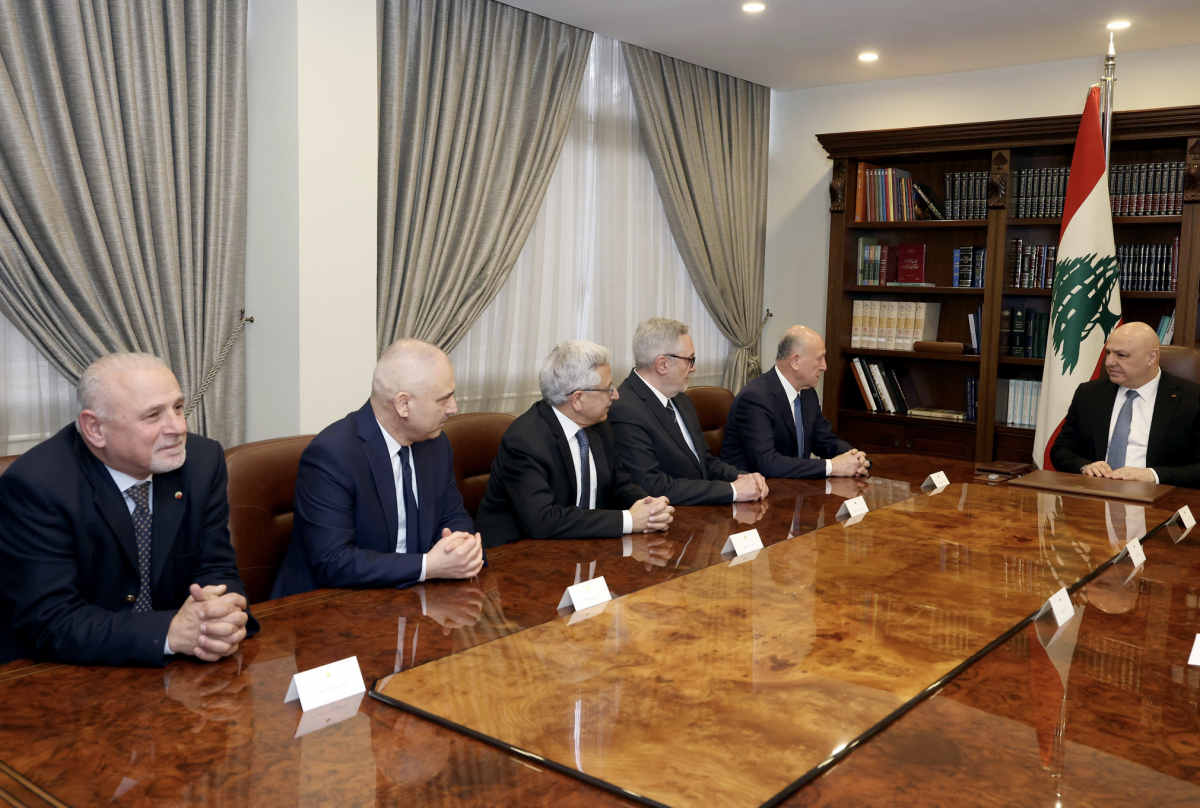
The Lebanese head of state, Joseph Aoun (on the right), talking with political figures hostile to Hezbollah on Feb. 3, 2026. (Credit: X account of the Lebanese presidency/@LBpresidency)






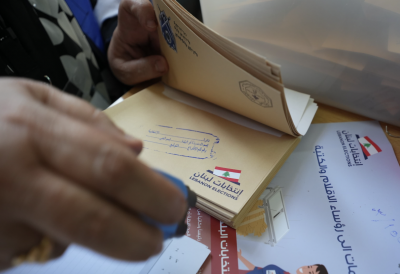
President Joseph Aoun affirmed on Tuesday his "determination" to hold the parliamentary elections "starting from May 3," according to a post by the Lebanese presidency on X. Amid speculation over a potential delay to the vote, fueled by political tensions around how expatriate voting will be carried out, the president noted that this issue does not fall under his prerogatives, but rather those of the legislative power.
"We reaffirm our determination, alongside the Speaker of Parliament (Nabih Berry) and the Prime Minister (Nawaf Salam), to organize the legislative elections starting from May 3. The ideas put forward regarding a postponement, for whatever reason or length of time, do not concern me; this matter falls under the prerogatives of the legislative power, which alone is entitled to decide on such proposals," Aoun said. He added that he maintains "equal distance from all candidates," specifying that he does not "intervene in electoral alliances." "My mission is to ensure the integrity, security, and proper conduct of the electoral process," he said.
Aoun made these remarks in front of a gathering of political figures hostile to Hezbollah, including Tripoli MP Ashraf Rifi.
The key vote in Lebanon's parliamentary democracy was set last week for May 10 for resident Lebanese, while Lebanese expatriates are slated to vote a week earlier, on May 3.
The issue of expatriate voting continues to divide parliament. Led by the Lebanese Forces, parties in favor of amending the electoral law argue that expatriates should be able to vote for all 128 MPs, as in the previous two elections, and not for six additional seats reserved for the diaspora, as stipulated in the 2017 electoral law. The latter option is favored by the Shiite tandem (Amal-Hezbollah), driven by parliament speaker Nabih Berry. Earlier in January, Aoun brought up a possible "technical" postponement of the legislative elections. "One, two months or more is not a postponement," he said in an interview with Télé-Liban.
"Avoiding the country being dragged into a new war"
Joseph Aoun also addressed core state issues. "I am working with all concerned parties to prevent the country from being dragged into a new war, because the Lebanese people can no longer endure further conflict, and because international circumstances have created new realities that require a realistic and rational approach to protect Lebanon and its citizens," Aoun said. This was an implicit reference to concerns about a possible Hezbollah intervention alongside the Islamic Republic of Iran in the event of American strikes on Tehran. "I hope that efforts to spare Lebanon from danger will be met with understanding and positive engagement," the president added.
The "rational" approach mentioned by Aoun echoes remarks he made in early January — widely criticized by Hezbollah — in which he called on the party to "act reasonably," in the context of the party's refusal to disarm north of the Litani River, despite a government decision in that regard in Aug. 2025.
Meanwhile, Lebanese Prime Minister Nawaf Salam and Deputy Prime Minister Tarek Mitri expressed similar positions. Salam, speaking from Dubai, also said he would not allow Lebanon to be "dragged into a new adventure." In an interview Tuesday with Saudi channel Al-Hadath, Mitri said he "hopes Hezbollah will act reasonably once again if a war breaks out against Tehran." He added that he rejected "any involvement in a regional war or turning our country into a theater for the wars of others." He also reminded that "Hezbollah refuses to turn over its weapons north of the Litani."
Aoun further stated that "the return of international trust and support for Lebanon is a natural consequence of the efforts we are making to rebuild the state on solid foundations, notably through establishing the rule of law and the state's monopoly on arms." "These are two irreversible principles ... and we are working to make them a reality," he added. "There is no question of suspending the implementation of the commitments I made in my inaugural speech," on Jan. 9, 2025, he noted.
International aid to Lebanon is conditioned on Hezbollah's disarmament and the implementation of structural reforms following the economic and financial crisis of 2019. Aid for the reconstruction of areas destroyed in the 2024 war between Hezbollah and Israel has not yet been granted, as the party refuses to surrender its arsenal across the entire Lebanese territory.

 8 p.m. recap: Israel again threatens Beirut’s south suburbs; 2 ships hit near Hormuz; Riyadh football matches canceled