





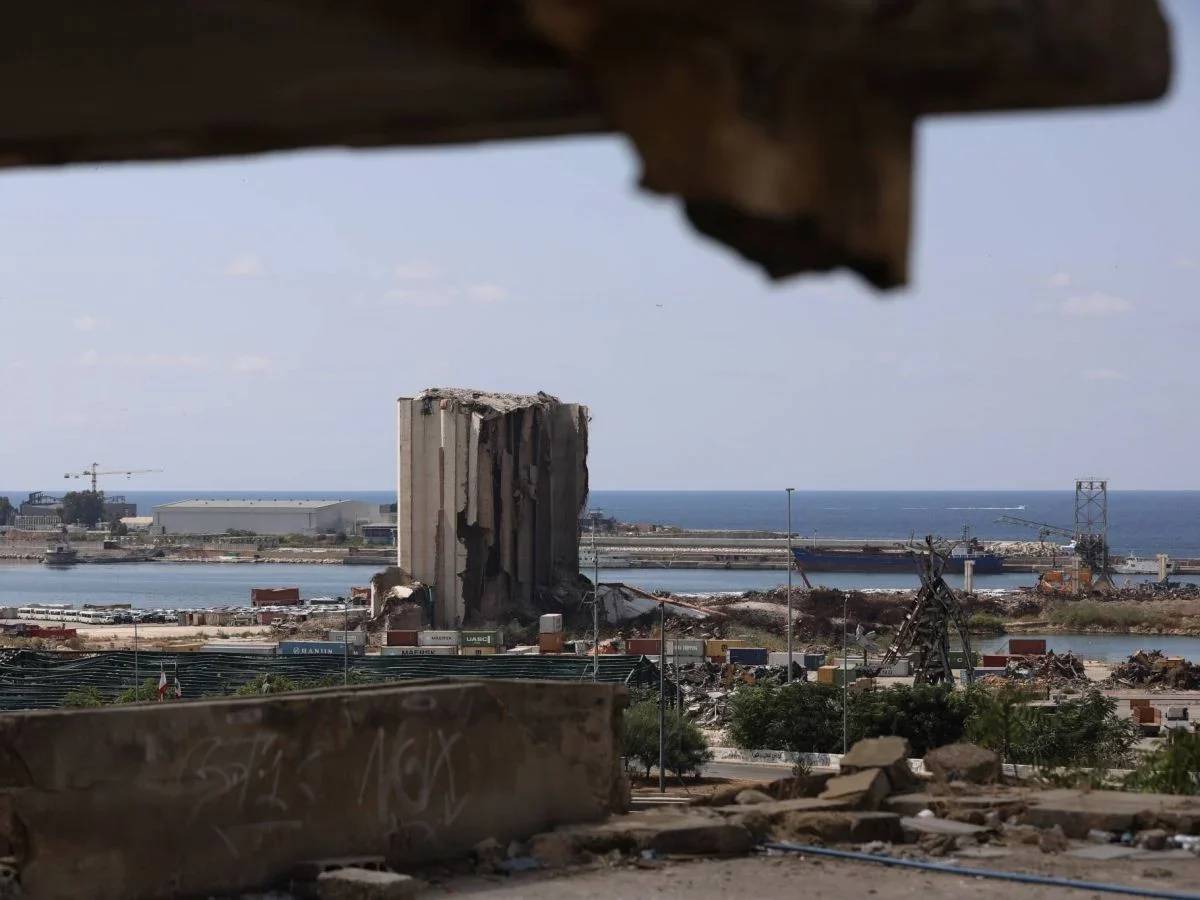
The destroyed silos at the Beirut Port, four years after the tragedy, on Aug. 4, 2024. (Credit: Matthieu Karam/L'Orient Today)






A committee representing the families of victims and martyrs of the Aug. 4, 2020, Beirut Port explosion submitted a written letter to Prime Minister Nawaf Salam following a Jan. 18 visit to his residence, clarifying their opposition to the appointment of Gracia Azzi as director general of Lebanese Customs, the group said in a statement Thursday.
The families stressed that they “do not accept and will not be false witnesses to violations of the law by anyone who may have caused, in any way, the port explosion and the death of their loved ones,” explaining that the letter was sent to formally outline their objections.
“Despite repeated objections and subsequent protests, which apparently have yielded no results,” the appointment went ahead, the families said.
Azzi’s appointment, approved in January during a Cabinet meeting on the proposal of Finance Minister Yassin Jaber, whose Ministry oversees the customs bureau, was the result of a broad political compromise, the families said, contrasting with promises of reform made by the new leadership, represented by President Joseph Aoun and Prime Minister Salam.
The letter recalled that on March 20, 2025, the government approved amendments to the mechanism for appointing first-category public officials, including directors general, as part of its reform commitments.
The mechanism was intended to prevent “arbitrary, political, or sectarian appointments” by relying on transparent criteria such as equality, equal opportunity, merit, and adherence to good conduct, all within a defined legal and administrative framework.
The families cited Article 65 of the Constitution, which entrusts the Cabinet with appointing state employees “in accordance with the law and in adherence to the principles of equality and equal opportunity for all Lebanese in assuming public positions,” as well as Legislative Decree No. 112/1959 (the Civil Service Law).
They noted that the appointment mechanism explicitly excludes candidates “who have previously been referred to a regulatory body and whose referral has not yet been decided.”
On this basis, the families said “it is clear that the government has violated the principle of this employee appointment mechanism in public administrations, the conditions of which it had previously established itself.”
They also argued that the government violated “the principle of non-contradiction and the principle of loyalty,” under which “it is impermissible to contradict oneself at the expense of others.”
While acknowledging the presumption of innocence, the families stressed that Azzi “is suspected of causing the explosion,” and said it was necessary to clarify the circumstances surrounding her interrogation.
They also argued that Azzi “does not possess the legally required good conduct, nor can she obtain such a record given the suspicions surrounding her,” noting that she is “accused in several cases other than the port explosion case.” While stating that they would not elaborate further.
Finally, the families pointed to the broader context of the stalled investigation, stating that “the delay in issuing the indictment and the obstruction of the investigation are due to political wrangling and violations that accompanied the investigation.”
Led by investigative judge Tarek Bitar, the probe into the port disaster has been stalled for several years, repeatedly slowed down by political pressure and administrative obstacles.
In a related development, Igor Grechushkin, the alleged owner of the Rhosus ship from which ammonium nitrate was unloaded in 2014 — and which caused the double explosion — was released by Bulgarian authorities.

 Evening recap: Netanyahu announces West Bank offensive; 7 killed in Jordan church shooting; tents burned in south Lebanon
 US strike on Iran this weekend? ‘Absolutely,’ says Barrack; ‘I have no idea,’ says Trump