





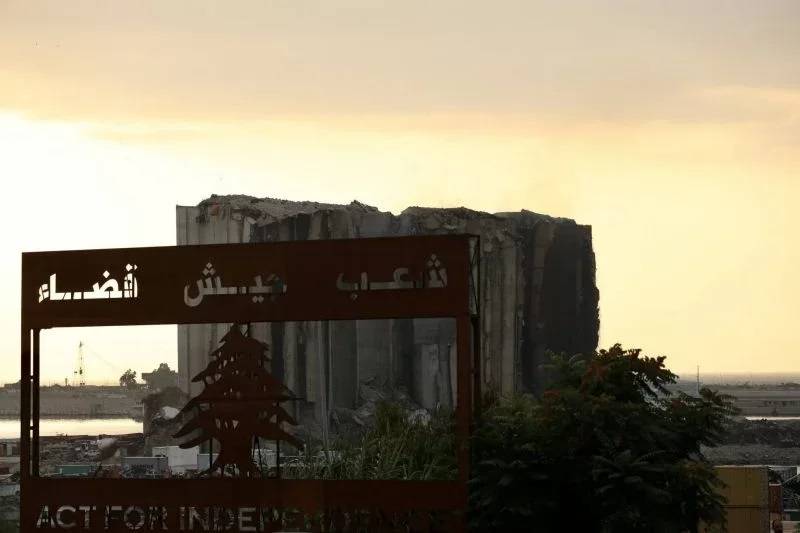
The silos of Beirut's port, damaged by the double explosion. (Credit: Matthieu Karam)






Igor Grechouchkine, the alleged owner of the Rhosus ship from which the ammonium nitrate responsible for the double explosion was unloaded in 2014, was released last week by the Bulgarian authorities.
The Bulgarian Court of Appeal (the country where the Russian-Cypriot national had been arrested on Sept. 5 based on an Interpol notice issued at Lebanon's request) confirmed the Sofia court's refusal, handed down on Dec. 10, to extradite Grechushkin to Lebanon. This court notably cited the insufficient guarantees provided by Lebanon concerning the non-application of the death penalty in the event of a conviction.
Since 2004, under pressure from the European Union, Lebanese justice has observed a moratorium on executing death sentences. However, the death penalty has not formally been abolished by law.
In parallel with the refusal to extradite, Bulgarian justice nevertheless authorized investigating judge Tarek Bitar, in charge of the Aug. 4 tragedy investigation, to question the alleged ship owner on site in Bulgaria. The hearing took place on Dec. 18, but Grechushkin exercised his right to remain silent, refusing to answer Judge Bitar’s questions.
Now that the extradition request has been settled in favor of Grechushkin, Bulgarian law requires his release. He was held for four and a half months, without his arrest having truly served the investigation.
Germany responds
However, positive developments for the investigation are on the horizon. Germany, to whom Lebanon sent a letter rogatory related to the investigation, responded to this request on Monday. Other responses are also expected, according to a judicial source, who believes they are not crucial to the remainder of the proceedings and that the indictment “may soon be issued.”
The finalization of the indictment was notably delayed by a usurpation-of-authority lawsuit filed in January 2023 by former Court of Cassation Prosecutor Ghassan Oueidat, which the ad hoc-appointed investigative judge, Habib Rizkallah, dismissed on Jan. 8, three years later.
It remains to be seen whether this dismissal in favor of Bitar will be upheld by the ad hoc-appointed indictment chamber. This appellate body, chaired by Elias Eid, was seized on Jan. 14 by Ali Hassan Khalil, a lawmaker and former minister implicated in the case, who became a civil party in Oueidat’s lawsuit.
The indictment chamber's decision is expected next week, according to the judicial source, who suspects that Bitar will no longer be prosecuted for usurpation of authority, especially since the cassation prosecutor’s office did not appeal Rizkallah’s decision.
The tide thus appears to be turning in favor of Bitar and, consequently, toward the final phase of the investigation, after obstacles notably caused by multiple motions for recusal and state liability actions against the investigating judge and the magistrates ruling on these complaints.
While not all of these matters have been settled, a key development occurred on Jan. 16: A Beirut First Instance Court ruling presided over by Hania Hilweh ordered Khalil and another lawmaker implicated in the case, Ghazi Zeaiter, to pay 110 billion Lebanese pounds (about $1.2 million) to 12 relatives of the port explosion victims who complained about abuse of their right to take legal action.
The two parliamentarians have each filed about a dozen motions. They intend to appeal and have 30 days from the date of notification of the ruling to do so.
This article was translated from L'Orient-Le Jour.