






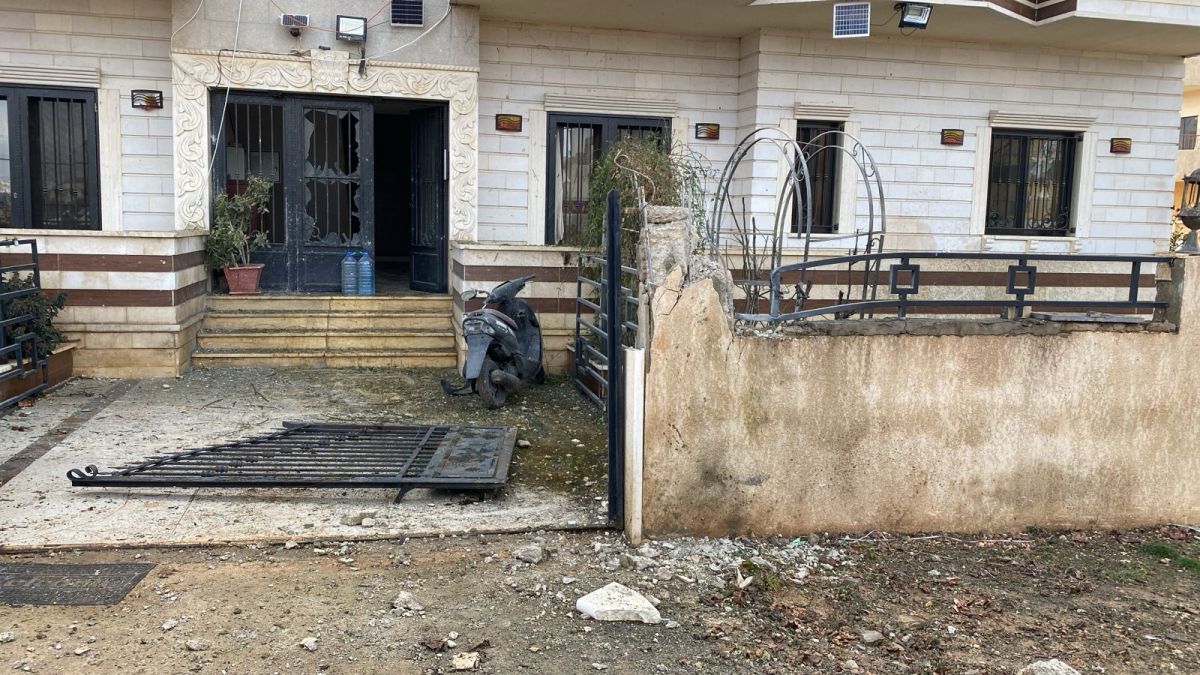
Material damage following a failed assassination attempt by the Israeli army on a Palestinian official in the Bekaa, on Friday, Jan. 23, 2026. Photo provided by our correspondent in the Bekaa, Sarah Abdallah.






BEIRUT — A failed Israeli operation near Baalbeck on Friday aimed to target a suspected Hamas official.
According to L'Orient Today's correspondent in the area, an Israeli drone attempted three times to target Bassam Qayed as he was driving between Majdaloun and Baalbeck (Baalbeck district).
The first missile missed its target, the second hit the sidewalk, and after Qayed fled toward nearby residential buildings, a third missile landed near a building without causing injuries.
In south Lebanon, an Israeli tank fired from the occupied Hamames hill, south of Khiam in the Marjayoun district, toward a Lebanese Army unit on a joint mission with U.N. peacekeepers near Wadi al-Assafir. No casualties were reported.

Lebanese soldiers and UNIFIL troops have been repeatedly targeted by Israeli tanks and drones in south Lebanon.
Elsewhere, an Israeli drone dropped a stun grenade near a group of young residents collecting scrap metal in Markaba (Marjayoun), without causing injuries.
Similar incidents were reported a few hours later in Odaisseh (Marjayoun) and Ramieh (Bint Jbeil), according to L'Orient Today's south Lebanon correspondent.
Early in the afternoon, Israeli forces opened fire with medium-caliber automatic weapons on the outskirts of Aitaroun (Bint Jbeil). Shortly afterward, a drone dropped two stun grenades on Odaisseh, one of them near a recently established Lebanese Army checkpoint at Khalet al-Mahafer, south of the village, as artillery shells hit the outskirts of Ramieh.
Aoun promises 'compensation and reconstruction' for the displaced
President Joseph Aoun received on Friday at Baabda Presidential Palace representatives of residents from south Lebanon, along with Hashem Haidar, head of the Council for the South, which is tasked with assessing damage caused by Israeli attacks ahead of reconstruction efforts.
The meeting followed a new series of major Israeli airstrikes on Wednesday, among the heaviest since the cease-fire took effect.
Wednesday's attacks displaced dozens of families in Qanarit (Saida), Kfour and Jarjouh (Nabatieh), followed by Kharayeb (Saida) and Ansar (Nabatieh).
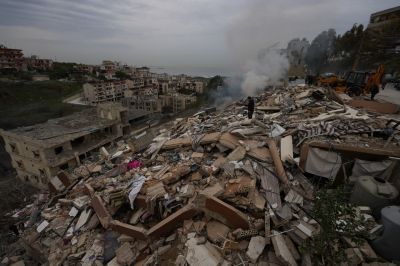
Aoun called for the continued delivery of aid to affected residents, particularly housing assistance, food and health care.
In Qanarit, municipal head Zein Khalife told L’Orient-Le Jour that 26 families would not be able to return home. Three residential buildings collapsed entirely, affecting about 100 apartments that sustained major damage, while 80 others suffered moderate to minor damage.
Head of Ansar's municipality, Mohsen Assi, reported a similar situation, saying displaced families were being hosted by other residents of the village until ongoing repairs are completed. In Ansar, 70 homes were partially damaged, and four were completely destroyed, in addition to numerous shops.
Assi added that the heads of the five affected municipalities had been informed that Parliament Speaker Nabih Berri, who was also received Friday at Baabda, had ordered the immediate release of funds to cover repair costs.
Aoun said he would discuss compensation and reconstruction assistance with Prime Minister Nawaf Salam and Finance Minister Yassine Jaber, stressing that the return of displaced residents and the release of detainees remain a priority and a national duty.
He added that the government is maintaining constant international contacts to demand an end to Israeli attacks. “Lebanon cannot be secure without the security of its South,” he said.
Information Minister Paul Morcos accused Israel of seeking to destabilize Lebanon’s internal situation and stir divisions, in remarks to Radio Liban. He said vigilance and national unity remain the first line of defense against such attempts.
Wednesday’s airstrikes injured 19 people, according to the Health Ministry. Two Hezbollah affiliates were also killed that day in Israeli drone strikes in Zahrani (Saida) and Bazourieh (Sour). Since the cease-fire began, more than 350 people, including at least 136 civilians, have been killed in Lebanon by Israeli fire or strikes, according to a count by L’Orient Today.
Additional reporting by Sarah Abdallah and Mountasser Abdallah.