


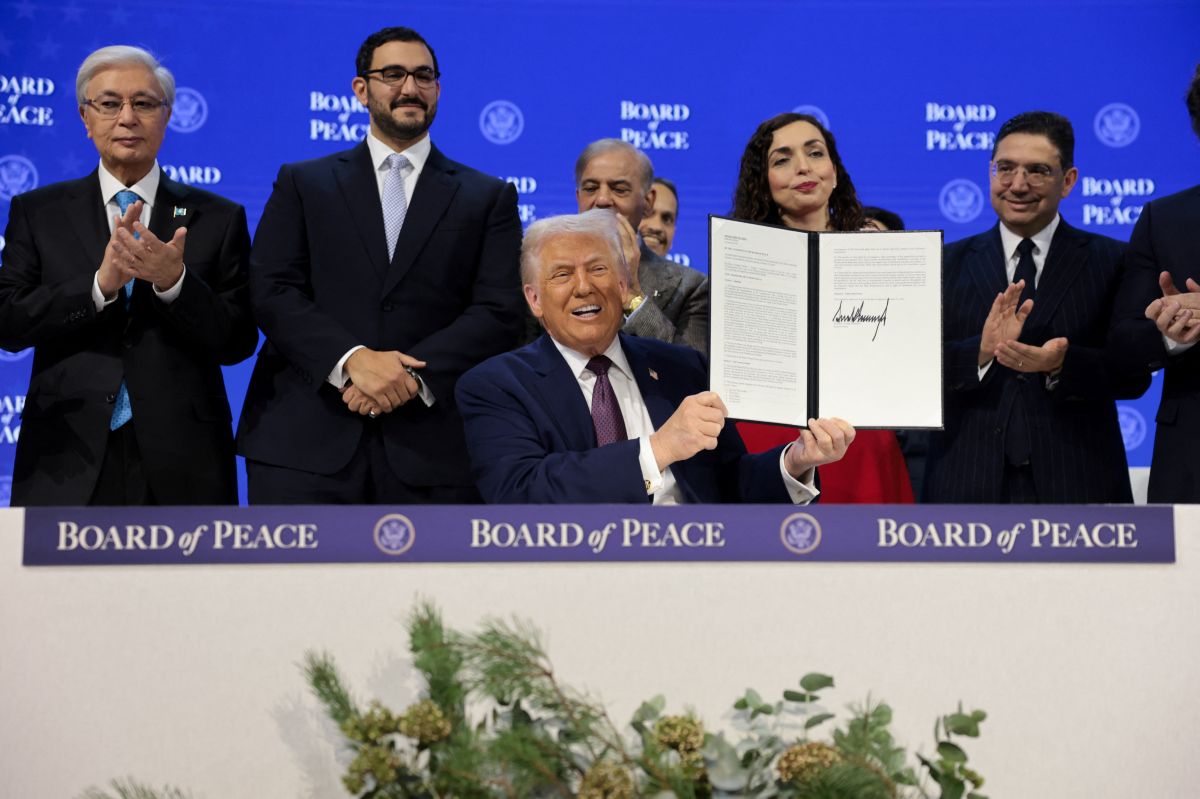
U.S. President Donald Trump, takes part in a charter announcement for his Board of Peace initiative aimed at resolving global conflicts, alongside the 56th annual World Economic Forum (WEF), in Davos, Switzerland, Jan. 22, 2026. (Credit: Jonathan Ernst/ Reuters)






Since Donald Trump returned to the White House more than a year ago, Washington has sought to reshape its diplomatic approach on a global scale.
It was in this context that, on Jan. 15, the U.S. president unveiled what he presented as a new overarching diplomatic framework: a 'Board of Peace.'
Dozens of leaders were invited to join. A signing ceremony was hastily organized on Thursday in Davos, on the sidelines of the World Economic Forum.
Several capitals were reluctant to commit to a structure led by Washington and driven by a president whose diplomacy is often described as transactional and unpredictable.
Seven Arab states received invitations. Some accepted it immediately. Others weighed the political cost of joining against the risk of alienating the United States, before ultimately agreeing to take part.
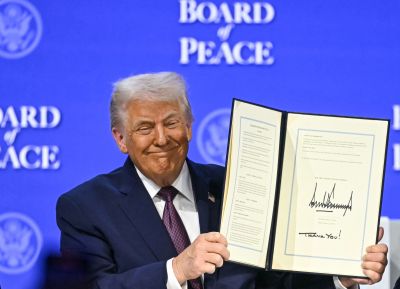
Trump allies take the lead
The first acceptances came from countries already firmly embedded in Trump’s diplomatic architecture. On Monday, Morocco announced that King Mohammad VI had accepted the U.S. invitation, making the kingdom the first Arab country to officially join the 'Board of Peace.'
Morocco’s Foreign Ministry said the king also welcomed Trump’s stated commitment to regional peace, a move consistent with its position since the Abraham Accords.
The announcement was quickly followed by those of the United Arab Emirates and Bahrain, who confirmed their participation and signaled alignment with the initiative.
“These countries have benefited from their partnerships with Israel and with the Trump administration,” said Annelle Sheline, a Middle East specialist at the Quincy Institute for Responsible Statecraft. “They saw this as another opportunity to signal their support for Trump and to secure what they believe could be further gains.”
When the U.S. president sent out invitations to join the initiative last week, some reports suggested that states seeking membership would be required to pay $1 billion to become permanent members. That claim was later denied. “Membership carries no financial obligation beyond any voluntary contribution each country or partner chooses to make,” a U.S. official told Saudi outlet al-Arabiya on Wednesday.
On Wednesday, Egypt, a central player in the U.S. plan for Gaza, announced its intention to join the 'Board of Peace.' Its Foreign Ministry confirmed that President Abdel Fattah al-Sisi had given his approval and that the necessary legal and constitutional procedures would be launched to formalize the move.

The same day, Israel also said it would join the initiative, though not without voicing reservations. Prime Minister Benjamin Netanyahu initially objected to the participation of Turkey and Qatar, two countries Israel does not want involved in security arrangements related to Gaza, particularly in the context of a potential international stabilization force that Israel intends to keep under its control.
Despite those objections, Turkish President Recep Tayyip Erdogan confirmed on Wednesday that Foreign Minister Hakan Fidan would represent Ankara at the Davos ceremony, signaling Turkey’s decision to take part in the initiative.
A collective stance
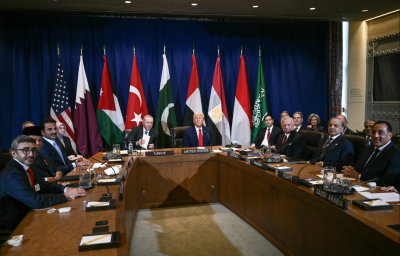
A few hours later, a broader signal followed in the form of a coordinated diplomatic message. In a joint statement, Saudi Arabia, Qatar, the United Arab Emirates, Turkey, Egypt, Jordan, Indonesia and Pakistan confirmed their acceptance of the U.S. invitation.
The statement, issued by the Saudi Foreign Ministry, said each country would proceed with joining “in accordance with its legal procedures.”
“These are the eight Muslim-majority countries Trump initially consulted before announcing his Gaza [cease-fire] plan in October,” said Sheline. As with their coordination last year, the countries appeared keen to project a show of unity while avoiding the impression that they were individually rushing into a broader framework whose contours remained unclear.
In November, the U.N. Security Council formally endorsed the 'Board of Peace' through a resolution drafted by the U.S., granting it international legitimacy and a mandate to work with governments to recruit peacekeeping forces for Gaza.
At the time, many countries in the region viewed it as a pragmatic, Washington-backed tool to stabilize the enclave.
But last week, the release of the board’s charter revealed a far broader ambition that went well beyond Gaza. The expanded mandate raised concerns among several Western states, some of which declined to take part, warning that it could weaken the U.N.
That concern likely factored into Riyadh’s decision. “Saudi Arabia has worked within the United Nations framework, notably by co-chairing with France the conference on the two-state solution last summer,” said Sheline.
Even so, “it is likely that these countries primarily sought to meet Trump’s expectations,” she added. More broadly, Sheline said, many participating states “may see existing institutions as offering little room for influence and view the 'Board of Peace' as a rare opportunity to carry greater weight on the international stage.”
This article was translated from L'Orient-Le Jour.

 7 p.m. recap: 1 person killed near border with Lebanon; 200 kilos of explosives carried by mules; Riyadh shuts its airspace