






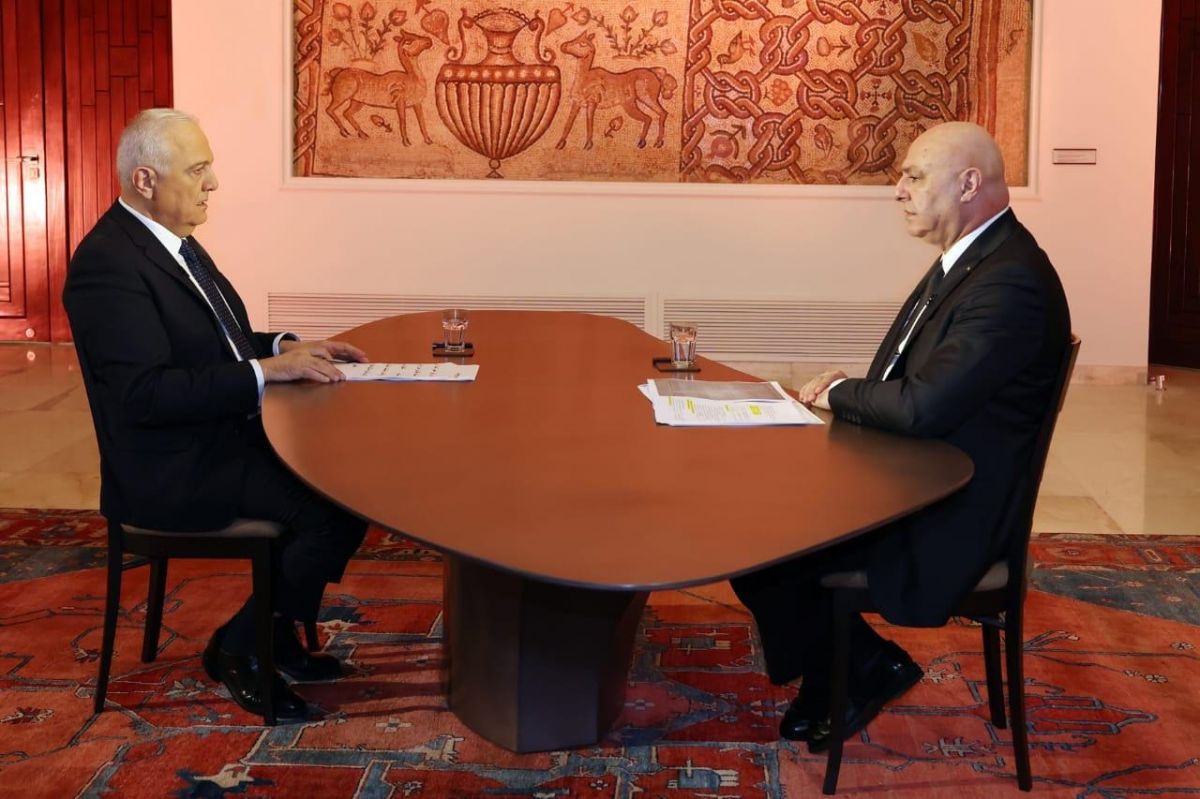
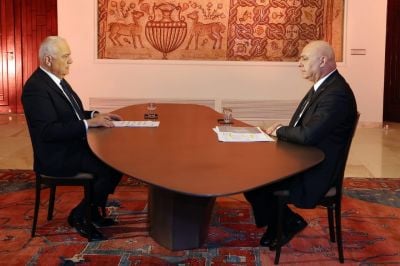
President Joseph Aoun during his live interview from the Presidential Palace in Baabda on Jan. 11, 2026. (Photo released by the presidency)






To mark the first anniversary of his term, President Joseph Aoun gave a lengthy interview Sunday night to Tele-Liban during which he struck a noticeably firmer tone toward Hezbollah.
"The situation that paved the way for the existence of weapons in Lebanon no longer exists," he said to journalist Walid Abboud, considering that "the presence of these arms has become a burden for [Hezbollah's base] and for Lebanon as a whole."
"The time has come to be reasonable," imploring the party's ministers and deputies.

The state prevented the country's "collapse" and managed to achieve a certain "stability in one year of office," Aoun added, before assuring that the risk of war in Lebanon had been significantly reduced due to the country's efforts to fulfill the commitments made at the time of the cease-fire secured in November 2024 between Israel and Hezbollah.
"The specter of war has receded. The possibility of a large-scale strike and a ground invasion have moved much further away," specified Aoun. "I said that the specter of war had receded, but not disappeared," he warned, adding that he doesn't know what goes through Israeli Prime Minister Benjamin Netanyahu's mind.
He continued: "The proof that the specter of war has receded is what we have seen during the holiday period — the influx of people who came to Lebanon and the fact that everything went smoothly," he emphasized. "As a political authority, and through the contacts we are making, we are monitoring the situation to definitively keep war away," he assured. "All wars ultimately end in political negotiations," he stressed.
A Lebanese decision
Reflecting on his inauguration speech in Parliament, Aoun said it "was the fruit of his military experience." "It was designed to accomplish the impossible, and we cannot deny what has been achieved over the past year," he added. "I will do the impossible to achieve what was set forth in the inaugural speech. We have reconciled national consensus and civil peace, and the president is an arbiter, not a side," he also declared.
While acknowledging that he has not fulfilled all the commitments taken by the executive since his election a little over a year ago, he nevertheless asserted that the disarmament process had advanced, that "the capacity to speed up or slow down depended on the means given to the Lebanese Army," and that any assistance the army "could receive would help it accomplish its mission." "We continue to implement the decision" to restore the state's monopoly on arms in the country, he assured those in the region who fear Lebanon might miss the window of opportunity it has been given.
The president asserted that this decision was made "in Lebanon, not abroad," and that "partners must cooperate with the state." "They are part of the state ... and if they cooperate, the state will guarantee their protection," he said in response to criticism from Hezbollah and its allies, who see Hezbollah's arms as the only means of protecting the country against attacks and possible Israeli invasion.
"The situation that had paved the way for the existence of these weapons in Lebanon [referring to Israel's occupation of South Lebanon, which began during the Lebanese Civil War and lasted until 2000] has disappeared," and now the army is present. "The presence of these weapons has become a burden for its environment and for Lebanon as a whole," asserted aOUN.
Peace and Israeli withdrawal
Asked about a possible Israeli withdrawal from South Lebanon, he maintained that "making peace" with Israel "was not a condition for the withdrawal" from the positions Israel still occupies along the southern border.
"My mission and that of the army is to protect the borders ... our efforts today are part of the truce agreement, that is, a security agreement, withdrawal, halting aggression, the return of prisoners, and resolving the border issue. This is an essential step toward peace, but it is not a condition in the sense of, 'If you make peace with me, then I will withdraw,'" Aoun further explained. As a reminder, Israel and its U.S. ally have in recent months repeatedly called for the normalization of relations between Beirut and Tel Aviv.
On the issue of Lebanese prisoners in Israel, Aoun said: "The president of the International Committee of the Red Cross [Mirjana Spoljaric] confirmed to me that the Israelis are refusing to allow a Red Cross delegation to meet with the prisoners, learn about their situation, or even know their location and health condition."
"I don't forget our prisoners, and I always demand their release in all my statements, whether inside or outside the country," he insisted.
Palestinian camps
On the question of disarming the Palestinian camps, Aoun lamented that there are "camps we call legitimate, and others that appeared during the last war, and for these, the president of the Palestinian Authority visited Lebanon in 2025, judging that these arms had also become a burden for the Palestinians."
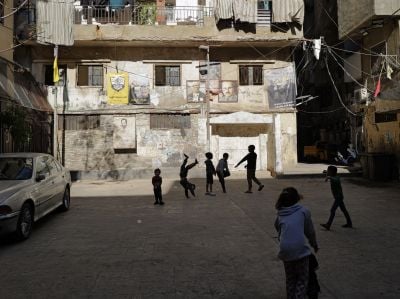
"Constant fighting occurred between Palestinians, and the camps became hotbeds of drugs and terrorism," he added. "There is cooperation with the Palestinian Authority on this issue, and they are responding positively. The security forces are making a huge effort in this area. The Palestinian Authority recently handed over one of the perpetrators of crimes to the intelligence branch conducting the investigation," he added.
On other issues, Aoun said there was no evidence of billions of dollars having been smuggled via Beirut Airport, and that the mechanism for implementing the reconstruction of areas destroyed by Israel would be examined next week.
This article originally appeared in French on L'Orient-Le Jour.

 8 p.m. recap: Israel again threatens Beirut’s south suburbs; 2 ships hit near Hormuz; Riyadh football matches canceled