






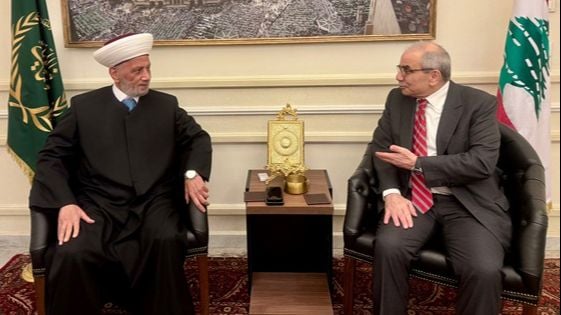
The mufti of the Lebanese Republic, Abdellatif Derian (right) met Prime Minister Nawaf Salam (right.) (Credit: NNA)






Prime Minister Nawaf Salam said Saturday, during a meeting with the Mufti of the Lebanese Republic, Abdellatif Derian, at Dar al-Fatwa in Beirut, that “to restore trust between Lebanon and its Arab and international partners, the state has no choice but to impose its authority.”
The closed-door meeting was held on the sidelines of a session of the Supreme Islamic Sharia Council, the highest authority of Lebanon’s Sunni community, which Salam attended. Discussions focused on the latest developments in Lebanon, according to a statement from Dar al-Fatwa carried by the official National News Agency (NNA).
Salam emphasized Lebanon’s national constants and the need to preserve unity in order to confront ongoing challenges, particularly continued Israeli attacks on Lebanese territory, despite the cease-fire reached between Hezbollah and Israel on Nov. 27, 2024. He also expressed satisfaction with the positive evolution of Lebanon’s relations with its Arab neighbors and partners, stressing that his government remains committed to its ministerial statement and is working to preserve achievements to help the country recover and regain stability, security, and a decent standard of living.
The Prime Minister further said that Hezbollah has been significantly weakened by its recent conflict with Israel, which inflicted heavy military losses and deprived it of its top leadership. This, he noted, has opened the door for Gulf countries to gradually restore diplomatic and economic relations with Lebanon. Relations between Beirut and Gulf and Arab states had been strained for years due to hostile statements by the pro-Iranian Shiite party.
Salam also briefed Sheikh Derian on developments related to Islamist detainees and the government’s efforts to resolve the issue fairly and swiftly. In recent months, protests by families of Islamist detainees have multiplied, with repeated calls for a general amnesty, as many have been imprisoned for years without trial. However, such a decision risks creating sectarian imbalance and, according to critics, could justify the simultaneous release of thousands incarcerated for drug-related offenses or other crimes.
For his part, Abdellatif Derian praised Salam’s efforts at the head of the government and stressed the importance of a unified national stance that brings together all components of Lebanese society to strengthen the foundations of the state for the benefit of all citizens, according to the NNA.
State monopoly on arms
Following the meeting, Dar al-Fatwa called for the “swift implementation of government decisions related to granting the state a monopoly on arms, extending state authority and that of its legitimate forces across the entire territory, and applying the Constitution and the Taif Agreement, which stipulates the disarmament of militias.”
The Sunni authority also praised the role played by the Lebanese army in southern Lebanon, as it is expected to soon begin the second phase of Hezbollah’s disarmament north of the Litani River.
The Council further stressed the importance of strengthening relations with Syria, warning against “the infiltration of remnants of the former regime into certain Lebanese regions and their actions that disrupt security and stability.” It also called for parliamentary elections to be held on schedule, as the vote risks being postponed due to divisions within the political class over expatriate voting.
