






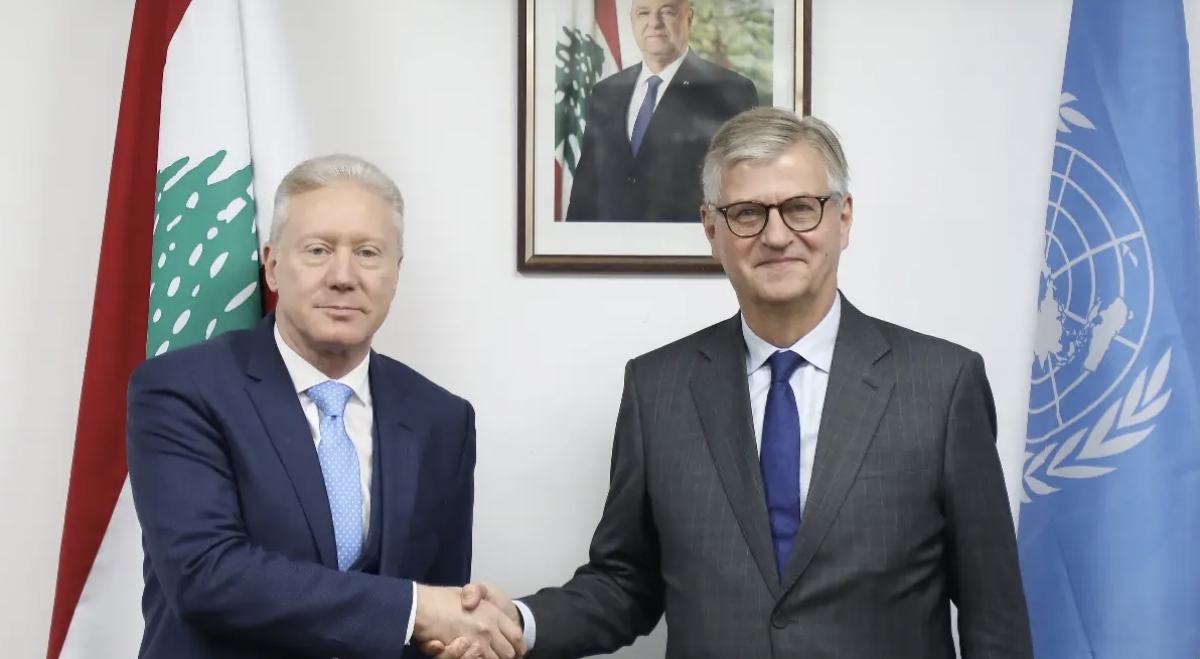
Foreign Affairs Minister Joe Rajji receives the United Nations Under-Secretary-General for Peacekeeping Operations Jean-Pierre Lacroix on Jan. 7, 2026. (Credit: National News Agency)






Lebanese Foreign Minister Joe Rajji on Wednesday proposed to the United Nations Under-Secretary-General for Peace Operations, Jean-Pierre Lacroix, "to take advantage of UNIFIL's presence during the remainder of its mandate to oversee the implementation of Resolution 1701 north of the Litani," as the Lebanese Army is about to finalize its plan south of the river.
During his visit to Lebanon, Lacroix met with several officials, including President Joseph Aoun and Parliament Speaker Nabih Berri, to discuss the post-UNIFIL phase, that is, the withdrawal of the peacekeepers deployed in the south of the country since 1978, with the pullback due to begin on Dec. 31, 2026, ahead of a complete departure by the end of 2027.
In his meeting with the senior U.N. official, Rajji proposed "considering taking advantage of UNIFIL's presence during the remainder of its mandate to monitor the implementation of Resolution 1701 north of the Litani," as the Lebanese Army is expected to soon proceed with the disarmament of Hezbollah in this area.
The Lebanese minister also emphasized that this resolution "is not limited to the area south of the river," where the army is supposed to have completed, by the end of 2025, the first stage of its plan to disarm militias throughout Lebanese territory, in accordance with the government's decisions of August 2025 and the November 2024 cease-fire agreement.
The minister also stated that "the Lebanese state is committed to maintaining an international presence in the South after the end of UNIFIL's mission," adding that several options are under study, including "the possibility of relying on the United Nations Truce Supervision Organization [UNTSO], with a strengthening of its personnel."
Rajji also praised "the role played by UNIFIL and the sacrifices made by the peacekeepers in Lebanon."
From the Bustros Palace, Lacroix explained that his visit aimed "to learn about Lebanon's vision and orientation for the post-UNIFIL era, as well as to ensure implementation of Security Council Resolution 1701," while stressing "the importance of reaching a clear formula on this issue in the coming months."
Resolution 1701, which serves as the framework for the truce agreement, calls for cessation of hostilities, withdrawal of Israeli forces, deployment of the Lebanese Army south of the Litani, and the disarmament of all non-state militias.
Aoun welcomes initiatives from countries 'to keep military presence in South'
Earlier in the day, Aoun received Lacroix at the Baabda Presidential Palace and reiterated that "the Lebanese Army is fully carrying out its role in the region south of the Litani, in accordance with the Cabinet decision."
"There is no truth to what Israel and some local sources are spreading about the army not fulfilling its assigned missions," he added.
However, the head of state said that full army deployment in the South remains hindered by "the occupation by Israeli forces of some hills, Israel's non-compliance with the terms of the truce, the continuation of its hostile operations against Lebanese territory, and the detention of Lebanese by Israel."
Aoun also affirmed that Lebanon "warmly welcomes any initiative by countries wishing to maintain a military presence in the South after UNIFIL's withdrawal," stating that "European countries that have expressed a wish to keep some of their units have been informed of Lebanon's positive response to such an initiative."
He noted that "this presence is part of an agreed system aimed at supporting the Lebanese Army," at "extending the state's authority up to internationally recognized borders, and at implementing Resolution 1701."
At the end of December, Italian Defense Minister Guido Crosetto had indicated that Rome wished "to keep its forces south of the Litani River" after the departure of the peacekeepers, noting that other European countries "share this intention."
"It is possible to reach an understanding with the concerned countries on how these forces would operate, and Lebanon attaches great importance to the United Nations' role in this regard," Aoun stressed.
He also praised the role UNIFIL has played since its deployment in the South, as well as its "coordination" with the Lebanese Army, highlighting that troop numbers have "gradually increased, now reaching more than 10,000 military personnel, officers, non-commissioned officers, and soldiers combined."
Lacroix, for his part, shared with Aoun the results of his visit to the South the previous day and the meetings he held with UNIFIL commanders.
He reiterated "the United Nations' continued support for the Lebanese Army" and "the ongoing coordination at all current and future stages regarding international forces," affirming "the U.N.'s willingness to support any arrangement that could ensure lasting security and stability in the South, and more broadly in the area of operations."
UNIFIL is part of the cease-fire monitoring committee for the November 2024 truce that ended the last war between Hezbollah and Israel. This mechanism is tasked with monitoring compliance with the truce agreement and ensuring the dismantling of Hezbollah's military infrastructure south of the Litani.
After meeting with Parliament Speaker Nabih Berri, Lacroix said from Ain al-Tineh that "the meeting was positive" and indicated he thanked Berri for "his support for UNIFIL."
The discussions also addressed the broader situation in Lebanon and the region.
Lacroix also met with Prime Minister Nawaf Salam and Lebanese Army Commander Rodolph Haykal.
