







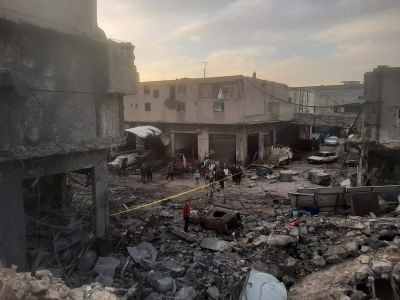
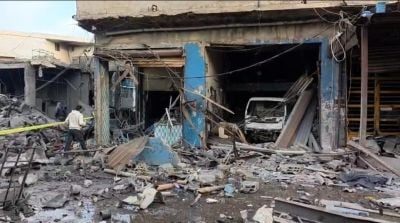
A 3-storey building was leveled by Israeli strikes on the industrial zone south of Saida at 1 a.m. on Tuesday Jan. 6, 2026. (Photo provided by our correspondent Muntasser Abdallah)






BEIRUT — Israeli newspaper Yedioth Ahronoth reported on Wednesday that the Israeli army already has an "attack plan against Hezbollah" and was ready to implement it, but instead decided to focus on the situation in Iran, where a protest movement on economic issues has taken a political turn the last 10 days.
"Were it not for the latest developments in Iran, there might have been little hesitation in executing an [Israeli] attack plan against Hezbollah," the Ynet media noted, adding that this plan has "already been prepared and is considered operationally ready."
In recent days, demonstrators in Iran took to the street to demand the end of the religious regime, chanting such slogans as "Death to Khamenei" and "Freedom, freedom." The Israeli authorities have announced their support to the protesters.
'Freedom of action for Israel across all arenas'
According to Yedioth Ahronoth, upon his return from a meeting with U.S. President Donald Trump held on Dec. 29, Israeli Prime Minister Benjamin Netanyahu convened a small, sensitive cabinet meeting with Israel’s security officials, in which he presented the understandings and agreements reached in Washington regarding the continued "freedom of action for Israel across all arenas: Iran, Lebanon, Gaza, Syria, Yemen and the West Bank."
The newspaper adds that Netanyahu has effectively received a green light from President Trump on the attack plan against Hezbollah, and the Israeli army has made clear that from its perspective, preparations are complete, leaving the decision largely one of timing.
According to to the same newspaper, developments in Iran, "particularly the destabilization of the Ayatollahs' rule, are at this stage the central factor shaping decision-making in Jerusalem."
Despite that, Israeli officials remain cautious about the implications of the unrest, as assessments in Israel are that the current wave, while broad and increasingly visible, is still "unlikely on its own to bring about the collapse of the regime."
At the same time, concerns are growing within Israel’s security establishment "over the risk of miscalculation": Israel and Iran fear the other may be planning a surprise attack, "increasing the danger of a preemptive strike based on flawed assumptions."
According to the newspaper, in recent months, Israel has conveyed messages to Iran through several channels stating it has no intention of initiating an attack, including during the latest protests.
Building detonated by the Israeli army in Khiam
Israeli threats of a military operation against Hezbollah have increased recently, as the group continues to refuse to completely disarm, especially in light of the continuous Israeli violations of the cease-fire agreement reached in November 2024.
These daily violations have continued on Wednesday as a three-story building located at the southern entrance to Khiam, a border village in the Marjayoun district of southern Lebanon, was destroyed by explosives at dawn by an Israeli patrol that had infiltrated Lebanese territory, according to information from our correspondent in the region. This building is located 1,200 meters from the position Israel occupies on Hamames hill in southern Lebanon.

In addition, at around 11 p.m. last night, an Israeli army drone fired several projectiles at a bulldozer northeast of Mais al-Jabal, a border town where the Lebanese Army yesterday set up a military position as part of its deployment south of the Litani River. According to available information, no one was injured in the attack.
The Israeli army has been increasing its military pressure on Lebanon in recent days with several strikes, some deadly. This escalation preceded a meeting of the committee monitoring the implementation of the cease-fire that took place in Naqoura on Wednesday.
