






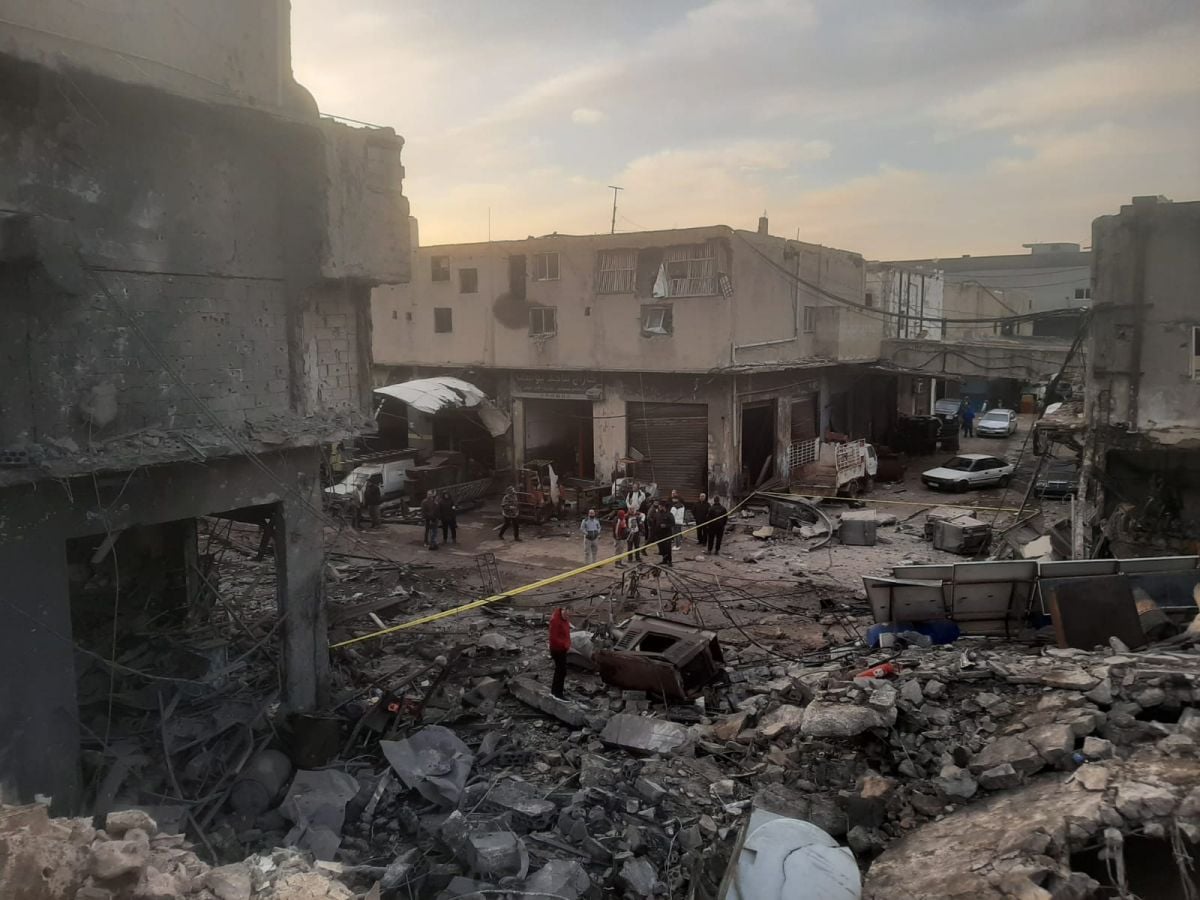
A 3-storey building was leveled by Israeli strikes on the industrial zone south of Saida at 1 a.m. on Tuesday Jan. 6, 2026. (Photo provided by our correspondent Muntasser Abdallah)






SOUTH LEBANON — Israeli strikes in southern Lebanon killed two people on Tuesday, the Health Ministry said, on the eve of a meeting of the cease-fire monitoring committee between Israel and Hezbollah.
Since Monday, Israel has intensified its operations in the south and east of the country, claiming to target the Shiite party and Hamas.
The strike that killed two people occurred in Kfar Dounin, in the Bint Jbeil district, targeting two individuals who were on the roof of a warehouse.
Abbas Hussein Mahmoud, one of the victims, will be buried Wednesday in Deir Kifa (Sour district), Hezbollah announced. His brother was killed during the previous war between Hezbollah and Israel, according to information from our South Lebanon correspondent.
The Israeli army's Arabic spokesperson, Avichay Adraee, said in the evening that the army targeted "two Hezbollah terrorists" accused of working on the "reconstruction of Hezbollah’s military infrastructure." According to Adraee, one of them was "an engineer within the complex and was leading Hezbollah’s rebuilding efforts."
Despite the cease-fire that went into effect at the end of 2024 after a year of conflict, Israel conducts regular strikes in Lebanon, claiming to mainly target Hezbollah and sometimes Hamas. These attacks aim "to thwart all efforts being made locally, regionally, and internationally to end the ongoing Israeli escalation, despite Lebanon’s response," said Lebanese President Joseph Aoun on Tuesday.
The cease-fire monitoring committee — comprised of the United States, France, Lebanon, Israel and the United Nations — will meet Wednesday.
U.N. Under-Secretary-General for Peace Operations, Jean-Pierre Lacroix, is also visiting Lebanon and is set to meet with local officials.
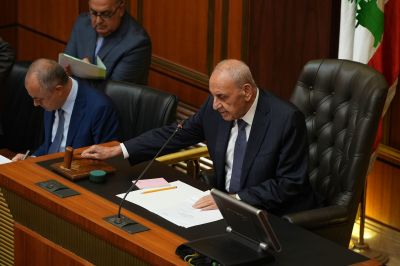
The Lebanese government is set this week to discuss the Hezbollah disarmament plan, launched under U.S. pressure, amid ongoing fears of intensified Israeli airstrikes. Israeli website Walla, citing Israeli security sources, claims "there is no plan to reduce the presence of Israeli forces at the Lebanese border" and that operations could even be carried out "in the southern suburbs of Beirut, if necessary."
The same sources say "Hezbollah coordinates its operations with the Lebanese army, causing concern in Israel over a possible strengthening of this cooperation. This concern has been transmitted to U.S. authorities." The site adds that "Iran continues to transfer funds and combat material to Hezbollah, both directly and via Syria."
The Lebanese Army was to complete by late 2025 the disarmament of Hezbollah south of the Litani River, about 30 kilometers from the Israeli border, before extending its mission to the rest of the country.
Aoun claims this plan is "implemented by the army with professionalism and precision." Israel, on the other hand, doubts the effectiveness of the Lebanese Army and accuses Hezbollah of rearming. Israeli Foreign Minister Gideon Saar on Sunday called the disarmament efforts insufficient.
A three-story building destroyed
On the night of Monday into Tuesday, Israeli strikes destroyed a three-story building in the Siniq industrial area, south of Saida, causing damage to several shops and neighboring buildings, as well as to vehicles and power lines.
Two workers were injured. Earlier, the Israeli army carried out three strikes in the Dalieh sector at Saksakieh, causing no casualties but material damage.
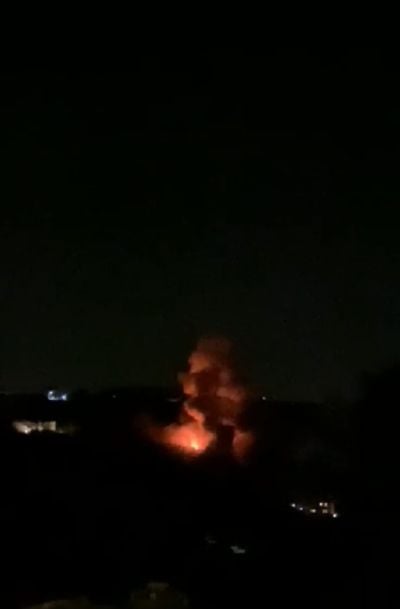
According to the website al-Modon, there is a connection between the bombing of a house in Anan (Jezzine district) on Monday night and that of the Siniq industrial zone.
The house targeted in Anan reportedly belongs to a member of the Qawam family, originally from Saida, and is rented by a Palestinian affiliated with Hamas. The Siniq building, also owned by the Qawam family, houses a workshop and a forge, rented to the same person in partnership with a member of the Chreiteh family.
'The transformation of peaceful villages into military zones'
Following these strikes in Jezzine district, the Lebanese Forces in the region "warned of the serious dangers posed by the presence of illegal weapons in densely populated villages."
"The transformation of peaceful localities into military zones, marked by destruction and death, is a direct consequence of the policies of the 'moumanaa' axis and its allies, who persist in holding Lebanon hostage to uncontrolled weapons, beyond the authority of the state, dragging citizens into conflicts that have nothing to do with them," the LF added.
In this context, they called on "the Lebanese state to act immediately and firmly, restricting arms bearer status exclusively to legitimate forces, without exception, and taking control of all military installations and sites."
The Chamber of Commerce of Saida and South Lebanon, referring to the strike in the Siniq industrial area, denounced "Israeli aggressiveness systematically targeting the productive and economic sectors of the South" and called on the government to quickly compensate owners.
Saida municipal council president Moustapha Hijazi inspected the Siniq site and called it a "criminal aggression."
The Jamaa Islamiya vice-president, Bassam Hammoud, and Nasserist party leader Oussama Saad also visited. Jamaa Islamiya condemned the Israeli attacks, while also criticizing "Lebanese authorities incapable of protecting their sovereignty and citizens."
Opposition MP Melhem Khalaf visited Khiam in Marjayoun district, South Lebanon, where he attended the Epiphany mass at St. Anthony the Great Church.
He declared his support for "the people of the south," noting that "this land brings together its children of all faiths around shared values of resilience and coexistence."
Sound bombs, drones and machine-gun fire
Incidents and Israeli attacks continued Tuesday in South Lebanon. In Yarin (Sour district), a resident found that the Israeli army had blocked the road about 900 meters from the border with sand, rocks and an electric pole, our correspondent reported.
An Israeli drone also dropped a sound bomb on Boustan (Sour district). In the Hasbaya district, the Israeli army fired machine guns at areas of Kfar Shuba from its Roueissat al-Alam site, while other drones flew over Zahrani plain (Saida district).
In southern Kfar Shuba, Bastra, two sound bombs were dropped by an Israeli drone, and sweeping fire was reported from the occupied Hamames hill, south of Khiam (Marjayoun district).
In Bint Jbeil district, a drone dropped a sound bomb on residents of Aita al-Shaab who were inspecting damage to their homes.
The Lebanese army, for its part, began earthworks Tuesday morning in the Ksair neighborhood, east of Mais al-Jabal (Marjayoun district), to build a military post — a move intended to reassure residents and prevent new Israeli incursions in an area where the Israeli army reportedly infiltrates almost daily, according to our correspondent. The army also recovered a downed Israeli drone in Adaisseh (Marjayoun).
In the Bekaa, our regional correspondent reported the presence of Israeli drones over several villages of the eastern chain, including Khodr, Hawr Taala, Brital, Taybeh and Douris.
Amal Movement MP Kabalan Kabalan visited neighborhoods hit the previous day by Israeli shelling in Manara and Ain al-Tineh, West Bekaa. In a statement, he said that "the repeated Israeli attacks reflect a persistent offensive approach," saying his visit aimed to "support residents in their ordeal" and asserting that Israel "has not succeeded and will not succeed in breaking the will of this people."
Reporting by our regional correspondents Muntasser Abdallah, in south Lebanon and Sarah Abdallah in the Bekaa.
