












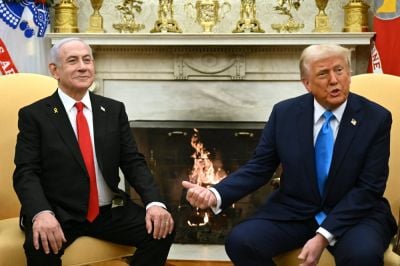
After holding their breath while waiting for the meeting between U.S. President Donald Trump and Israeli Prime Minister Benjamin Netanyahu, most Lebanese parties are now analyzing the statements that followed.
These parties are especially highlighting the connections between Hezbollah Secretary-General Naim Qassem's recent speech on Sunday and Trump’s comments about Hezbollah, which he described as having "behaved badly."
In fact, Qassem's latest speech was seen by some as adopting a firmer tone than earlier ones and, most importantly, as conveying threats — particularly his statement: “Don’t ask us for anything anymore.”
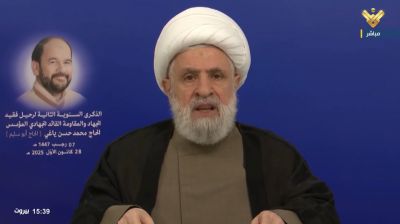
This is the most remembered phrase from the speech, which was deliberately delivered on the eve of the Trump-Netanyahu meeting.
It has been interpreted as a direct threat to Israelis and Americans should they consider launching a major new attack on Lebanon.
Qassem's remarks indicate that Lebanon is now entering a new phase, with no space left for concessions without reciprocation— neither from Hezbollah nor from the Lebanese overall.
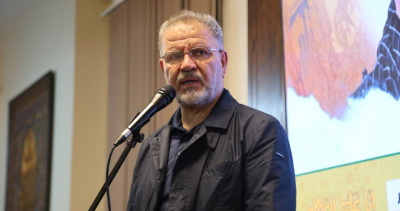
It is now the responsibility of the Israelis to fulfill their obligations under the agreement that took effect on Nov. 27, 2024.
However, according to sources close to Hezbollah, that phrase was not addressed to Americans or Israelis. It was aimed internally, particularly at Lebanese authorities.
Qassem advises these leaders not to request anything further from Hezbollah, since the group has fulfilled all that was asked of it, notably during the first stage of the Lebanese Army’s plan regarding the arms monopoly.
In other words, Hezbollah continues to support the Lebanese state and in no way intends to take its place, particularly in confronting Israel. But this does not mean that Hezbollah must approve everything done by those handling the matter.
Sources close to Hezbollah explain that, by issuing this statement, Qassem sought to break the vicious circle in which Lebanon has been trapped for over a year.
For the party, Lebanon has unilaterally implemented all required provisions. It has even gone further, making all the requested concessions without the Israelis making any gesture in return.
The situation today is as follows: The Lebanese Army is about to announce the completion of the first phase of its plan — adopted by Cabinet — concerning the demilitarization of the area south of the Litani River, scheduled for completion on Jan. 1, 2026.
Yet, the Israelis are continuing their attacks — sometimes after alerting the monitoring committee (the so-called "mechanism"), sometimes without even bothering to notify it.
At the same time, they keep threatening to expand their aggression, extracting more concessions from Lebanon during negotiations.
According to the mentioned sources, Hezbollah believes this cannot go on, and it's necessary to break the cycle that allows the Israelis to get what they want by merely threatening, while continuing their attacks.
Nevertheless, the sources stress, this does not mean Hezbollah is questioning the Nov. 27 agreement, or is preparing to take back the initiative, let alone resume military action.
The phrase is not a threat to Americans and Israelis but a reminder to Lebanese authorities to demand that Israelis, in turn, implement the agreement's stipulations.
From Hezbollah’s perspective, this is not about escalating or responding to Israeli threats with threats of its own, but instead reminding authorities of their responsibility to implement the terms of the agreement.
Hezbollah continues to refer to the agreement, believing it is in its favor — or at least equitable. That is why, just two weeks after it took effect on Nov. 27, Western (mainly American) envoys began calling for a new deal or its amendment.
In the meantime, a significant change occurred in Syria (Dec. 8) with the fall of the Assad regime, which had been a part of the "Axis of Resistance."
With the regime’s fall, Iran and Hezbollah lost a key supporter, and the Israelis and Americans want this change to be reflected in security arrangements, whereas Hezbollah demands the strict application of the agreement.
In this context, sources close to Hezbollah say Qassem’s recent speech boils down to this equation for Lebanese officials: “If you can’t get anything from Israel, don’t ask us for anything else.”
The timing is calculated to coincide with the start of the army plan’s second phase, which involves Hezbollah’s weapons north of the Litani and is scheduled to begin at the start of the year.
According to the sources, if the Israelis make no gesture, then ways must be found to “contain the weapons,” rather than destroy them, especially since in a previous speech, Qassem insisted that Hezbollah has no offensive intentions and merely maintains a defensive stance.
But regionally, and concerning confrontation with the Israelis, Hezbollah’s position remains unaltered: The group will stand behind the Lebanese state, and it is the state that must make the appropriate decisions.
According to these same sources, this approach more or less echoes the comments of Trump, who, after he met with Netanyahu, acknowledged Hezbollah’s bad conduct but said the key was to see how the Lebanese government deals with it.
In other words, for Trump as well, the ball is still in the court of Lebanese authorities. But in the larger regional picture, all eyes remain on Iran.
This article was translated from L'Orient-Le Jour.