


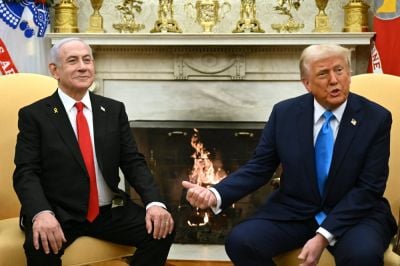
U.S. President Donald Trump meeting with Israeli Prime Minister Benjamin Netanyahu during a bilateral meeting at Trump's residence in Mar-a-Lago in Palm Beach, Florida, on Dec. 29, 2025. (Credit: Jim Watson/AFP)






During U.S. President Donald Trump and Israeli Prime Minister Benjamin Netanyahu's meeting on Monday in Florida, Trump warned Iran and Hamas against any attempt to rearm, as the latter is expected to disarm under the second phase of the Gaza cease-fire.
Speaking at a joint news conference at Trump’s Mar-a-Lago residence, the U.S. president said any Iranian effort to rebuild its nuclear program or ballistic missile arsenal would be swiftly "crushed."
“I hope they’re not trying to build up again because if they are, we’re going have no choice but very quickly to eradicate that buildup,” Trump said, adding that the U.S. response “may be more powerful than the last time.”
A close adviser to Iran’s supreme leader, Ali Shamkhani, responded that “any aggression” against Iran would be met with an “immediate harsh response,” writing on X that Iran’s missile and defense capabilities “are not containable or permission-based.”
Gaza's cease-fire
Trump also dismissed reports of tensions with Netanyahu over the fragile Gaza cease-fire, saying Israel had "lived up" to its commitments and that responsibility now lay with Hamas, whose disarmament is a key provision of the second phase of the deal.
"If they don't disarm as they agreed to do, then there will be hell to pay for them," Trump said. "They have to disarm in a fairly short period of time."
Hamas’ armed wing reiterated earlier Monday that it would not surrender its weapons. “Our people are defending themselves and will not give up their weapons as long as the occupation remains,” the Ezzedine al-Qassam Brigades said in a video message.
While some White House officials fear Netanyahu is slow-walking the process, Trump said he had "very little difference" with the Israeli premier and was "not concerned about anything that Israel's doing."

Netanyahu described his talks with Trump as “very productive” and announced that Israel would award the U.S. leader its highest civilian honor, the first time it has been given to a non-Israeli citizen.
Trump said Netanyahu had done a “phenomenal job” and “Israel wouldn’t exist without him” after the Oct. 7, 2023, Hamas-led attacks.
The meeting was the fifth between the two leaders in the United States since Trump's reelection in November 2024. Washington has been pressing to move ahead with the second phase of the cease-fire that has been in effect since Oct. 10, despite daily Israeli violations.
According to Gaza’s Government Media Office, Israel committed 969 violations in the 80 days of the cease-fire, including repeated attacks and incursions, wounding at least 1,141 Palestinians, and illegally arresting 45 others.
Over 71,000 Palestinians have been killed in Israel's war on Gaza.
The second phase outlines the disarmament of Hamas, a gradual Israeli military withdrawal from Gaza, the establishment of a Palestinian technocratic transitional authority and the deployment of an international stabilization force. Progress has stalled.
Axios reported that the Trump administration wants to announce a Palestinian technocratic government for Gaza as early as January. The outlet also reported Monday that Trump and his top advisers urged Netanyahu during their meeting to change Israel’s policies in the occupied West Bank.
Trump said he hoped reconstruction could soon begin in Gaza, which has been devastated by over two years of relentless Israeli attacks.
Threats to Iran
Israeli officials have voiced concern that Iran is rebuilding its ballistic missile arsenal after it was damaged during a 12-day conflict with Israel in June. A government spokeswoman said Netanyahu’s visit aimed to highlight the “danger posed by Iran,” not only to the Middle East but also to the United States.
Trump said Iran “may be behaving badly” and looking for new nuclear sites to replace those targeted by U.S. strikes, while also attempting to restore its missile capabilities. Still, he said Tehran remained interested in a deal with Washington on its nuclear and ballistic programs, an assertion Iran disputes, while denying it seeks nuclear weapons.
The leaders also discussed other regional flashpoints, including Syria and Hezbollah in Lebanon. Trump said he hoped Netanyahu could “get along” with Syria’s new president, Ahmad al-Sharaa, a former jihadist who came to power after the ouster of Bashar al-Assad, despite recent Israeli strikes along the border and against Hezbollah targets.
“The new president of Syria is working very hard to do a good job, he really is," said Trump. "You’re not going to get a choir boy to lead Syria.”
Netanyahu’s visit capped several days of intense diplomacy in Palm Beach, where Trump hosted Ukrainian President Volodymyr Zelensky a day earlier for talks on ending Russia’s invasion of Ukraine.

 7 p.m. recap: 1 person killed near border with Lebanon; 200 kilos of explosives carried by mules; Riyadh shuts its airspace