





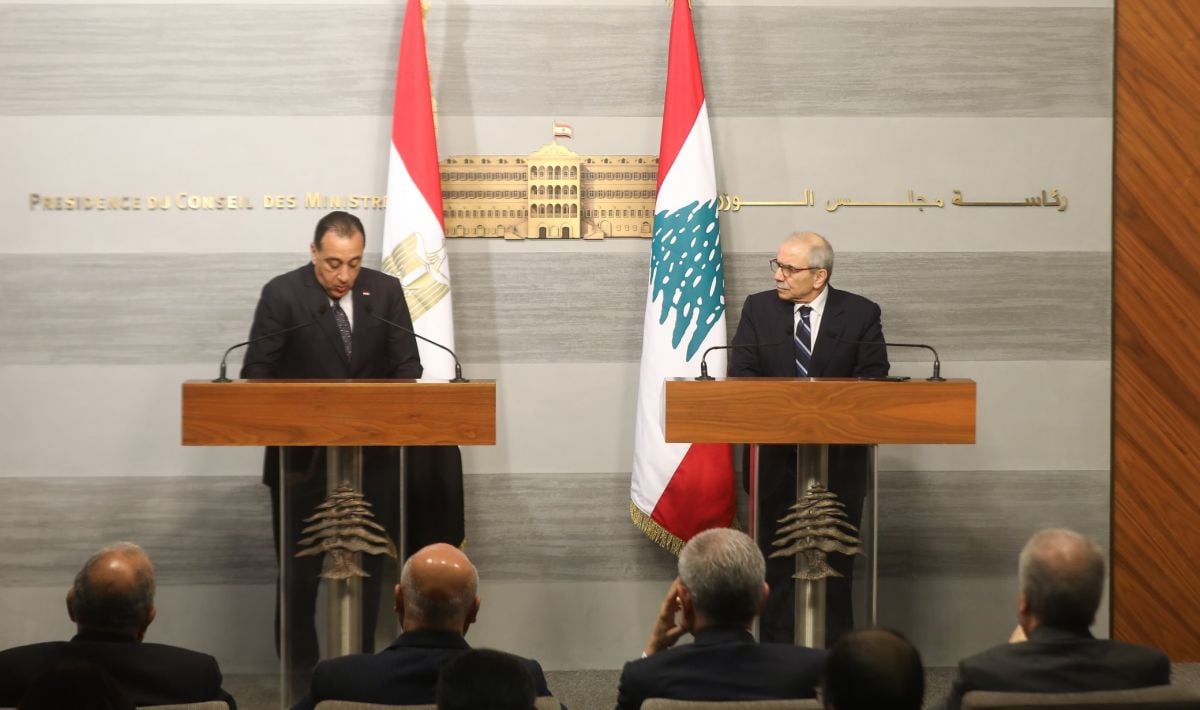
The Egyptian and Lebanese prime ministers at a joint press conference at the Grand Serail, Friday, Dec. 19, 2025. (Credit: Lebanese Parliament X page)






Cairo is continuing its mediation efforts to prevent a new Israeli offensive in Lebanon, Egyptian Prime Minister Mostafa Madbouly reiterated Friday during an official visit to Beirut, as part of Egypt’s commitment to keep Lebanon safe from renewed tensions, more than a year after a shaky cease-fire agreement. He called Lebanon “a key pillar of stability in the Middle East.”
Madbouly reiterated this support in Beirut and also voiced his disapproval of Israel’s violations of the truce during a joint press conference with his Lebanese counterpart, Nawaf Salam, at the Grand Serail.
“We support the Lebanese government’s efforts to extend state control over all national territory and salute the efforts of Presidents Joseph Aoun and Nawaf Salam to consolidate stability,” he said, referring to decisions made by the executive branch to regain the monopoly over arms for the state and deploy the Lebanese Army in the South.
“A strong state is a guarantee and establishes legitimacy,” he stressed, before affirming that Egypt continues to work to ensure Lebanon remains safe from any Israeli escalation.
“We reaffirm Egypt’s longstanding position of support for Lebanon and renew our rejection of continuing Israeli violations and the occupation of certain points in the South,” he added, as the Israeli army strikes southern Lebanon almost daily and occupies at least six positions on Lebanese soil along the border.
He reiterated Egyptian demands for “an immediate and unconditional Israeli withdrawal from all Lebanese land, respect for the cessation of hostilities agreement, and full and non-selective implementation of U.N. Security Council Resolution 1701.”
This latest Egyptian show of support was expressed by Madbouly, who said that a meeting of the ‘Mechanism’, the cease-fire monitoring committee, was being held in Naqoura (southern Lebanon).
Egypt is the only major Arab country to communicate with both Israel and all Lebanese stakeholders, including Hezbollah, maintaining open channels with Iran — unlike Saudi Arabia, which keeps a cautious distance from the pro-Iranian party.
Cairo also hopes to leverage the central role it played in the Gaza agreement validated at the historic Sharm al-Sheikh summit to become a key player once again in a region undergoing major changes and to consolidate its place on the diplomatic chessboard.
Arriving at the Grand Serail at 9:30 a.m., Madbouly was welcomed by Salam. After an official ceremony at which the Internal Security Forces (ISF) band played the national anthems of both Lebanon and Egypt, the two prime ministers inspected the honor guard and greeted members of the official Lebanese and Egyptian delegations.
They then met to discuss bilateral relations and ways to strengthen cooperation between the two countries.
Salam hails Egypt's 'efforts'
The Lebanese prime minister, in turn, praised Egypt’s efforts to end the Israeli occupation in the South. “We reiterate our deep gratitude for Egypt’s support role for Lebanon as it strives to end the Israeli occupation of certain parts of the south, halt ongoing Israeli attacks and secure the release of our prisoners,” Salam said in a statement on the Presidency of the Council’s X account.
“We also salute Egypt’s consistent support for Lebanon in its reform process and its steadfast commitment to Lebanon’s unity and sovereignty, under all circumstances,” he added.
Salam also discussed with his Egyptian counterpart “cooperation priorities in several vital sectors, from energy to transport, industry to digital economy, infrastructure to education and irrigation,” noting that the relationship between the two countries goes beyond a simple exchange of interests.
“It’s a complementarity of visions, an interaction along our paths, and a shared history that we wish to confidently carry into the future,” he observed.
The prime minister also welcomed Madbouly’s interest in meeting with business leaders “to strengthen relations between the Egyptian and Lebanese sectors” and explore opportunities for joint investment.
Madbouly is accompanied on his visit to Lebanon by Deputy Prime Minister for Industrial Development and Minister of Industry and Transport Kamel Abdel Hadi Farag and the ministers of Electricity and Renewable Energy, Mahmoud Essmat, and Petroleum and Mineral Resources, Karim Badawi.
'A message of total support from Egypt'
The Egyptian Cabinet chief then went to the Baabda Presidential Palace, where he conveyed the support of Egyptian President Abdel Fattah al-Sisi to Aoun and to “the efforts undertaken” by Aoun and the Lebanese government to “guarantee Lebanon’s stability and security, implement Resolution 1701 and enable the army and Lebanese institutions to exercise their authority over the entire territory and restore sovereignty there.”
He also stated that Egypt “strongly condemns all brutal Israeli aggression against the south of the country.”
Madbouly further clarified that the purpose of his visit was to “convey a message of total support from Egypt, with all the means at its disposal, to Lebanon, its presidency, government, and people, at this delicate time.”
He added that the meeting also aimed to “revive the work of the Lebanese-Egyptian High Commission” and “discuss with the Lebanese government cooperation prospects in several sectors, including energy, electricity, gas, as well as industry and transport.”
He also stated Egypt’s “readiness,” both as a state and in the private sector, “to support Lebanon in development projects, including reconstruction efforts in the south of the country, affected by the Israeli offensive.”
For his part, the president of the republic emphasized that Lebanon was counting on “Egypt’s fundamental political role in the Arab world, as well as its aid during this difficult period.”
He said that “reviving the work of the Joint High Commission between the two countries is necessary for the common interest,” and expressed hope “that ongoing efforts will help to stabilize Lebanon and bring peace to the region.”
Noting that “Egypt has never intervened in Lebanese affairs except in Lebanon’s interest,” the head of state said that “every bit of support Cairo provides is appreciated.”
He also noted that while Egyptians consider Lebanon their “second country,” Lebanese feel the same about Egypt.
The Egyptian prime minister then visited Ain al-Tineh, where he was hosted by Parliament Speaker Nabih Berri.
On Friday, Egyptian Foreign Minister Badr Abdelatty said in an interview published by Asharq al-Awsat that he had “held intensive talks with Israel, Iran, and the United States to spare Lebanon the agony of any intervention or military operation that might harm the capabilities and resources of the Lebanese people,” he said.

 Evening recap: Netanyahu announces West Bank offensive; 7 killed in Jordan church shooting; tents burned in south Lebanon
 US strike on Iran this weekend? ‘Absolutely,’ says Barrack; ‘I have no idea,’ says Trump