






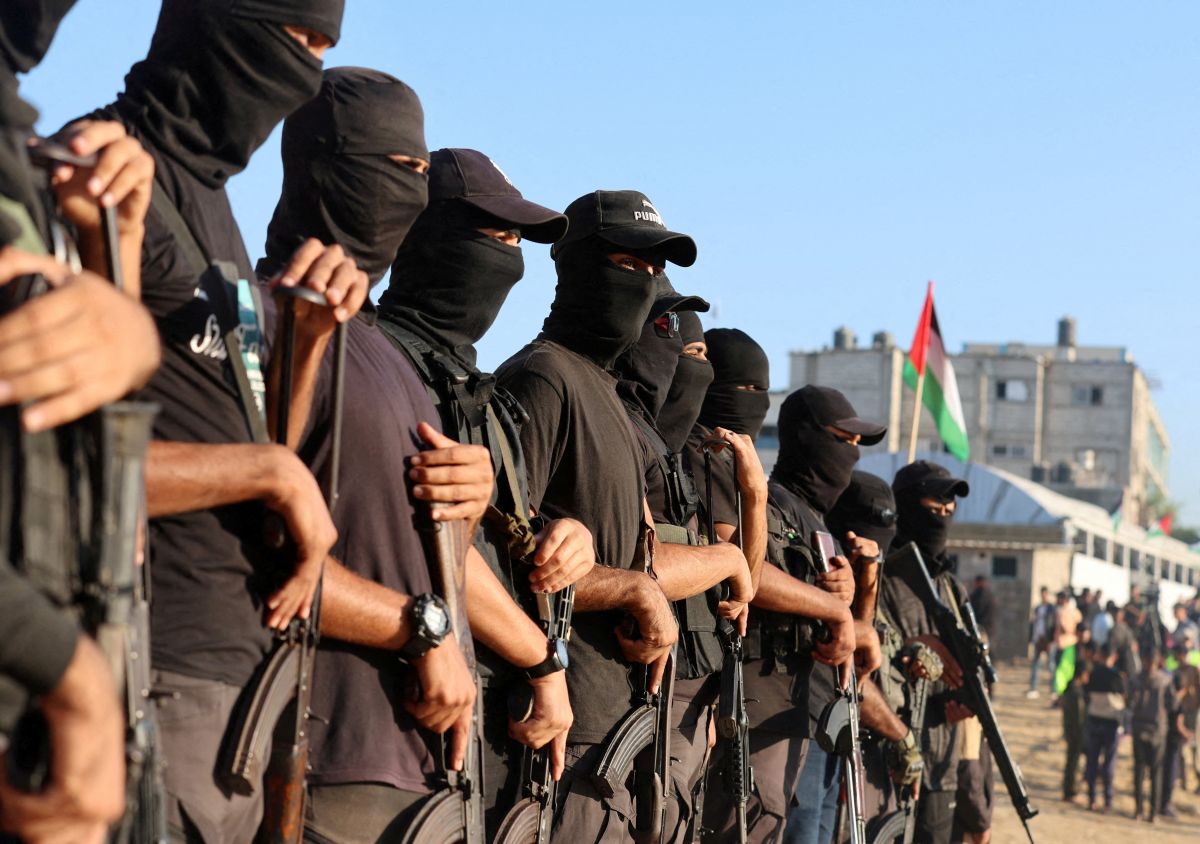
Palestinian militants standing guard during a hostage release in Gaza as part of the cease-fire agreement, in Khan Younis, in the south of the Gaza Strip, on Oct. 13, 2025. (Credit: Ramadan Abed/Reuters)






A militia leader hostile to Hamas operating in the Gaza Strip has said on an Israeli TV channel that his group is funded and supported by Israel, as Israel continues its efforts to strengthen its control over the besieged enclave.
Speaking on the right-wing Israeli channel Channel 14, Shukri Abu Nassira claimed that his militia, known as the “Forces of the Popular Army of the Free Homeland,” receives direct support from Israel in “weapons, food, drinks and clothing.” "We have top-level security coordination," he said.
This militia was established last November, according to a video showing Abu Nassira speaking to armed men chanting "death to Hamas."
Channel 14’s report, as well as observers of the Gaza war on social media, report that Abu Nassira’s men operate near Khan Younis, in the south of the enclave, in areas under Israeli control, east of what is now called the “Yellow Line.”
Links to Abu Shabab
A former member of the Palestinian Authority’s security services, Abu Nassira previously served in these security forces and was sentenced to five life sentences after being arrested by Israel in 1984.
His name has also been linked to the network of Yasser Abu Shabab, the leader of another militia supported by Israel, who was killed last month in suspicious circumstances near Rafah, in the south of the enclave.
He is also said to have ties with a mercenary named Ashraf al-Mansi, leader of the “Popular Army – Northern Force,” one of six independent Hamas militias reportedly enjoying Israeli backing.
After tacitly supporting Hamas funding for many years, the Israeli government has forged links with various armed factions hostile to the Islamist movement since the beginning of its Gaza offensive.
These same groups have been accused by several international observers, the United Nations, and the local population of contributing to the looting of humanitarian aid, the entry of which is controlled by the Israeli army.
This policy has already sparked controversy within Israel itself. Last June, several officials accused Israeli Prime Minister Benjamin Netanyahu of authorizing the arming of such groups without official approval.
Despite a cease-fire, Israel has continued its strikes on Gaza and extended its area of control, now covering more than half the enclave. The majority of Gaza’s population, however, remains in areas still controlled by Hamas, which has rejected demands from Israel and the United States for its disarmament.
Despite the truce agreement that came into effect on Oct. 10, at least 394 Palestinians have been killed by Israeli attacks. In addition, the ongoing blockade on humanitarian aid has prevented essential winter supplies from entering, while the devastated enclave has been hit by harsh weather that has caused several deaths, including children who died from the cold.

