






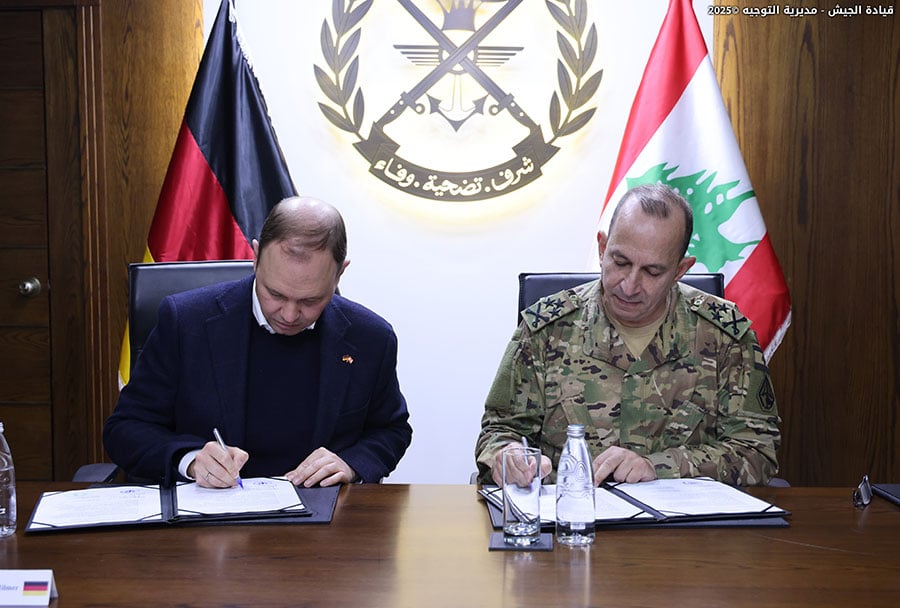
Defense Minister Michel Menassah welcoming German Deputy Defense Minister Nils Hilmer in Yarzeh on Dec. 16, 2025. Photo taken from the Lebanese Army website.






BEIRUT — Defense Minister Michel Menassah met Tuesday at the ministry in Yarzeh with German Deputy Defense Minister Nils Hilmer to discuss Germany's support for the Lebanese Army and the situation in south Lebanon.
During the meeting, Menassah thanked Germany for its support of the army and its participation in UNIFIL's naval force. He also emphasized "the ongoing cooperation to develop the naval forces' capabilities, which are essential for protecting maritime borders and securing territorial waters, ahead of the gradual withdrawal of peacekeepers planned for the end of 2026."
Hilmer, for his part, reaffirmed his country's commitment to continue supporting the army and the Lebanese state, saluting "the military institution's role in maintaining security and stability, as well as its efforts in South Lebanon to centralize weapons in the hands of the state."
Menassah highlighted "the difficulties faced by the Lebanese army in fulfilling its missions," and expressed hope that Germany, in coordination with the international community, "would exert the necessary pressure on Israel to withdraw from still-occupied positions in south Lebanon and to end its repeated violations and attacks."
On Monday, the commander in chief of the Lebanese Army, General Rodolph Haykal, received Hilmer in his office in Yarzeh, where they discussed cooperation between the two countries' armies. The officials signed two agreements regarding German support for the army, notably "guaranteeing its fuel supply and strengthening military health services," according to the state-run National News Agency (NNA).
"The signing of these agreements reaffirms the German authorities' commitment to supporting Lebanon's stability and the capabilities of its army in the face of current challenges," the agency added.
The Lebanese Army is expected, by the end of the year, to finish dismantling Hezbollah's military infrastructure between the Israeli border and the Litani River — the area about 30 kilometers further north — as stipulated by the cease-fire agreement. Israel, for its part, maintains five positions on Lebanese territory and continues to carry out near-daily strikes.
