



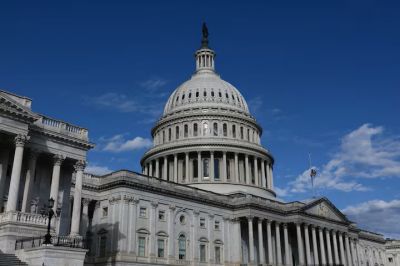
The Capitol after the Senate passed a bill to end the shutdown of government services in Washington, D.C., Nov. 10, 2025. (Credit: Evelyn Hockstein/Reuters)






After being initially lifted temporarily by the U.S. Treasury, the U.S. House of Representatives has now approved the permanent repeal of heavy sanctions imposed on Syria under the "Caesar Act," following the adoption of the new Defense budget for 2026.
The final version of the bill, detailed by Reuters, was passed Wednesday by the House of Representatives, allocating nearly $1 trillion in total to the state for defense spending. The measure includes the repeal of economic sanctions against Syria enacted with the passage of the Caesar Act in 2019, a key move for any prospect of the country's economic recovery.

Passed with 312 votes to 112
The Caesar Act, passed in late 2019 by the U.S. Congress and coming into force in June 2020, constituted one of the toughest sanction packages ever imposed on a country. It targeted the Syrian regime of Bashar al-Assad as well as any person or entity providing it with economic or military support.
Its name comes from a former Syrian military police photographer, "Caesar," who fled the country carrying tens of thousands of photos depicting the torture and abuses inflicted on prisoners in Syrian jails by regime authorities.
The U.S. House of Representatives voted Wednesday to adopt the budget by a wide majority, 312 votes to 112. The bill will be sent to the Senate next week and is expected to be signed into law by U.S. President Donald Trump by the end of the month.
"I am grateful to the House of Representatives for adopting the COMPLETE repeal of the Caesar Act," wrote Republican Senator Joe Wilson, who authored the repeal legislation, in a statement on X after the vote. "I hope the Senate will adopt it in the coming days and it will then be submitted for President Trump's signature," he added.
This repeal comes nearly eight months after a promise made by Trump last April, during his first meeting with Syrian President Ahmad al-Sharaa in Saudi Arabia. Two temporary suspensions of these sanctions, each for four months, had since been announced by the U.S. Treasury, before the definitive repeal was enacted this week.

Renewed support for Israel
Furthermore, this finance bill includes many other expenditures related to the Middle East, particularly regarding support for Israel.
Although precise figures are not yet known, the budget provides for increased support to Israel, including full funding for Israel's Iron Dome and David's Sling air defense systems. It also requires ongoing assessment of international arms embargoes targeting Israel, notably those enacted in response to the war in Gaza, as well as an analysis of whether the United States could itself meet Israel's military production needs.
Finally, the text also provides for the repeal of the authorizations for the use of military force against Iraq, dating from 1991 and 2002, marking Congress' intent to regain control over decisions regarding military engagement.
These authorizations had notably allowed several administrations to justify foreign operations, including the 2020 killing of Iranian General Qassem Soleimani, which at the time was claimed on this legal basis.

 1 p.m. recap: Third death in 2 days in Israeli-occupied south Lebanon, Salam comments on the Dahr al-Baidar case, Saudi Arabia bombs Yemen