


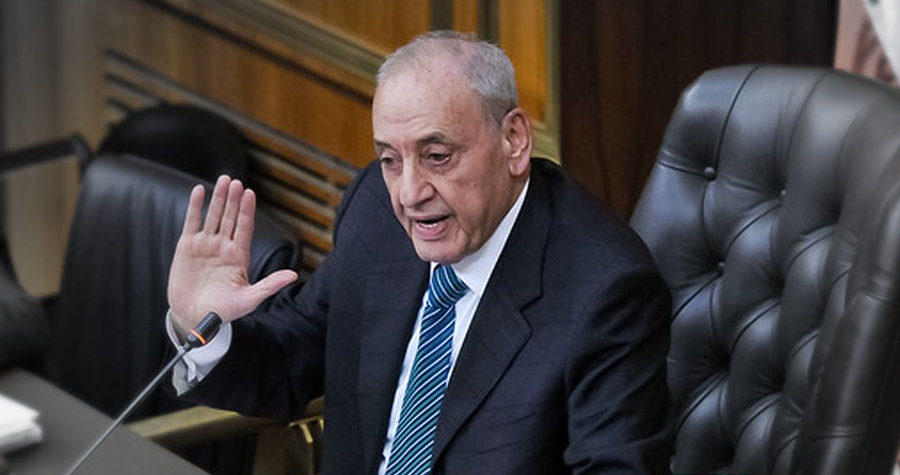
Parliament Speaker Nabih Berri. (Credit: NNA)






BEIRUT — Parliament Speaker Nabih Berri told a delegation from the Lebanese Press Syndicate on Thursday that the May 2026 legislative elections will take place according to the current electoral law, in which the diaspora would vote for six separate MPs, with room for "consensus" regarding its controversies.
"The current electoral law remains in effect and the elections will be held according to this law," the state-run National News Agency cited Berri as saying during the meeting with the delegation, which was led by Aouni Kaaki, "We are open to any formula that allows for a consensus on points of disagreement between the political forces, particularly regarding the expatriate vote."
"No one wants to exclude them," he added.
The Amal Movement's Development and Liberation bloc has been advocating for the implementation of the Taif Agreement for "more than eight years, " Berri said, referring to the party of which he is head, "especially the section related to the electoral law and the creation of a Senate," he stressed.
The expat vote is the subject of a bitter standoff in Parliament. The Amal Movement and Hezbollah spport maintaining the law as is, which relegates all diaspora votes to six specially designated MPs, while the opposing sides want expats to be allowed to vote in their ancestral villages regardless of their residency there. Berri refuses to place an amendment to the electoral law on the agenda of any plenary session, and as a result, several meetings have been block due to walkouts that led to a lack of quorum.
'No one is asking if Israel has respected the cease-fire'
Berri also told the syndicate that the Lebanese Army has now "implemented 90 percent of the cease-fire's provisions" and would complete the implementation by the end of the year. According to him, this information has been confirmed by the United Nations Interim Force in Lebanon (UNIFIL), the cease-fire monitoring committee, and the army commander, General Rodolph Haykal.
"Since November 2024, Lebanon has fulfilled all its obligations. The Lebanese Army has deployed more than 9,300 officers and soldiers, supported by UNIFIL, which confirmed in its latest reports what we are saying about Lebanon's commitment to fulfilling all its obligations, while Israel has violated this agreement nearly 11,000 times," Berri emphasized.
"Unfortunately, no one is asking, and no one has ever asked, where, when, or how Israel has implemented or respected even one clause of the cease-fire agreement. On the contrary, Israel has expanded its occupation of Lebanese territory."
"Isn't the 'Mechanism' [the cease-fire monitoring committee] a negotiation framework? We are negotiating certain principles within this committee: Israeli withdrawal, deployment of the Lebanese Army, and the monopoly of weapons in the area south of the Litani under the authority of the Lebanese Army."
"This committee operates under the auspices of the United States, France, and the U.N., and I have repeatedly stated that I have no objection to seeking the assistance of any civil or technical expert if necessary, provided the [cease-fire] agreement is implemented," he said.
In early December, Lebanon appointed lawyer and former ambassador Simon Karam, to the committee, responding to a demand from Washington and Tel Aviv to have a civilian representative negotiatin with Israel.
Israel continues to attack Lebanon, despite the Nov. 27, 2024, cease-fire agreement and the fact that Hezbollah has so far refrained from retaliating. Israel has violated the agreement more than 12,000 times, according to an investigation by L'Orient Today, and has killed more than 350 people. It is also still occupying six outposts on Lebanese territory along the Blue Line, from which soldiers regularly fire on Lebanese border villages.
Berri also received U.S. Ambassador to Lebanon Michel Issa on Thursday. Issa had already met with Berri on Wednesday with a delegation from the American Task Force for Lebanon (ATFL), chaired by Edward Gabriel.
Questioned about the remarks of U.S. envoy Tom Barrack relating to Lebanon and Syria, Berri replied: "No one should threaten the Lebanese. It is totally unacceptable to address the Lebanese in this manner, especially from diplomats."
He added that Barrack's remarks "constitute a serious error and are absolutely unacceptable."
"I reiterate that the Lebanese have no choice but to unite to face dangers, repercussions, and threats from wherever they come. It is through our unity that we can liberate our land," he said.
Barrack had stated that the United States wants to "find solutions" to the crises in Lebanon and Syria, calling to "bring together and align" the two countries, during a roundtable at the Doha Forum on a year of transition in Damascus.

 7 p.m. recap: 1 person killed near border with Lebanon; 200 kilos of explosives carried by mules; Riyadh shuts its airspace