





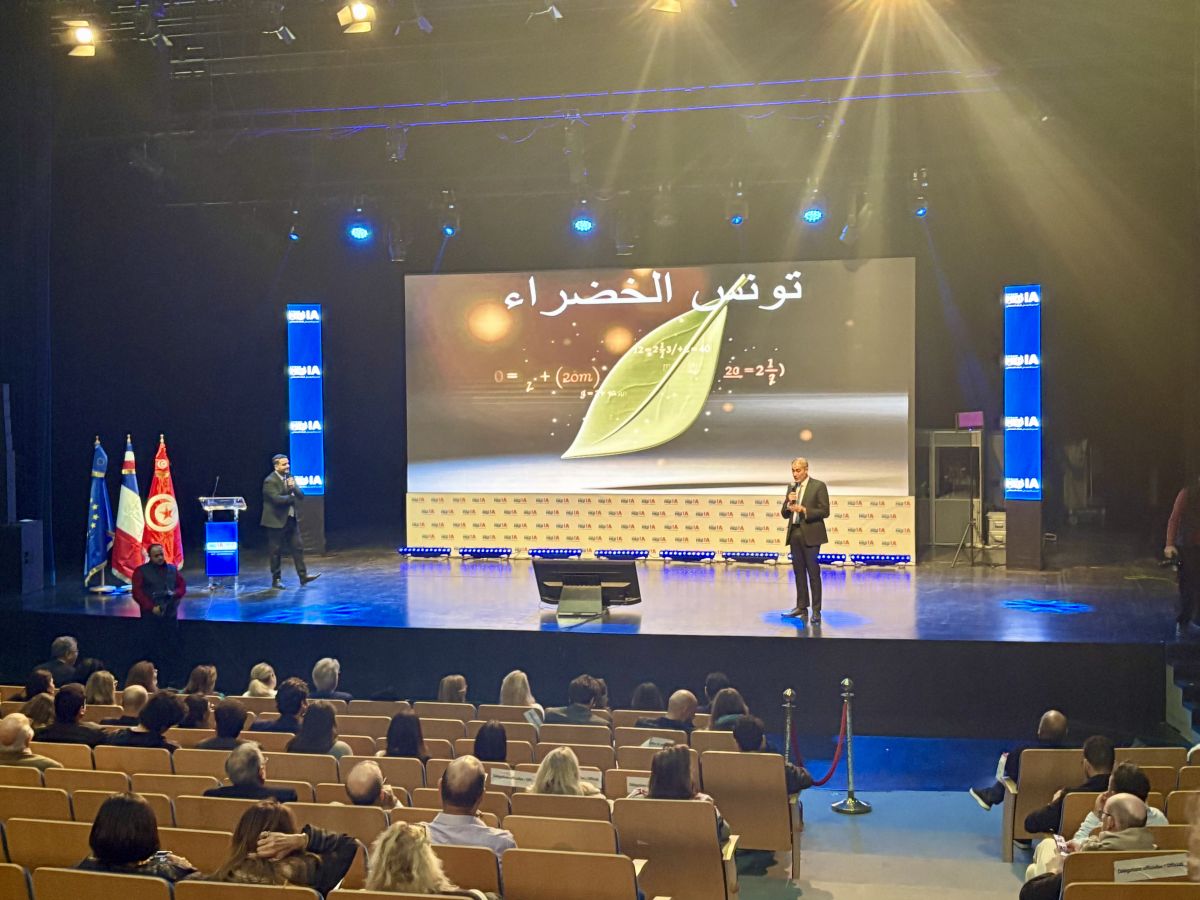
Keynote by Nizar Yaiche, former Tunisian Minister of Finance, at the Mediterranean Forum on Artificial Intelligence. (Credit: Emily Carpenter)






“What solutions can AI bring to the major challenges facing the Mediterranean?” That was the central question at the Mediterranean Forum for Artificial Intelligence, held in Tunis on Nov. 20 and 21.
One of the region’s biggest challenges is ecological. “A hotspot for climate change, the Mediterranean is warming 20 percent faster than the global average and faces unprecedented threats to its ecosystems, economies and communities,” the Union for the Mediterranean (UfM) reports on its website, citing findings from the first Mediterranean Assessment Report (MAR1), conducted in 2020 by Mediterranean climate and environmental experts (MedECC) and the UfM.
“If warming continues at its current pace, many Mediterranean territories will become uninhabitable,” geographer Magali Reghezza-Zitt warned four years later in an op-ed in Le Monde.
It is no surprise, then, that the ecological emergency and the real or expected solutions AI could offer dominated several panels in Tunis.
During a session titled “AI, water and agriculture: food security and sustainability,” speakers highlighted the range of technologies now available. Faten Aiss, global partnerships director at Flat6Labs, a startup accelerator active in emerging markets across the Middle East and Africa, pointed to companies developing intelligent irrigation systems in high–water stress agricultural zones, including Algeria.
These systems, she said, can save between 40 percent and 60 percent of water — a critical difference in regions where every drop matters.
“The Mediterranean is a beacon of hope and full of solutions,” said Rym Benzima, director of the World Sea Forum. She noted innovations such as AI tools that detect plastic clusters in the Mediterranean Sea through satellite imagery, offering new ways to target cleanup operations.
The stakes are high. The Mediterranean has record concentrations of microplastics per square kilometer, making it the most polluted sea in the world. In this context, AI-assisted cleanup technologies appear to be a promising — perhaps even decisive — path.
The case of data centers
Another opportunity for the region lies in data centers, the infrastructure needed to train, deploy and operate AI systems. “Data centers are the refineries of the 21st century,” said Karim Beguir, co-founder of Instadeep, an AI startup.
These facilities, pillars of the global digital economy, consume enormous amounts of energy. There are now more than 10,000 worldwide, but only 239 in Mediterranean countries.
For Beguir, countries in the region, rich in renewable resources such as solar and wind, must reduce their dependence on major international data centers, largely concentrated in the United States.
Building local centers, he argued, would strengthen technological sovereignty as well as economic and environmental autonomy by giving Mediterranean states more control over the hosting, security and energy supply of these strategic facilities.
The environmental impact of AI
AI’s environmental footprint extends beyond energy demand. Data centers are also major consumers of fresh water used in cooling systems. According to a recent study by U.S. universities, global AI demand could use between 4.2 and 6.6 billion cubic meters of water by 2027, up to five times Lebanon’s total annual consumption.
Added to this are greenhouse gas emissions, the use of rare metals whose extraction is highly polluting, and the rapid turnover of electronic equipment, which accelerates the production of e-waste.
Few participants in Tunis dwelled on these issues, even as more researchers warn about AI’s growing environmental cost.
Nesrine Shehata, a lecturer in geospatial science and AI for Earth observation and moderator of the panel “AI for territory anticipation and resilience,” said she was surprised by how little attention the topic received. This is all the more striking, she added, because circular solutions exist — such as closed-loop cooling systems that recycle wastewater or capture rainwater to reduce a facility’s water footprint.
However, a 2024 World Economic Forum report notes that such systems can be difficult to implement because cooling water often becomes contaminated with dust, chemicals and minerals, reducing its effectiveness if recirculated.
For Bendjedid Rashad Sanoussi, founder of Green Leaf AI — which uses artificial intelligence to help farmers protect date palms from disease — what is needed is a civic awakening. “It is startups and businesses that must advocate for greener, more ethical AI,” he said.
Whether that awakening — or even a basic awareness — will come in time remains uncertain.
“There will be competition between us and artificial intelligence for resources,” warned Mayssa Sandii, CEO of the Tunisian environmental media outlet Blue TN and one of the few panelists to clearly voice concerns about AI’s environmental impacts.

 Midday news recap: Hebron attack sparks Israeli crackdown, international meeting in Istanbul for regional 'de-escalation'