






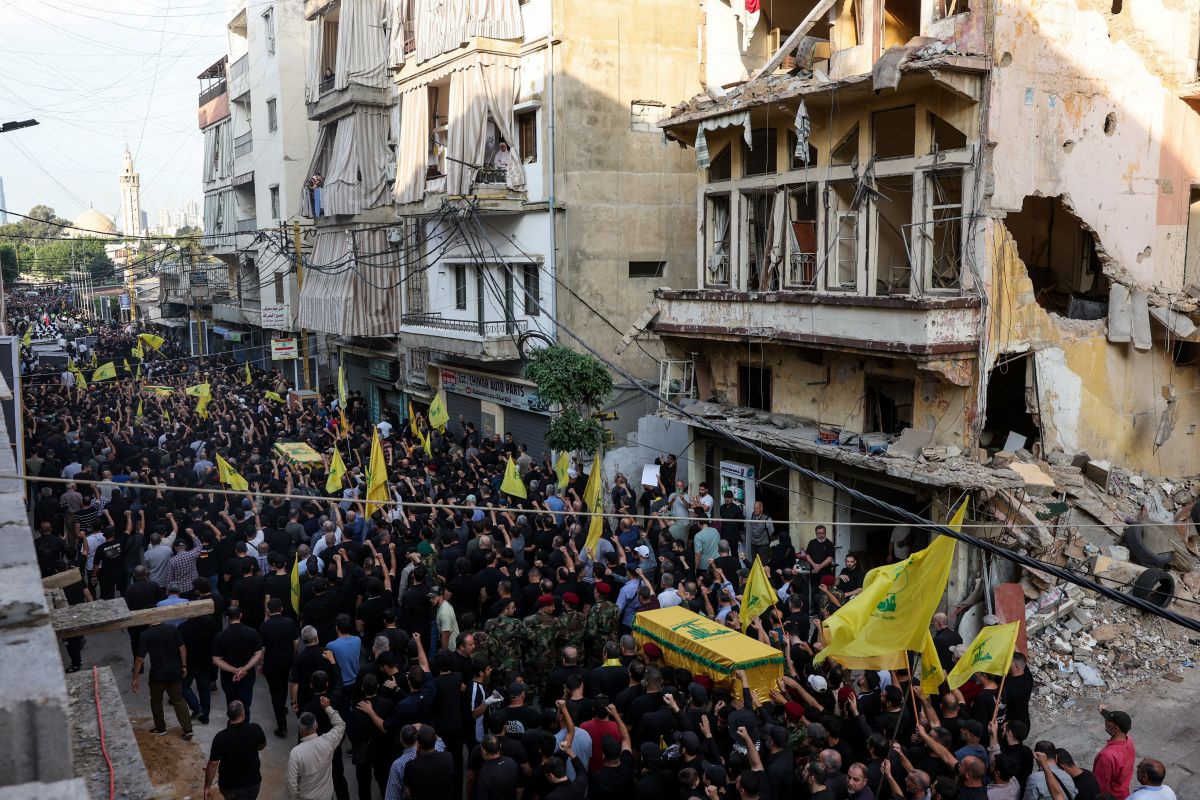
Funeral of Hezbollah's top military official Haytham Ali Tabtabai, in Beirut's southern suburbs






BEIRUT — Iraq’s central bank-affiliated committee will review its recently published list of 26 groups, including Hezbollah and the Houthis, whose assets were frozen over alleged “terrorist” activities.
In a statement released via the official Iraqi news agency INA, the Committee for the Freezing of Terrorist Assets said the list included "a number of parties and entities that have no connection to terrorist activities" of the Islamic State organization or al-Qaida, while Iraq had committed, at Malaysia's request and in line with U.N. Security Council Resolution 1373 [2001, on the suppression of the financing of terrorist acts, ed.], to only include entities whose assets should be frozen that are "linked to ISIS and al-Qaida."
The committee said the inclusion of other entities was due to the "publication of the list before its revision." "What was published in the Iraqi official gazette will be corrected to remove these parties and entities from the list of groups linked to the terrorist organizations Daesh [the Arabic acronym for IS, ed.] and al-Qaida."
The decision published in Iraq's official gazette, which is still available online, included 24 entities, among them Hezbollah, accused of having "participated in terrorist acts," al-Jamaa al-Islamiya, a Lebanese Sunni party affiliated with the Muslim Brotherhood and close to Hamas, and Yemen's Houthis.
Iraqi Prime Minister Mohammad Shia al-Soudani ordered an “urgent investigation” into this “mistake,” AFP reported.
The publication in the Official Journal on Nov. 17 was widely criticized, especially by pro-Iranian politicians, in a country that has for years maintained a delicate balance between its Iranian and American allies.
Hussein Mounes, head of the parliamentary group close to Kataeb Hezbollah, accused the government of being “weak” and “lacking dignity.”
According to the committee’s decision, taken on Oct. 27, 2025, all funds and assets of people identified by the committee were to be frozen. The list, which includes 24 entities and many individual names, also mentions al-Qaida, the al-Nusra Front, al-Shabaab in Somalia, and AQAP, al-Qaida’s branch in the Arabian Peninsula.
U.S. warnings to Baghdad
This decision followed two messages last month from the U.S. administration to Iraq — one from Defense Secretary Pete Hegseth, the other from envoy Tom Barrack — urging Iraq not to intervene if Israel were to target Iran or Lebanon.
Washington is determined to reduce Iranian influence in the region after the Gaza war, notably through economic pressure, as it seeks to consolidate what it calls the new Middle East.
The Committee for the Freezing of Terrorist Assets is a body formed by the general secretariat of the Iraqi parliament.
It is chaired by the governor of the Central Bank, with the deputy being the director of anti-money-laundering and counterterrorism funding. It includes representatives from the ministries of Finance, Interior, Foreign Affairs, Justice, Commerce, Telecommunications, Science and Technology, as well as the Integrity Commission, the Counterterrorism Service and the Intelligence Service.
Even as Baghdad backtracks on its decision regarding Hezbollah and the Houthis, Iranian influence appears to be waning in Iraq, where negotiations are currently underway to form a new government following last month's legislative elections, which saw Sudani's Alliance for Reconstruction and Development make gains against other competing Shiite groups.
In addition, consideration of a law to institutionalize the integration of the Popular Mobilization Forces (Hashd al-Shaabi) into the Iraqi state was suspended in August after Washington opposed it.
The U.S. special envoy for Iraq, Mark Savaya, praised on Nov. 13 what he called “a clear sign that Iraq is moving toward greater prosperity and sovereignty.”
At the height of the Gaza war, Iran-backed Iraqi militias had launched near-daily drone attacks targeting Israeli positions. After American pressure on pro-Tehran militias, these attacks were suspended, particularly after the deaths of three U.S. soldiers at a base in Jordan in January 2024.

