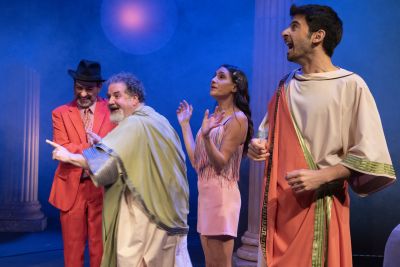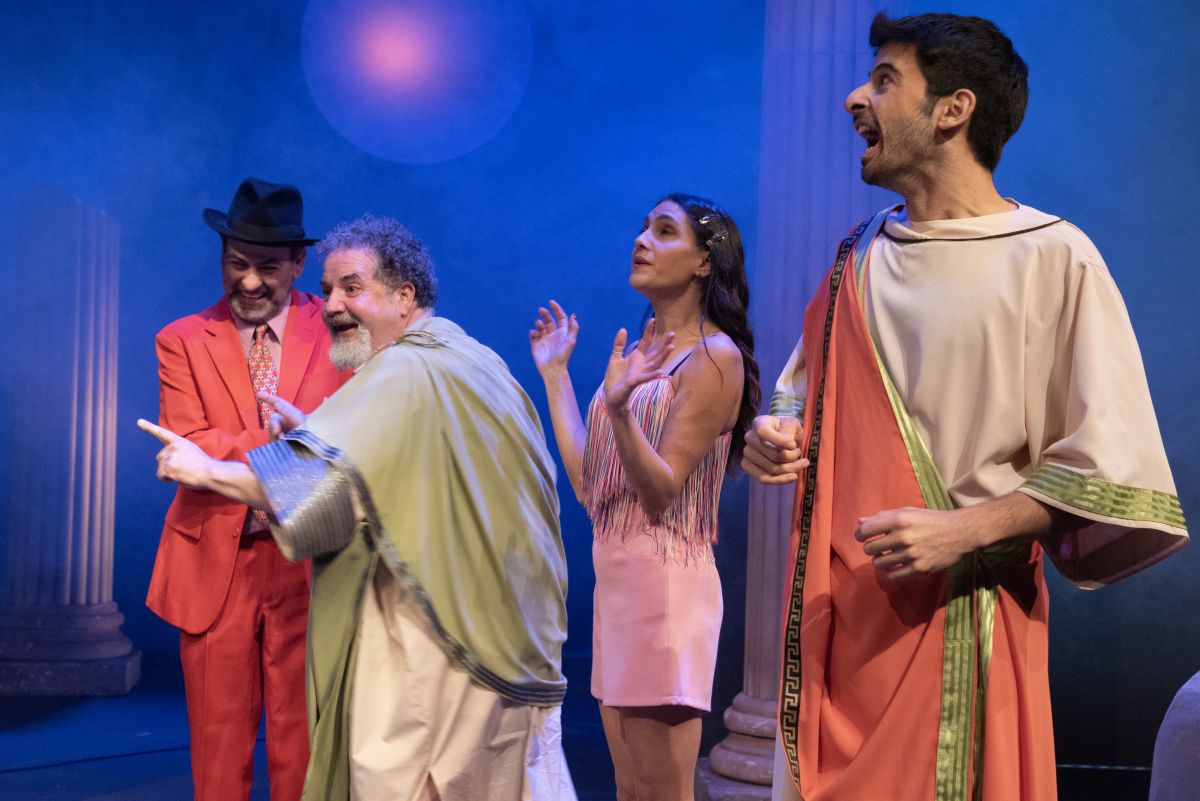
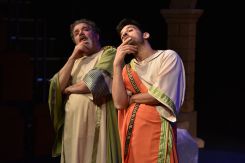
Talal al-Jurdi, Tarek Tamim, Wafa Halawi, and Sani Abdel Baki in "Abou al-Zeus," directed by Lina Khoury at the Gulbenkian Theatre. Photo courtesy of Lina Khoury.






In a comic, satirical and deliberately absurd register — sometimes bordering on sheer confusion — Lina Khoury’s play Abou al-Zeus, running through Dec. 13 at the Gulbenkian Theater at the Lebanese American University (LAU), tackles existential, philosophical and religious questions about truth and illusion, seriousness and lightness, sincerity and deception, free will and fate.
What has meaning and what is nonsense? Are we free or determined? Do we truly exercise choice, or only brush against its shadow? Have we entered an age of stupidity, or is the flood of emptiness on social media, on screens and in the streets simply a distraction?
Where do the boundaries of freedom lie, and how is it reshaped into a commercial, consumerist mold that “gives you a headache”?
Does God exist? Does our presence matter? Does life have an end? Where can salvation be found?
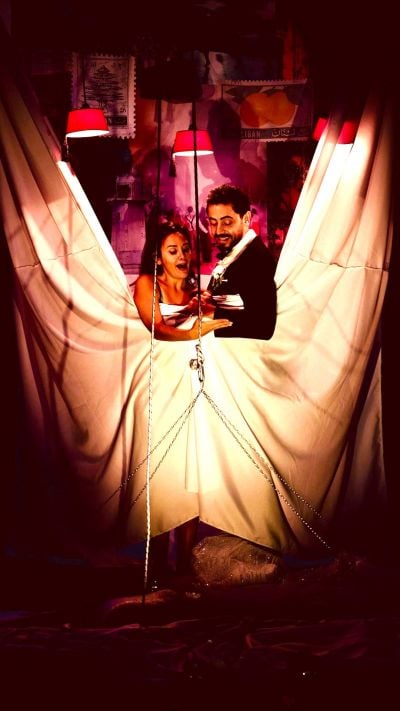
These age-old questions were first explored in God, the 1975 Woody Allen play set somewhere between New York and ancient Athens. Khoury, director, playwright and professor, adapts it with intelligence, humor and a light touch, “Lebanonizing” it in contemporary language while keeping its journey to ancient Greece intact.
Taking on Allen’s text demands nerve. The material is complex, layered and moves through absurd, comic, musical, tragic, epic and philosophical registers, all infused with the filmmaker’s contradictions and his often heavy, provocative humor.
The scale of the production matches that complexity. Twenty-four actors burst onto the circular, intimate stage, sometimes all at once. Many take on multiple roles, slipping in and out of identities with speed and precision.
A playful device draws the audience into the action, blurring the line between spectacle and spectator. Abou al-Zeus becomes a chain of small scenes nested within a larger whole, carried by LAU-trained actors Talal al-Jurdi, Tarek Tamim, Wafaa Celine Halawi, Sany Abdel Baki, Hala Masri, Aliya Khalidi, Mona Knio and more.
Even performers without a professional theater background, like Marwan Tarraf or Soumaya Khawli, handle the pace and wit of the comedy with finesse, reflected in the audience’s laughter and lively reactions.
Schizophrenia or chaos?
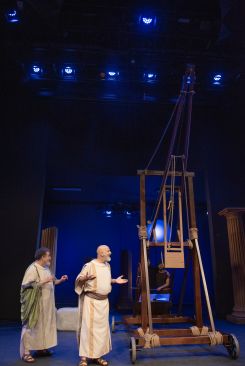
The play opens in ancient Greece, with elegant sets and costumes. Hepatitus (Tamim), an exhausted playwright desperate to finish his script and win a competition, turns to actor Diabitus (Abdel Baki) for advice. But where does the character end and the actor begin? And who are we, really?
A doubling mechanism unravels everything: The two know they’re characters in someone else’s play. The stage fills with historical and eclectic figures. Rahbani songs — Petra, Mais al-Rim — make cameo appearances, and Fairuz, played mischievously by Masri, emerges straight from Baalbeck’s Bacchus Temple.
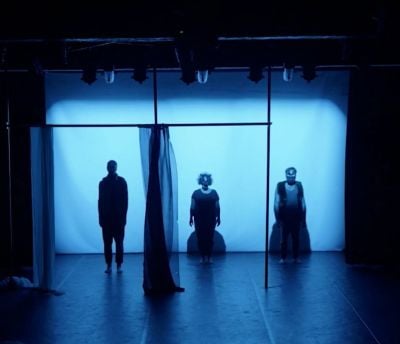
The plot deliberately spins out, mixing eras, meanings and themes. Reality cracks. The performance spills into the audience, who become characters themselves. The viewer wonders: Have the creators lost control? Are the actors adrift? Or is this a joyful, choreographed chaos meant to stir both mind and mood?
“This khabsa, this deliberate confusion, reflects the deep chaos we live every day,” Khoury told L’Orient-Le Jour. “We think we’re walking a logical path, only to discover we’re reacting to events beyond our control. We lose the line between real and imaginary, no longer sure of our place or our control over fate.”
Subtle and incisive messages
Khoury captures the metaphysical layers and humor of the original, as well as Allen’s scorn for social pretenses. She transposes them lightly — sometimes mischievously — into the Lebanese context: the theater and TV world with its hollow awards; corruption in public institutions (highlighted by investigative journalist Riad Kobeissi, who plays a customs officer); the media; social networks; and the “chorus” of society that applauds whoever follows trends, cheers winners and craves happy endings.
Themes rooted in Lebanese daily life ripple through her adaptation: fear, courage, cowardice, freedom, chaos, harassment, toxic masculinity, armed robbery, the realities of actors’ lives, “leader-actors” posing as representatives of the people, dubbing, emptiness, pretension, the tyranny of shallow intellect fostered by social media, the illusion of change, greed, foreign meddling, messages trying to “neutralize” a country already living through war, corruption, anxiety, the battered South and the dead ends of heritage preservation.
The Khoury touch
Khoury is known for her bold choices and appetite for challenge. She has tackled difficult foreign works — Paula Vogel’s How I Learned to Drive (2014), Fizya w Aassal adapted from Nick Payne’s Constellations — as well as daring local projects like Hake Neswen, inspired by The Vagina Monologues, and Majnoun Yehki, which brought Ziad Rahbani back to the stage after 20 years.
In Abou al-Zeus, she orchestrates the shifts in rhythm, preserves the surprises — including Jurdi’s standout turn as Lorenzo in a blazing red costume — and highlights each actor’s strengths, despite varied backgrounds. The entire cast volunteered their time for a production that supports LAU’s arts scholarship fund.
“Abou al-Zeus” runs Dec. 2 and Dec. 10–13 at 8 p.m. at the Gulbenkian Theater at LAU’s Ras Beirut campus. Tickets available through Antoine Ticketing.